12.08.2026 10:30
August 12, 2026 is set to be one of the most unforgettable days of the year for sky enthusiasts. This night, when the Perseid meteor shower peaks, will also feature a captivating alignment of six planets and a total solar eclipse.
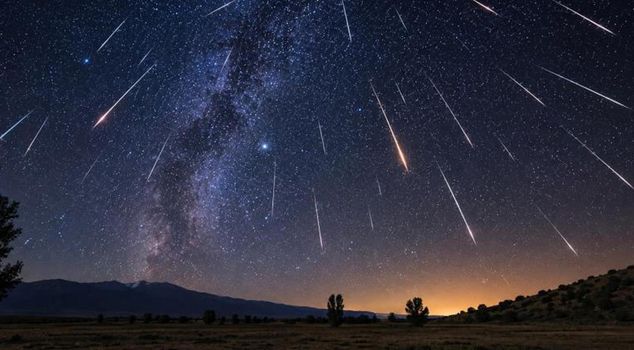
The Perseid meteor shower, which turns July and August into a visual feast every year, will reach its most intense phase on the night of August 12-13. In this natural phenomenon, formed when debris left by the Swift-Tuttle comet rapidly enters Earth's atmosphere and burns up, 60 to 100 "shooting stars" per hour can be observed under suitable weather conditions.
PAY ATTENTION TO THESE HOURS FOR OBSERVATION
Experts have some critical advice for those who do not want to miss this magnificent spectacle, which can be easily watched with the naked eye from Turkey. The biggest advantage this year is that the Perseid peak coincides with the "new moon" period. Because moonlight will not illuminate the sky, meteors will be much more clearly visible in the dark. The sky activity is expected to peak especially after midnight, between 02.00 and 05.00 hours. Dark rural areas away from city lights and light pollution should be preferred to see meteors clearly. It is recommended not to look at phones or similar bright screens for 20-30 minutes before starting observation so that the eyes can fully adapt to the dark.
TOTAL SOLAR ECLIPSE WILL NOT BE VISIBLE FROM TURKEY
Another significant astronomical event of this historic day will be a total solar eclipse. This eclipse, where the Moon will pass between Earth and the Sun completely covering the Sun's disk, unfortunately will not be observable from Turkey due to the geographical location. The eclipse path, which will last about 2 minutes, will pass through a narrow section of Northern Russia, Greenland, Iceland, the Atlantic Ocean, Spain, and Portugal.
6 PLANETS IN ALIGNMENT
Another surprise of the night will occur towards the morning. Just before dawn, Saturn, Neptune, Uranus, Mars, Mercury, and Jupiter will be positioned in the same region of the sky, forming a wide arc. This unique view, where the planets appear to be lined up in a row when seen from Earth, is called a "planet parade" in astronomical terms and will be observable until the first light of the morning on August 12.