23.11.2026 19:12
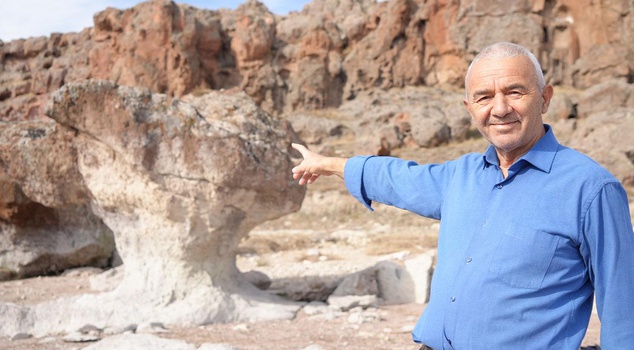
In the Develi district of Kayseri, a boat-shaped tomb approximately 2,000 years old, believed to date to the Roman period, was found on a mushroom-shaped rock formed by wind erosion. Historian researcher Nezir Ötegen, who discovered the structure on the shore of Gümüşören Dam, stated that the presence of a tomb on the natural formation makes the region special in geological and historical terms. Ötegen applied to the authorities for the tomb to be examined academically and the area where it is located to be placed under protection.
On the shore of Gümüşören Dam in the Develi district of Kayseri, a boat-shaped tomb, considered to date from the Roman period, was found on a rock that has taken on a mushroom shape through wind erosion. History researcher Nezir Ötegen said, “We believe we have contributed something new to the geological heritage literature.”
History researcher Nezir Ötegen, who lives in the Develi district, noticed the mushroom rock—formed by sand and gravel particles carried by the wind eroding the lower parts of rocks—during field surveys around Gümüşören Dam and along the Zamantı River. Seeing that there was a Roman-period boat-shaped tomb with its lid opened on the rock, Ötegen reported the situation to the authorities and requested that the structure be registered and examined academically.
IT IS LOCATED AT AN ELEVATION OF 1297
Providing information about the area he explored, Nezir Ötegen said, “While researching the historical heritage in our region, we are by the Zamantı River, around the Hüseyinli and Yenice neighborhoods. This place is located at an elevation of about 1297 and was previously an important settlement during the Hittite and Roman periods. Nearby are the Fraktin Rock Monument, historical settlements, the Çinçin Caves, and Direkli Cave. During the Roman period, it was a tradition to build tombs by the river and in high places where everyone could see them. On the opposite side are the Çukuryurt Rock Tombs, built along the valley edge. Since this mushroom rock, formed in very ancient times, was also in the middle of the settlements and in a place where everyone could see it, they built a tomb on it,” he said.
“WE BELIEVE WE HAVE CONTRIBUTED SOMETHING NEW TO THE GEOLOGICAL HERITAGE LITERATURE”
Stating that the tomb was built by the Romans, Ötegen said, “The place where the tomb is located is about 1 kilometer upstream from the river. There are mushroom rocks in various parts of the world and Turkey. We currently believe that we have contributed something new to the geological heritage literature. Because in geological heritage, mushroom rocks exist all over the world, but having a tomb on one adds a distinct feature to this rock. Therefore, the mushroom rock and the tomb on it are of particular importance,” he said.
“FIRST THE BOAT-SHAPED TOMB, THEN THE MUSHROOM ROCK MUST BE RESEARCHED”
Emphasizing that the academic community needs to conduct research on the structure, Ötegen concluded his words as follows: “The boat-shaped tomb structure dates back to the Roman period, that is, approximately 2,000 years ago, but the formation of the mushroom rock extends back to very ancient times. We request that this place be taken under protection as a registered structure. For its promotion, first of all, the academic community needs to conduct research here. Experts have determined the elevation here. Academically, the boat-shaped tomb must be researched first, and then the mushroom rock. Normally, boat-shaped tombs have a lid on top, but the top of the tomb here has been opened.”
Following the application regarding the tomb, the relevant institutions are expected to conduct an examination in the area.