23.11.2026 14:50
The Yerevan administration took a noteworthy step toward moving away from historical discourses that cause disputes with Turkey and Azerbaijan. In the new draft constitution, the reference to the Declaration of Independence, which envisages territorial claims beyond the country's current borders, was removed, while Prime Minister Nikol Pashinyan explained how the "Greater Armenia" discourse dragged the country into a dead end.
The Armenian government has shared the new draft constitution with the public. It drew attention that the 1990 Declaration of Independence, which is controversial for Turkey and Azerbaijan, is not referenced in the preamble of the new text. While the draft also does not include the phrase Mount Ararat, Prime Minister Nikol Pashinyan said the new constitution would pave the way for lasting peace.
REFERENCE TO DECLARATION OF INDEPENDENCE REMOVED
In the new draft constitution published on the Armenian government's official website, expressions referencing the Declaration of Independence of August 23, 1990 were not used. The reference to this declaration in the preamble of the current constitution had been a subject of debate in relations with Turkey and Azerbaijan. The preamble of the new draft emphasized the goal of building an independent, peaceful, secure and prosperous state within Armenia's internationally recognized borders.
The draft included the following statements: "We, the people of the Republic of Armenia; acting for the sake of the continuity and development of our statehood, with the mission of building an independent, peaceful, secure and prosperous state on our internationally recognized territory, and with the determination to pass this state from generation to generation, adopt the Constitution of the Republic of Armenia."
THE PHRASE MOUNT ARARAT ALSO NOT INCLUDED IN NEW TEXT
Article 21 of the current Armenian Constitution contains provisions regarding the country's flag, coat of arms and anthem. The current coat of arms features depictions of Noah's Ark and Mount Ararat. The new draft constitution, however, does not include detailed descriptions of these symbols. Instead, the statement was used: "The symbols of the Republic of Armenia are the coat of arms, the flag and the anthem. The description of the coat of arms and the flag, and the anthem, shall be determined by law adopted by referendum." The draft also explicitly included the principle of secularism. Accordingly, Armenia was defined as "a sovereign, democratic, secular and social state governed by the rule of law."
PASHINYAN: WE ARE ABANDONING THE LOGIC OF CONFLICT
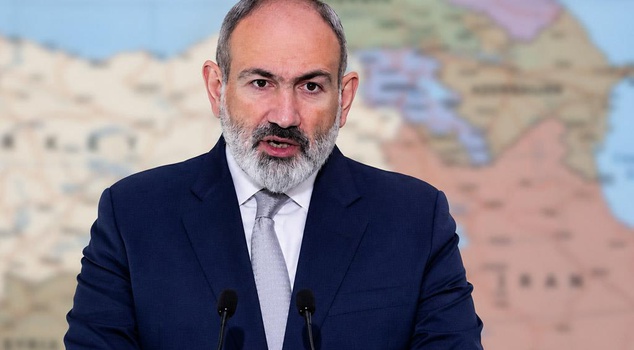
In his address to the nation after the publication of the draft, Prime Minister Nikol Pashinyan said the new constitution would create a new state model for Armenia. Describing this model as the "Fourth Republic," Pashinyan argued that the previous era's understanding of conflict must be moved away from.
Noting that Article 8 of the new constitution sets the main goal of foreign policy as ensuring peace, Pashinyan stated that the logic of conflict in the 1990 Declaration of Independence must be abandoned.
Pashinyan said, "After the adoption of the new constitution, we will not only sign and ratify a peace agreement with Azerbaijan, but we will also have institutionalized, lasting and irreversible peace."
"WE WILL TURN ARMENIA INTO A 'CROSSROADS OF PEACE'"
Also explaining his goals for Armenia's future, Pashinyan said his country must have an army capable of protecting its internationally recognized borders. Pashinyan said, "Our goal is to turn Armenia into a 'Crossroads of Peace.' At the same time, to make it a country with an army capable of independently protecting the inviolability of its state borders and internationally recognized territory."
Touching on the Karabakh issue as well, Pashinyan argued that past negotiation processes and the conflict with Azerbaijan brought Armenia to the brink of losing its statehood.
HE WILL RESIGN IF REFERENDUM IS REJECTED
Calling on the opposition to take the new draft constitution to a referendum, Pashinyan announced that he would determine his political future according to the people's decision. Pashinyan, stating that he would resign as prime minister if the draft is rejected in the referendum, announced that if it is accepted, he would not be a candidate for prime minister in the next elections.
Pashinyan also invited citizens to examine the new draft constitution and submit their opinions through the government's website. The draft has not yet entered into force; after public evaluations, it must pass through government and parliamentary processes and be submitted to a referendum.