03.08.2026 14:47
Wenyen Gabriel, who fled the civil war in South Sudan and settled in the United States, where he achieved success playing in the NBA, has become the first basketball player appointed as a Goodwill Ambassador for the UN High Commissioner for Refugees.
Wenyen Gabriel, who fled the civil war in South Sudan, settled in America, and achieved success playing in the NBA, is setting an example as the first basketball player appointed as a Goodwill Ambassador for the UN Refugee Agency (UNHCR).
Gabriel had to flee his country with his family when he was still a baby due to the civil war in Sudan. While his father stayed in Khartoum for a while, his mother and children migrated in search of a safe life. His family was later resettled in the USA as refugees, where Gabriel grew up.
The South Sudanese player, who started basketball in the USA, seized the opportunity to play first in college basketball and then in the NBA thanks to his talent. Despite his success, he never forgot his roots and always maintained his interest in the land his family had to leave.
Recently visiting South Sudan, Gabriel met with people living in refugee camps. The story of a mother separated from her family reminded him of his own family, who was separated from his father during his childhood.
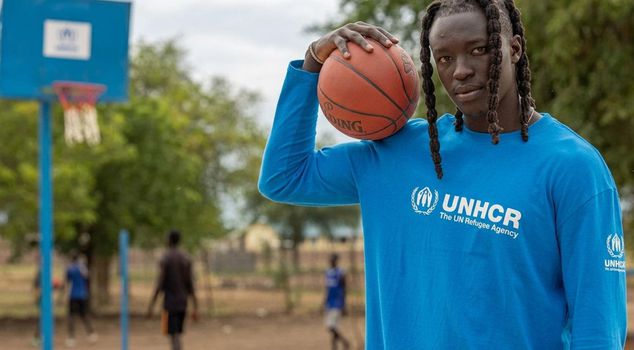
Gabriel, who inaugurated a basketball court at the Doro Refugee Camp and trained with children, conveyed that sport is not just a game but a tool of hope and solidarity.
Responding to questions from an Anadolu Agency reporter, Gabriel stated that they come to countries to work, and their aim is not to live for free or at the expense of others.
Underlining that protection is not a privilege but a fundamental right, the 29-year-old basketball player said, "Even if you are born in a country experiencing conflicts, everyone should have the opportunity to be a productive individual who contributes to society."
DESPITE HIS PARENTS WORKING, THEY FACED FINANCIAL DIFFICULTIES
He was born in Khartoum, the capital of Sudan, to parents who had fled the civil war in South Sudan.
When he was still a baby, his family left Sudan and went to Cairo, the capital of Egypt. Here, the family received support from UNHCR and applied for resettlement to a third country.
However, this journey initially separated the family. Despite selling all their belongings in Khartoum, they did not have enough money for everyone to travel together.
Therefore, while Gabriel's father remained in Sudan, his mother took the children to Egypt, hoping that her husband could join them later.
In Cairo, Gabriel's mother worked as a cleaner, while his father, who later rejoined the family, became a security guard, but they struggled to adapt to the living conditions there.
THE NBA CHANGED GABRIEL'S LIFE
When Gabriel was two years old, the family's resettlement to the USA was approved, and they began their new life there.
Gabriel's basketball career began at the University of Kentucky, one of the teams in the American College Basketball League (NCAA), and extended all the way to the NBA.
During his NBA career, he also wore the jerseys of the Sacramento Kings, Portland Trail Blazers, New Orleans Pelicans, Brooklyn Nets, Los Angeles Clippers, Los Angeles Lakers, and Memphis Grizzlies.
In 2024, he competed in the Paris Olympics with the South Sudan National Team, taking part in his country's first representation in the history of the Olympic Games.
Saying that his life story is concrete proof of what the international refugee protection system can make possible, Gabriel stated, "I think I am one of the best examples and living proof of how positive outcomes resettlement can produce."
RETURNED HOME AFTER MANY YEARS
Although Gabriel was too young to remember the events when he left the region, stories about South Sudan were a part of his life throughout his childhood.
While his mother and father constantly told him about their homeland, his father also played an active role in the activities of the South Sudanese community in New Hampshire.
Gabriel also recalled the bus trip they took to Washington DC during South Sudan's independence referendum, saying, "At that time, I didn't fully understand what was happening, but I knew a new country was being born."
Growing up in the USA, Gabriel said he always had a great curiosity about the country his family had to leave, expressing, "I was always wondering. I really wanted to know where I was from because I knew I looked different from the people around me."
When he went to South Sudan years later, the visit was almost like a homecoming for him. Greeted by crowds at the airport, Gabriel said, "I have many more relatives in my homeland than in America. I felt like I had returned home, and it was a great honor for me."
Stating that he experienced many different emotions in the same month upon returning to his country, Gabriel said, "You see that people are happy, hopeful, and encouraged when they see you. But at the same time, you witness the hardships they face and the lack of opportunities that we often don't even realize exist abroad. This gives me an even greater desire to help."
A MOTHER'S STORY REMINDED HIM OF HIS OWN PAST
Gabriel spent more than two weeks in South Sudan and visited Maban county, which, according to UNHCR data, hosts over 220,000 Sudanese refugees.
At the Doro Refugee Camp, Gabriel met a mother who had been separated from her family. The woman recounted that she couldn't sleep at night because she didn't know if her children were eating or if her husband was safe.
Noting that this story reminded him of what his mother went through during the period when his father stayed in Khartoum and the family was torn apart, Gabriel commented, "What that woman went through touched me deeply because she also couldn't sleep at night. Separating families from each other is truly heartbreaking... No family should have to be separated."
BASKETBALL COURT INAUGURATION IN SOUTH SUDAN
Gabriel inaugurated a basketball court at the Doro Refugee Camp and organized a basketball event for the youth in the camp and children from the surrounding host communities.
Saying that he saw some children playing basketball for the first time in their lives, Gabriel stated, "It was truly an indescribable joy. Seeing them have fun together and share this sport that I love so much was a very special experience for me."
Expressing that the people of South Sudan have very urgent needs such as food, shelter, and clean water, Gabriel said, "People who have endured so many hardships need a space where they can come together as a community and spend time together."