23.10.2026 20:52
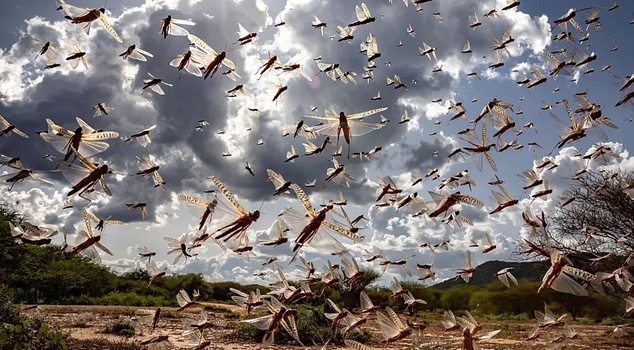
Footage recorded in Mauritania revealed one of nature's largest invasions. It was seen that billions of desert locusts came together to form swarms that can reach 64 kilometers in width. It became clear how giant swarms threaten food security by destroying agricultural land in a short time.
Billions of desert locusts covering the sky created striking images in BBC's Planet Earth documentary. In footage recorded in Mauritania, the destructive impact of locust swarms that can reach 64 kilometers in width on nature and agriculture was described.
BILLIONS OF LOCUSTS COME TOGETHER
BBC's nature documentary Planet Earth revealed how desert locusts turn into enormous swarms under suitable conditions. In the episode narrated by David Attenborough, the reproduction and migration processes of locusts living in desert regions stretching from Africa to India were covered. Under normal conditions, desert locusts, which are scattered across wide areas, can form crowded groups when environmental conditions become suitable. Swarms joining together can turn into giant infestations consisting of billions of locusts. The documentary states that the width of these swarms can reach approximately 64 kilometers.
THE SEARCH FOR FOOD SETS GIANT SWARMS IN MOTION
Rainfall and vegetation growth play an important role in the life cycle of desert locusts. Young locusts hatching from eggs under suitable humidity and temperature conditions begin to feed and develop rapidly. Young locusts whose wings have not yet fully developed are known as hoppers. During this period, locusts head toward areas with newly sprouting plants and advance in crowded groups. Locusts feeding in areas with dense vegetation become flying adults when they complete their growth.
AN INFESTATION 64 KILOMETERS WIDE
For desert locusts, a decrease in food in a region means the beginning of a new migration. According to the documentary, chemical signals secreted by adult locusts play a role in increasing movement within the swarm. Swarms leaving a region travel long distances to reach new feeding areas. Swarms joining other locust communities along the way grow increasingly larger. David Attenborough explains that some swarms can consist of billions of locusts and reach a width of about 64 kilometers. A locust infestation of this scale can directly affect not only wildlife but also agricultural production.
THEY CAN DESTROY AGRICULTURAL LAND IN A SHORT TIME
The greatest danger of giant locust swarms is that they consume the plants and crops in the areas they pass through. Crowded swarms can cause serious crop losses on large agricultural lands. This poses a major economic risk, especially for communities that make their living from agriculture. The locust invasion in West and North Africa between 2003 and 2005 is cited as one of the important past examples of this danger.