23.11.2026 21:34
In Bolu, through university-industry cooperation, 24 types of fabrics have been developed that slow bleeding, accelerate wound healing, and have antibacterial and thermal properties. It was stated that the fabrics, which in tests reduced the time for bleeding to stop from 300 seconds to as low as 60-100 seconds, can provide coolness in hot weather and a warmth sensation of up to 5 degrees in cold weather. In the TÜBİTAK-supported project, the products are aimed to be used first by soldiers and police, then in the healthcare sector and extreme sports.
The fabric varieties developed through university-industry cooperation in Bolu are intended to be used in the security, health, and sports sectors thanks to their bleeding-slowing, wound-healing-accelerating, antibacterial, and thermal properties.
The project titled 'Development of Hemostatic, Anti-Inflammatory and Antibacterial Silver-Containing Fabrics from Natural and Synthetic Fibers with Chitosan Fiber', prepared in cooperation with the Department of Medical Pharmacology of the Faculty of Medicine of Bolu Abant İzzet Baysal University (BAİBÜ), has been entitled to receive support from the 'TÜBİTAK University-Industry Cooperation Support Program'.
IT CAN REDUCE THE BLEEDING STOPPAGE TIME TO AS LITTLE AS 60 SECONDS
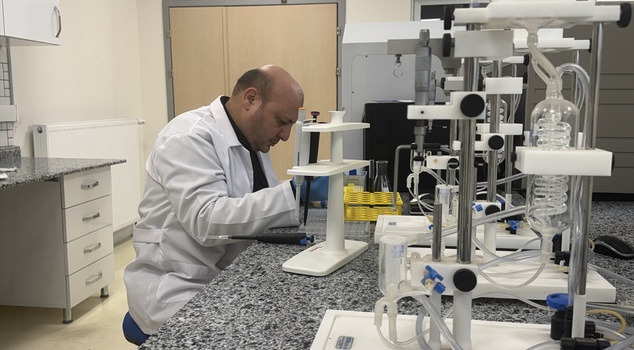
In the project led by Prof. Dr. Akif Hakan Kurt, 24 types of fabric were produced that slow bleeding (hemostatic), kill microbes and fungi with their silver content (antibacterial), accelerate wound healing (wound healing activity), and have thermal comfort properties.
In addition to tests within the university, the fabrics, which were tested in private laboratories and international companies and were also monitored by the textile departments of 3 universities, can reduce the bleeding stoppage time from 300 seconds to as low as 60-100 seconds.
'DEVELOPED TAKING INTO ACCOUNT THE NEEDS OF SOLDIERS AND POLICE OFFICERS'
Kurt said that within the scope of the project they began dreaming of in 2016, the production processes of the fabrics developed through university-industry cooperation had been completed, and they had succeeded in bringing together wool, cotton, and synthetic fibers with the fibers they specially developed.
Pointing out that there had previously been technical difficulties regarding the use of different fibers together, Kurt said, 'In the fabrics we have currently obtained, the superfine wool fiber and our special fiber have come together. We also included silver in this structure. Thus, we obtained fabrics carrying different properties together.'
Kurt emphasized that the fabrics were developed primarily by taking into account the needs of soldiers and police officers working in the defense industry, and that they aimed for two different uses suitable for hot and cold climate conditions.
Pointing out that the fabrics were aimed especially to contribute to first aid in case of injury, Kurt continued as follows: 'We developed fabrics that provide a feeling of coolness in summer months for our soldiers and police officers working in hot regions. In the event of a possible injury, we aim for these fabrics to slow bleeding, reduce the effect of microorganisms through antibacterial action, and initiate the wound healing process. We also worked on fabrics that can provide a warmth sensation of up to 5 degrees for our personnel working in regions with harsh winter conditions such as Erzurum and Kars. While our soldiers serve in these regions, they will both be protected from the cold and, in the event of any injury, be able to benefit from the fabric's bleeding-reducing and antibacterial properties.'
CAN BE USED IN HOSPITAL CLOTHING, BEDSPREADS AND PATIENT GARMENTS
Kurt, stating that the project also aimed to respond to an important need in the field of health, noted that hospitals are among risky environments in terms of the spread of infections.
Kurt, touching on the fact that patients staying in bed for a long time and body fluids contacting bed components can increase the risk of infection, recorded that they planned to use the developed fabrics in hospital clothing, bedspreads, and patient garments.
Kurt, saying they benefited from silver to strengthen the antibacterial properties of the fabrics, spoke as follows: 'Silver is a substance that has been used throughout history, especially for water disinfection. We also supported our fabrics with silver. Thanks to the silver used at a rate of approximately 1 to 2 percent, we aim to contribute to preventing wounds from becoming infected. In addition, the threads we use have the property of accelerating the wound healing process.'
IT IS AMONG THE STUDIES OFFERING THESE PROPERTIES TOGETHER FOR THE FIRST TIME IN THE WORLD
Prof. Dr. Kurt, pointing out that the fabrics could also be used in areas with a high risk of injury such as mountaineering and motorsports, drew attention to the fact that these products could provide an important advantage especially in regions where reaching healthcare institutions takes time.
Kurt, touching on the importance of athletes keeping their body temperatures balanced in variable weather conditions, underlined that the fabrics could respond to this need with their properties that provide both warmth and a feeling of coolness.
Kurt stated that work to develop the project was ongoing and that they planned to give new properties to the fabrics.
Kurt, expressing that they would focus on developing the 24 types of fabric whose production processes had been completed according to their areas of use, concluded his words as follows: 'Our priority is to produce products that our soldiers and police officers, especially personnel working in the defense industry, can use. In the second stage, we will work on the products we designed for hospitals, and in the third stage, on products for extreme athletes. These fabrics are among the studies that offer these properties together for the first time in the world. They stand out with their technical features that slow bleeding, show antibacterial effect, accelerate wound healing, and at the same time provide a hot-cold sensation.'