29.10.2026 23:56
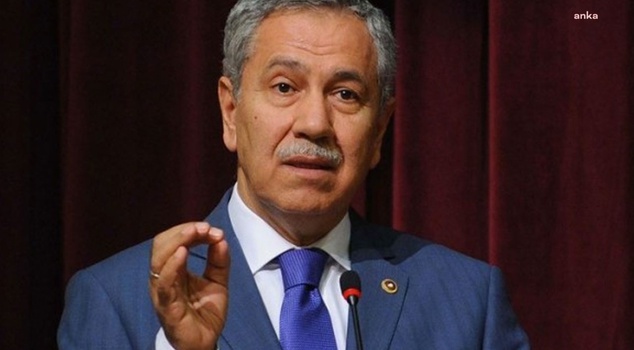
Former Speaker of the Turkish Grand National Assembly Bülent Arınç described the situation of journalist İsmail Saymaz, who cannot leave his home under a judicial control order, as tragic. Comparing the shackle on Saymaz’s foot to the locked tomb of Nasreddin Hodja, Arınç said, "This situation truly saddens and embarrasses me," and emphasized that the press must be fully free.
(ANKARA) -
Former Speaker of the Grand National Assembly of Turkey Bülent Arınç, stating that journalists must be free while performing their duties and the press must be fully free, said: "Whether it supports the government or is in opposition, we as a society need the accurate and honest journalism of journalists from every viewpoint. Restricting citizens' freedom to receive news is absolutely unacceptable and not right."
HE DESCRIBED THE PERIOD WHEN HE WAS RESPONSIBLE FOR THE MEDIA
In a statement on his social media account, Bülent Arınç recalled that for five years between 2009 and 2016, in addition to serving as deputy prime minister, he was also responsible for all relations with the media; and that TRT, Anadolu Agency, the General Directorate of Press and Information, RTÜK and affiliated organizations were under his authority.
Arınç, stating that he established honest relations with these institutions within a framework of principles, noted the following in his statement:
"The Press Law enacted during the term of my predecessor, Minister of State Prof. Dr. Beşir Atalay, was perfect in every respect. I also tried to act in accordance with the rationale of that law.
On the other hand, many articles of the RTÜK Law enacted in 1994 had been annulled by the Constitutional Court, and the law had virtually lost its integrity. Together with all stakeholders, we enacted an exemplary RTÜK law in 2012. We allowed members of the press and journalists to exercise the press freedom recognized in the Constitution in its broadest interpretation. We welcomed the news they reported with appreciation. Press freedom must be fundamental, because it is directly related to freedom of expression. In the first years after we took office, we also took freedom of expression and understanding of journalism at EU standards to the furthest point and made very broad interpretations on this issue.
What matters here is to adopt a libertarian approach in criminal laws. In this libertarian approach, it is necessary not to ignore the difference between criticism and insult, and the accuracy, honesty and ethical understanding in news.
At that time, there was a development that caught my attention. Some press institutions abroad sent us a list and asked why around 5 or 6 journalists were detained. There was no such situation in my records. I told my colleagues, 'Investigate this matter.' The list that came before us relieved me, because the people named on this list had no characteristic beyond carrying a reporter's card from a newspaper or news agency. They were mostly people who had obtained journalist identity cards from newspapers or news websites linked to terrorist organizations of that time, and they were convicted or detained for ordinary crimes such as bank robbery or extortion. When we conveyed this to the institutions abroad, they were very pleased with this explanation and congratulated and commended us.
I STOOD UP FOR ŞENER AND BALBAY
Now let us come from there to the present. When journalists and scientists also began to be tried during the Ergenekon process, I directly stood up for Nedim Şener and Mustafa Balbay, whom I especially knew as journalists. I said that they should not be accused in any way. In the same way, I stood by Mr. Mehmet Haberal, a valuable scientist who had been imprisoned for four years, at every stage of this process. This justified conduct of ours found a response, albeit late, and all of them were acquitted.
THE SAYMAZ FOOTAGE: BOTH TRAGIC AND COMIC
Now I want to say this from here: In recent days, they connected Mr. İsmail Saymaz on a news channel. Mr. Saymaz was expressing his thoughts on some issues from his home. This footage is tragic: İsmail Saymaz, who for years has been an objective writer and journalist with his ideas, cannot leave his home due to judicial control conditions. Unfortunately, some of his colleagues are also in prison. This footage is also comic: Mr. Saymaz cannot leave his home because of the shackle attached to his feet, but fortunately his mouth has not been taped, and he can connect to television and speak and send his articles to his newspaper. In this state, he is like Nasrettin Hoca's tomb: open on all four sides, but with a big lock on its door. This situation truly saddens and embarrasses me.
Beyond this, journalists must be free while performing their duties, and the press must be fully free. Whether it supports the government or is in opposition, we as a society need the accurate and honest journalism of journalists from every viewpoint. Restricting citizens' freedom to receive news through such practices is absolutely unacceptable and not right.
In his speech at our party's group meeting in recent days, our Mr. President ended with the sentence 'How fortunate that we have a base that asks, questions and criticizes.' From this perspective, we must also welcome journalists' criticisms, investigations and news with understanding."