23.10.2026 21:01
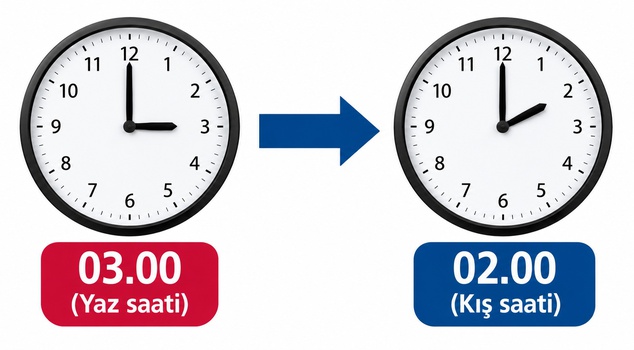
Daylight saving time in Germany ends on Sunday, October 25. Clocks will be set back one hour at 03:00 at night to 02:00. With the switch to winter time, Turkey will be two hours ahead of Germany; when it is 12:00 in Germany, it will be 14:00 in Turkey. Smart devices will update automatically, while manual clocks will need to be set back by hand.
Daylight saving time in Germany will end on Sunday, October 25, 2026. At 03:00 at night, clocks will be set back one hour to 02:00. As a result, the time difference between Turkey and Germany will increase to two hours.
As part of the time change applied across Europe, Germany switches to winter time every year on the last Sunday of October. This year too, with clocks being set back on October 25, the night will be one hour longer.
THE DIFFERENCE WITH TURKEY INCREASES TO TWO HOURS
With Germany switching to winter time, Turkey will be two hours ahead of Germany. When it is 12:00 in Germany, it will be 14:00 in Turkey.
Experts state that especially those planning international travel, those who will take flights, and those who organize business meetings according to the times of different countries should take the time change into account.
PHONES WILL UPDATE AUTOMATICALLY
With the time change, mornings in Germany will become light earlier, while it will get dark earlier in the evenings. The clocks of smartphones, computers, and similar digital devices will generally update automatically. Manual clocks, however, will need to be set back one hour.
ITS ABOLITION IS ON THE AGENDA IN THE EU, BUT THE PRACTICE CONTINUES
The main purposes of daylight saving time include making greater use of daylight and achieving energy savings. However, the practice's contribution to energy consumption and its effects on human health have long been debated. The time change can cause some people to experience disruptions to their sleep patterns and difficulty adapting to daily life.
The issue of abolishing seasonal time changes in the European Union has also long been on the agenda. In 2019, the European Parliament adopted a resolution supporting ending the practice. However, because member states could not reach a common decision on which time zone to remain in, the regulation could not be implemented.
For this reason, daylight saving and winter time will continue to be applied in Germany in 2026 as well. Under the current practice, clocks are set forward one hour on the last Sunday of March and set back one hour on the last Sunday of October.