30.10.2026 02:57
Prof. Dr. Hasan Sözbilir, Director of the Dokuz Eylül University Earthquake Research and Application Center, shared new data on the faults in the city ahead of the 6th anniversary of the October 30, 2020 İzmir earthquake, in which 117 people lost their lives. Sözbilir said that according to research conducted over the last 5 years, in addition to the İzmir Fault, faults such as Tuzla, Seferihisar, Gülbahçe and Bergama also have the potential to generate earthquakes in the near future.
IZMIR Director of the Dokuz Eylül University (DEU) Earthquake Research and Application Center Prof. Dr. Hasan Sözbilir made assessments on the 6th anniversary of the 6.6-magnitude earthquake off Seferihisar. Referring to the research they conducted after the earthquake, Prof. Dr. Sözbilir said, “We have determined the earthquake history of all our faults within Izmir. According to new data we have obtained in the last 5 years, it has emerged that faults such as the Tuzla Fault, Seferihisar Fault, Gülbahçe Fault and Bergama Fault, in addition to the Izmir Fault, also have the potential to produce earthquakes in the near future.”
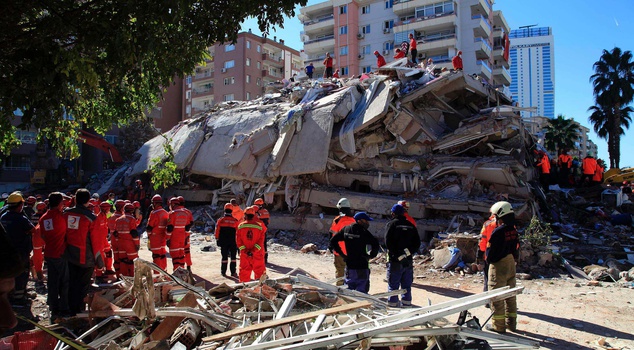
In the 6.6-magnitude earthquake that occurred off Seferihisar on October 30, 2020, 117 people lost their lives and 1,034 people were injured. Many apartment buildings and structures collapsed in the earthquake, and large-scale damage occurred. DEU DAUM Director and AFAD Science Board Member Prof. Dr. Hasan Sözbilir made assessments with only days left until the anniversary of the earthquake. Prof. Dr. Hasan Sözbilir said, “As is known, the 1999 Kocaeli and Düzce earthquakes are regarded as a milestone for Turkey. After that date, efforts to raise disaster awareness and reduce risk as a society came to the fore. The 2011 Van, 2017 Bodrum and 2020 Elazığ and Izmir-Samos earthquakes constantly reminded us that being prepared for earthquakes is of vital importance. The October 30, 2020 Samos-Izmir earthquake showed that the Samos Fault, located undersea 70 kilometers away from us, could also cause loss of life and property and create a tsunami.”
ATTENTION TO THE TUZLA, SEFERİHİSAR, GÜLBAHÇE AND BERGAMA FAULTS
Mentioning the research they conducted after the earthquake, Prof. Dr. Hasan Sözbilir said, “With the projects of the Scientific and Technological Research Council of Turkey (TÜBİTAK) that we initiated as Dokuz Eylül University in 2022, we had the opportunity to examine our seismic sources in detail. At the stage we have reached, we have determined the earthquake history of all our faults within Izmir. According to the new data we have obtained in the last 5 years, it has emerged that faults such as the Tuzla Fault, Seferihisar Fault, Gülbahçe Fault and Bergama Fault, in addition to the Izmir Fault, also have the potential to produce earthquakes in the near future.”
THE BUILDING STOCK OF THE LAST 50 YEARS HAS BEEN PUT UNDER REVIEW
Continuing his statement, Prof. Dr. Hasan Sözbilir said, “Between 2021 and 2026, the first 5-year actions of the Provincial Disaster Risk Reduction Plans (İRAP) were implemented. At the end of 2026, the second 5-year İRAP actions were prepared. These actions are targeted for completion in 2031. In addition, at the end of 2025, in accordance with the protocol signed between the Izmir Metropolitan Municipality and Dokuz Eylül University, the ‘Izmir Earthquake Master Plan’ was launched. Thus, the revision of the first earthquake master plan, prepared 25 years ago and called the RADIUS project, will be completed in light of the scientific and technological developments of 2026. Within this scope, the building stock inventory and infrastructure conditions of the last 50 years have been put under review. In addition to all this, under the coordination of AFAD, the World Bank-supported ‘Resilient Izmir’ project has also been launched on a wider scale and to cover all disasters. In these projects, for an Izmir resilient to all disasters: what has been done so far, what should be done from now on, how will the financial dimension of the works to be carried out be provided, and how should urban transformation works be prioritized within this scope? We have moved into a phase in which relevant public institutions and universities carry out multidisciplinary work together to answer all these questions. In short, we can say that after the 2020 earthquake in Izmir, the disaster mobilization continues in all its aspects. If we can move forward at this pace, as Izmir, we will have achieved serious resilience against disasters toward 2030.”