11.11.2026 18:00
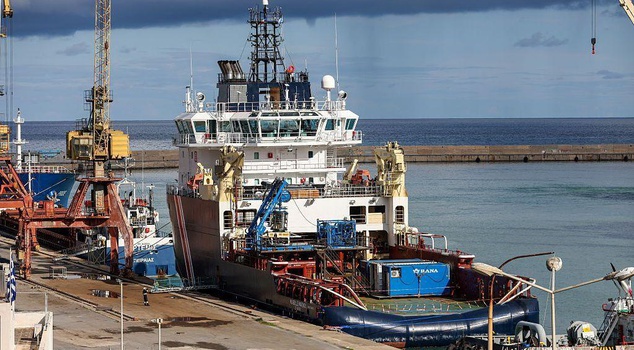
Turkey issued a NAVTEX regarding the French vessel Abeille Marengo, which will work on the Crete-Cyprus submarine electricity cable project, announcing that the works will be carried out on routes for which the approval of Turkish authorities has been obtained. Greece, on the other hand, announced with a counter-NAVTEX that the Turkish notification is null and void. While it remained unclear whether France requested permission or made a notification, the vessel left Crete and began work.
After months of negotiations between Turkey, Greece and France, the first concrete step was taken on November 10 regarding the electricity line to be laid underwater from the island of Crete to the Republic of Cyprus.
Turkey issued a NAVTEX (maritime communication system) stating that a French research vessel would begin work at certain points on the Turkish continental shelf in the Eastern Mediterranean. However, immediately after this notification, Greece stated that Turkey's notice was null and void and that the area where research would be conducted fell within Greek jurisdiction.
Despite the parties' differing positions, the French-flagged vessel left Crete and began work. It was not clarified whether France asked Turkey for 'permission' or merely made a 'notification'.
ELECTRICITY CABLE PROJECT AT THE CENTER OF TENSION
Ankara and Athens have long been experiencing tension due to Greece's project to lay an underwater electricity cable between the island of Crete and the Republic of Cyprus (Great Sea Interconnector - GSI).
The purchase of a 66% majority stake in the GSI project by the French investment fund Meridiam in August made Paris part of this tension as well.
The reason for the tension is that Turkey and Greece cannot agree on maritime jurisdiction areas in the Eastern Mediterranean and the continental shelves and exclusive economic zones (EEZs) designated by the parties overlap.
Turkey states that, according to the map that emerged from the maritime jurisdiction agreement it made with Libya in 2019 and which was also approved by the Libyan House of Representatives in 2026, permission must be obtained from Ankara before work to be carried out within the scope of GSI.
In October, at a panel he attended in Brussels, Foreign Minister Hakan Fidan, in response to a question on the matter, noted that Turkey was not against the GSI project but that they requested a written notification.
The Ministry of Defense had also recorded that no initiative would be allowed without permission.
Greece, stating that according to the continental shelf and EEZ originating from the island of Crete this area was within its own jurisdiction, had informed that for this reason the notification requested by Ankara would not be made.
Athens also argues that the Turkey-Libya agreement is contrary to international law and violates part of the maritime jurisdiction agreement made between Greece and Egypt in 2020.
Ankara and Athens signed the Athens Declaration in 2023 and launched a period of 'calm waters' in the Eastern Mediterranean and the Aegean. However, the maritime spatial plans and marine parks that the parties recently declared reciprocally in the Aegean caused tension to rise again.
FRANCE LED THE DIPLOMATIC PROCESS
It was observed that France stepped in in recent months to prevent this tension between Turkey and Greece from increasing further and from turning into a military dimension as happened in the 2019-2020 period.
It is assessed that France, although it defends Greece's and the Republic of Cyprus's Eastern Mediterranean theses, has adopted a more neutral stance in order not to damage its relations with Turkey that have developed in recent months and to protect the interests of the French company. France's talks, especially with Turkey, have also at times caused serious criticism in the Greek press.
It was noted that this issue was mainly discussed in the meeting of France's Ambassador to Ankara Isabelle Dumont with Deputy Foreign Minister Mehmet Kemal Bozay on November 5.
One day after this meeting, in a written statement by the Ministry of Foreign Affairs, it was emphasized that 'the process regarding the consent that must be obtained' from Turkey concerning the work the French vessel planned to carry out had not been completed.
Reports in the press indicate that long negotiations took place between Ankara, Athens and Paris on how to formulate the text to be submitted to the Turkish authorities regarding the French vessel.
While Ankara emphasized that the party conducting the work must request 'permission', Paris and Athens had focused on completing the process with a general notification note covering all coastal states.
THE WORD 'CONSENT' IN THE TURKISH NAVTEX
At the end of the negotiations, the expected development occurred with the NAVTEX issued by Turkey on the night of November 10.
The NAVTEX prepared by the Navigation, Hydrography and Oceanography Department (SHOD) under the Turkish Naval Forces Command and announced by the Antalya Station of the Directorate General of Coastal Safety included the following statements:
Marine scientific research activities will be conducted in the Turkish NAVTEX service area and in an area within the Turkish continental shelf in the Eastern Mediterranean, whose outer limits were notified to the United Nations on 18 March 2020 with number A/74/757, along lines coordinated with the competent Turkish authorities and for which the consent of the Turkish authorities has been obtained.
The research activity for the said underwater cable laying work will be carried out by the vessel named Abeille Marengo between 10 Nov 26 and 19 Mar 27 along the lines connecting the following points.
The coordinates of the areas where the French vessel will conduct work were also included in the maritime communication system.
The phrase 'the consent of the Turkish authorities has been obtained' in the NAVTEX issued by Turkey led to interpretations that permission was requested in the notification made by France.
No statement was made by Ankara or Paris regarding the notification made to the Turkish side.
COUNTER NAVTEX FROM ATHENS
Immediately after this step by Turkey, Greece issued a counter NAVTEX and announced that the area where the French vessel would conduct research was within its own jurisdiction.
Greece's NAVTEX, which stated that the Turkish side's notification was null and void and that Athens had made the necessary authorization on three separate dates for the work of the Abeille Marengo, also explained the coordinates in detail.
After the parties' mutual NAVTEXes, it is noted that the French Abeille Marengo left Crete and began work, and that it would first operate in Greek territorial waters and later move into disputed areas.
In a written statement by GSI, it was stated that the vessel would operate according to the NAVTEXes announced by the authorities of Greece and the Republic of Cyprus.
It is noted that Greek Prime Minister Kyriakos Mitsotakis will bring the developments in the Eastern Mediterranean, and especially the problems arising from the Turkey-Libya maritime jurisdiction agreement, to the EU summit to be held in Ireland on November 13.
THE PROJECT HAS BEEN ON THE AGENDA SINCE 2012
Greece and the Republic of Cyprus had been unable to implement the GSI project, which they first put on the agenda in 2012, due to problems with Turkey in the Eastern Mediterranean and financial reasons.
It is planned to connect the Republic of Cyprus to the European electricity grid through cables to be laid underwater starting from Crete, thus meeting the island's energy needs in a more sustainable and cheaper way.
The EU also supports the project and commits to covering 657 million euros of the 2 billion euro cost. After laying the 898-kilometer line, it is also envisaged to extend it to Israel with a 310-kilometer cable line to be added to the project.
Greece, the Republic of Cyprus and Israel announced their agreement on this matter to the public in 2019.
.