16.10.2026 13:34
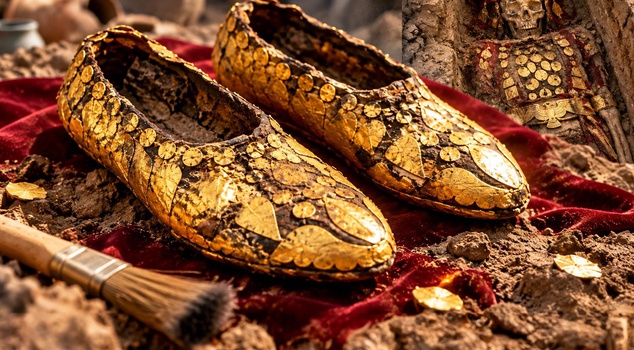
In a 1,500-year-old tomb in Kazakhstan, gold-plated shoes belonging to a young woman were found. Researchers determined that the shoes were prepared not for daily use, but only for the funeral ceremony. While a crown and belt decorated with gold were also found in the tomb, more than 150 ancient coins discovered in the same region shed light on the trade network of the period.
During archaeological excavations conducted on the Mangyshlak Peninsula in western Kazakhstan, a remarkable discovery dating back approximately 1,500 years was made. At the Karakabak cemetery near the city of Aktau, gold-plated shoes were found in the grave of a young woman believed to have belonged to an elite family. Researchers revealed that the shoes may have been specially made not for everyday use, but for the burial ceremony held after the woman's death.
THE SECRET OF THE GOLDEN SHOES REVEALED
At first glance, the shoes found in the grave were thought to be made entirely of gold. However, examinations revealed that the outer surface of the shoes was covered with thin gold sheets.
Researchers determined that the shoes and some buckles on the belt lacked the connections necessary for normal use. This strengthened the possibility that the items were produced solely for the funeral ceremony rather than for use in daily life. It was stated that the grave was dated between the second half of the 5th century AD and the first half of the 6th century AD.
HER HEADDRESS AND BELT WERE ALSO ADORNED WITH GOLD
In the young woman's grave, not only shoes but also other items decorated with gold were found. In her headdress, round gold plates, a crown made of red fabric, and decorations resembling a mask were identified.
It was determined that the decoration in the forehead area was inspired by the Gorgoneion depiction used in the Hellenistic period, while motifs resembling birds of prey with open wings on the belt buckles drew attention.
The finds indicated that the young woman was buried in an ornate funerary outfit after her death.
GOLD ORNAMENTS MAY HAVE BEEN PRODUCED IN LOCAL WORKSHOPS
Researchers Andrei Astafyev and Evgeny Bogdanov assessed that the gold ornaments in the grave may have been produced in local workshops in Karakabak rather than brought from distant regions.
The discovery of traces related to metalworking, jewelry production, glassmaking, and pottery in previous excavations in the region also supported this possibility.
MORE THAN 150 ANCIENT COINS FOUND IN THE SAME REGION
More than 150 ancient coins were also unearthed during the excavations at Karakabak. Coins linked to different geographies such as Parthia, Khwarezm, Sogdia, Sasanian, Byzantine, and China showed that the settlement was part of a vast trade network approximately 1,500 years ago.
Researchers stated that Karakabak may have been associated with the ancient Azov-Caspian trade corridor that connected Central Asia with the North Caucasus, the Volga region, and the Southern Urals.
The gold-plated shoes found in the young woman's grave, on the other hand, provided important information about the burial customs of the period, local craftsmanship, and social status differences in society.