19.11.2026 06:40
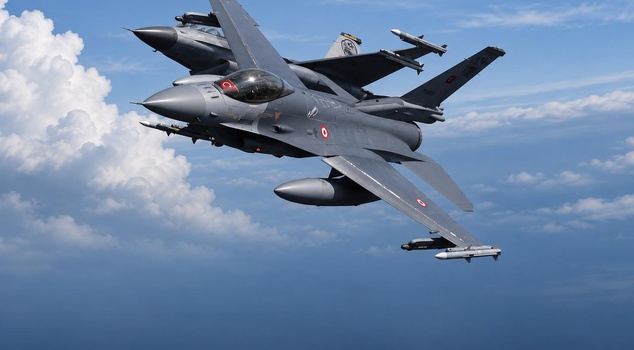
Flights carried out by Turkish F-16s and UAVs in the Aegean Sea prompted Greece to take action. Greek fighter jets that scrambled to intercept the Turkish jets came face to face with Turkish F-16s between the islands of Lesbos and Chios, while the Athens government claimed that 10 airspace violations occurred.
Flights conducted by Turkish warplanes and unmanned aerial vehicles in the Aegean Sea caused a stir in Greece. The Greek press wrote that Greek fighter jets, which took off to intercept Turkish F-16s, came face to face with Turkish jets between the islands of Lesbos and Chios. While the Athens administration brought allegations of airspace violations to the agenda, the activities of Turkish UAVs in the region also received wide coverage in the Greek media.
THEY SCRAMBLED FOR TURKISH F-16S
To Vima, one of Greece's leading newspapers, brought the military activity in the Aegean Sea on November 17 to the agenda. According to the news, based on the statement of the Hellenic National Defense General Staff (GEETHA), four Turkish F-16s, two of them armed, and five unmanned aerial vehicles carried out flights in the northeastern, central and southeastern parts of the Aegean. It was reported that Greek F-16s, which took off to intercept the Turkish jets, engaged in a dogfight with Turkish warplanes between the islands of Lesbos and Chios.
ATHENS CLAIMS 10 VIOLATIONS
According to a report by the Türkiye newspaper, the Greek General Staff claimed that Turkish aircraft violated air traffic rules nine times and Greek airspace 10 times. The airspace dispute that has continued in the Aegean for many years came to the agenda again after the flights in question. Turkey, on the other hand, does not accept Greece's practice of a 10-nautical-mile airspace extending beyond its territorial waters.
BAYRAKTAR UAV'S FLIGHT IN THE GREEK PRESS
According to flight data shared in the Greek press, a Turkish Bayraktar UAV with the call sign "BATU61" took off from southwestern Turkey in the morning and headed north over the Aegean. The ability of Turkish UAVs to remain in the air for long periods and to carry out reconnaissance and surveillance activities over wide areas stood out in the assessments of Greek defense circles.
10-MILE AIRSPACE DISPUTE IN THE AEGEAN
At the center of the airspace dispute between Turkey and Greece is Athens' practice of 10 nautical miles. Although the territorial waters of the two countries in the Aegean are 6 nautical miles, Greece argues that its national airspace extends up to 10 nautical miles. Ankara, on the other hand, states that the airspace should end at the territorial waters boundary and considers the area between 6 and 10 nautical miles as international airspace.
TURKEY'S OBJECTION TO FIR
Another dispute between the parties stems from Flight Information Region (FIR) practices. Turkey argues that FIR responsibility does not give Greece sovereignty rights over the relevant area and that there is no obligation for Turkish military aircraft to submit flight plans to Athens for their activities in international airspace. Greece, on the other hand, records these flights as violations of air traffic rules.
COST PRESSURE OF TURKISH UAVS ON THE AGENDA
The Greece-based Topontiki newspaper, in an analysis it previously published, drew attention to the effects of Turkey's unmanned aerial vehicle activities in the Aegean on the Greek air defense system. In the analysis, it was assessed that long-duration reconnaissance and surveillance flights could create operational and economic pressure by directing Greek fighter jets into constant interception activities.