13.10.2026 10:50
The crisis that began in Azerbaijan due to the refusal to admit veiled students and teachers to schools is growing. While a barricade was set up at the entrance of a school to prevent veiled people from entering, students in different regions of the country boycotted classes to protest the practice. As the headscarf debates turned into protests, 37 people were detained.
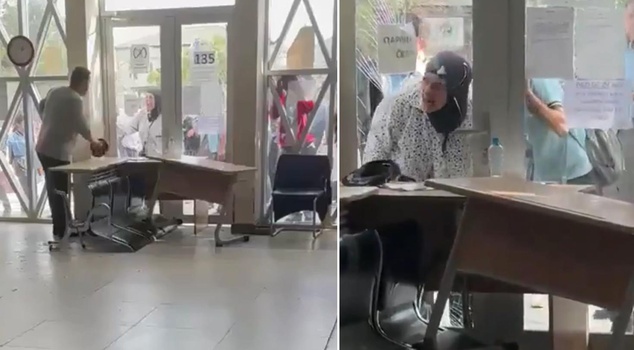
Tension that began in Azerbaijan over the refusal to admit headscarved students and teachers to schools is growing. In the latest footage circulating on social media, barricades were seen erected at the entrance of a school to prevent headscarved people from entering.
Reports that similar incidents have occurred in different regions of the country are also coming to the fore. In particular, the turning away of headscarved female students from the school gate at Secondary School No. 9 in the Jalilabad region drew a strong reaction. It was reported that while parents wanted to speak with the school administration, the doors were closed and the students were sent home.
REGULATION SPARKED A CRISIS
At the center of the debate are the Azerbaijani government's new regulations on school clothing. The Azerbaijani Cabinet of Ministers changed the rules for student clothing in public schools on September 21, 2026. The regulation stated that clothing elements that disrupt the integrity of the school uniform or are considered incompatible with the principle of secularism in education will not be allowed.
However, although the text does not contain a provision explicitly banning the headscarf, it was reported that some school administrations implemented this regulation in the form of not admitting headscarved students to school. A separate regulation concerning teachers' clothing was also adopted on October 6. Thus, the debate expanded to include not only students but also educators.
TEACHERS ASKED TO REMOVE THEIR HEADSCARVES
It was alleged that some headscarved teachers in the capital Baku and the city of Sumgayit were warned to remove their headscarves or leave their posts. Teacher Zahra Hasanova, who said she was told she could not work at the school because of her headscarf, expressed her sadness and said that wearing a headscarf was her personal choice and that she should be the one to make that decision.
In other footage shared on social media, students were seen hugging their teachers and crying, and supporting educators who were not admitted to school. This situation experienced by students and teachers opened up for debate the effects of dress codes on the right to education and working life.
STUDENTS BOYCOTTED CLASSES
Reactions to the headscarf practice turned into class boycotts in some schools. At School No. 69 in Baku's Balahani settlement, students reacted to their headscarved friends not being admitted to classes and did not enter the classrooms. The students held a protest in front of the school with banners emphasizing that the headscarf is not an obstacle to education.
It was reported that similar solidarity actions were carried out in some schools in the Masalli region. In footage circulating on social media, headscarved students were seen being turned away from school gates, while some students did not attend classes to support their friends and teachers.
37 PEOPLE DETAINED IN PROTESTS
As reactions to the practices in schools grew, the intervention of security forces also came to the fore. According to a statement made by the Azerbaijani Ministry of Internal Affairs on October 12, 37 people were detained within the scope of incidents related to school clothing.
The ministry claimed that those detained had caused arguments with education workers, damaged educational institutions, and tried to obstruct their work. It was stated that a criminal investigation was launched within the scope of organizing actions that disrupt public order or actively participating in such actions. The detentions further increased the reaction of groups opposing headscarf restrictions.
SECULARISM DEBATE IN A COUNTRY WITH A MUSLIM-MAJORITY POPULATION
Approximately 96 percent of Azerbaijan's population has a Muslim identity. In contrast, the country's constitution is based on the secular nature of the state and guarantees freedom of religion.
The government's justification of the school clothing regulations on the basis of a secular education approach raised the question of where the line should be drawn between religious freedoms and dress standards in public schools.
Those opposing the practice argue that pushing headscarved students away from education and forcing teachers to give up their religious preferences in order to continue their profession violate fundamental rights.
The defended rationale for the regulation is the protection of common dress standards and the principle of secular education in public schools. However, the absence of an explicit ban on the headscarf increases debates over how the rules are interpreted in schools.
DEBATES MOVED TO SOCIAL MEDIA
Footage of headscarved students being made to wait at school entrances and teachers bidding farewell to their students resonated widely on social media platforms.
Although some posts claimed that restrictions were imposed on internet access and social media platforms, according to Al Jazeera, these claims were not confirmed by data from independent internet monitoring organizations.
Developments in Azerbaijan show that the debate that began with school clothing has now turned into a broader social issue involving student protests, teachers' labor rights, and detentions.