15.12.2025 13:55
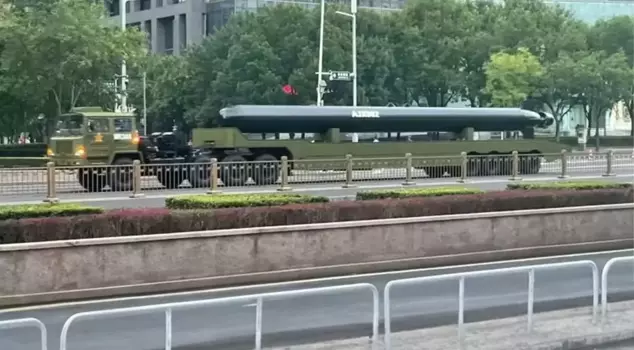
The claim that China is testing giant unmanned underwater vehicles capable of crossing the Pacific Ocean has garnered significant attention from the global public. If the allegations regarding these 40-meter-long vehicles, which can be equipped with traditional submarine weapons such as torpedoes and mines, are confirmed, it is stated that these systems could provide a significant strategic advantage for the Chinese military.
It has been claimed that China is testing large uncrewed underwater vehicles capable of blocking critical maritime routes such as the Panama Canal and the U.S. West Coast. These vehicles, technically named "Extra-Extra-Large Uncrewed Underwater Vehicle" (XXLUUV), are said to be similar in size to traditional diesel submarines but can operate completely autonomously.
EASILY CROSSING THE PACIFIC OCEAN
It is reported that these submarines, which do not require human crews, can allocate a large portion of their internal volume to fuel, batteries, sensor systems, and weapon payloads. This allows them to have an extremely long range and the ability to cross the Pacific Ocean, remaining in specific areas for weeks or even months.
40 METERS LONG
According to reports, the new generation of uncrewed submarines being tested by China is approximately 40 meters long, exceeding 131 feet. It is estimated that the vehicles have a hybrid diesel-electric propulsion system, with their energy needs met by lithium-ion or lithium iron phosphate battery packs.
RANGE OF 10,000 NAUTICAL MILES
It is also noted that these uncrewed underwater vehicles could be equipped with classic submarine weapons such as torpedoes and mines, and could serve as a "mother platform" for smaller uncrewed vehicles. Evaluations suggest that their range could exceed approximately 10,000 nautical miles, or 18,500 kilometers.
WILL ADD GREAT POWER TO THE ARMY
If these claims are verified, it is stated that these systems could provide a significant strategic advantage for the People's Liberation Army Navy of China. Especially for a navy with limited open-sea capabilities, these vehicles, which can be used in high-risk or one-way missions without human risk, are considered to enhance deterrence power.