11.11.2026 15:31
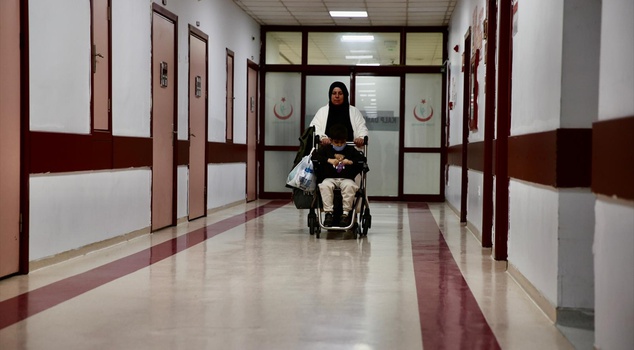
Eight-year-old Roni Denizer, who was born with visual and speech disabilities in Diyarbakır and had been undergoing dialysis three days a week for two years due to chronic kidney failure, was placed on the transplant list when his mother's and father's kidneys were incompatible. Roni, who received a kidney from a deceased donor at Gazi Yaşargil Training and Research Hospital about three weeks ago, was freed from dialysis. His mother, Ayşe Denizer, called on everyone to donate organs.
Roni Denizer, an 8-year-old boy born with visual and speech impairments in Diyarbakır, regained his health thanks to a kidney transplant from a deceased donor.
Roni, the son of Ayşe and Ramazan Denizer, was taken to the hospital when he was only 3 months old, where it was determined that he had no vision.
Roni was also diagnosed with chronic kidney failure and continued his life with medication under a doctor's supervision, but his kidney function declined to 10 percent.
It was decided that Roni, who had been receiving hemodialysis treatment 3 days a week for the last 2 years at Diyarbakır Gazi Yaşargil Training and Research Hospital, would undergo an organ transplant.
HIS MOTHER'S AND FATHER'S KIDNEYS WERE NOT COMPATIBLE
His mother and father wanted to be donors to connect their son to life, but when their health conditions were not suitable, Roni was placed on the Ministry of Health's organ and tissue transplant list.
The news that would connect Roni to life came from the Ministry, and the Denizer couple's anxious wait was replaced by joy.
The kidney delivered to Diyarbakır Gazi Yaşargil Training and Research Hospital was transplanted to Roni about 3 weeks ago by Prof. Dr. Nurettin Ay, Head of the Organ Transplant Center, and his team in a successful 2-hour operation.
Roni, who regained his health and was discharged, comes to the hospital for checkups.
THE PHONE CALL THAT CAME AT 5 A.M.
Mother Ayşe Denizer told an AA reporter that there was a genetic kidney disease in the family and that they had previously lost two nephews to kidney failure.
Stating that her son had also gone through a difficult process since he was born, Denizer said, "We noticed his visual impairment when he was only 3 months old. Then one day he became ill, and we learned that he could not speak. He had also been diagnosed with congenital kidney failure. He both received medication and was on dialysis. It is a difficult disease. Especially when it is a child, it is much harder."
Explaining that a transplant decision was made for her son, Denizer said, "Both my husband and I wanted to give our kidneys, but they were not compatible. One morning at 05.00 our phone rang; they called from the Ministry and gave us the good news. We could not believe it; we were very happy. How could we not be happy? It is a very beautiful feeling. When a kidney became available for my son, I was very emotional; as his mother and father, we were very happy. Roni was also saved from dialysis. Everyone should donate organs. Thanks to them, children like this hold on to life and are saved. May God not show the pain of losing a child to anyone."
Stating that they were very pleased with the health service provided and the doctors' attention, Denizer thanked everyone who contributed and worked for her son's recovery.
HIS DOCTOR: HIS QUALITY OF LIFE HAS INCREASED MUCH MORE
Dr. Çiğdem Oruç, a specialist working in the nephrology department of Diyarbakır Gazi Yaşargil Training and Research Hospital, said that vital parameters such as growth, development, running and playing, and going to school are important for children undergoing hemodialysis.
For these reasons, Oruç stated that kidney transplantation in children is not only a life-saving treatment but the only option for children to walk, run, and be able to dream again, and noted that Roni Denizer is one of these patients.
Expressing that Roni's family's health conditions were not suitable for being donors for the organ transplant, Oruç said, "This cannot be done without blood compatibility. If the mother or father has chronic diseases, unfortunately they may not be able to be donors. In such cases, our only chance is transplantation from a deceased donor. Unfortunately, the donation rate in our country is very low, but Roni had a chance and we performed the transplant on Roni. He is currently extremely healthy. Everything is going well; he is not on dialysis. He spends time with his sibling at home. This is very pleasing for us and for Roni. It was a great chance. Roni's quality of life has increased much more. He is a patient who needs to attend special education. His well-being has increased greatly not only vitally but also socially."
Explaining that both people waiting for organ donation and the centers where transplants will be performed are placed in a certain order on the transplant list, Oruç stated that every donation news also makes them happy.
Stating that patients are informed according to the list directed by the Ministry of Health, Oruç said that the team works devotedly at every hour and that they deliver the donated kidney to the recipient as quickly as possible.