23.07.2026 13:41
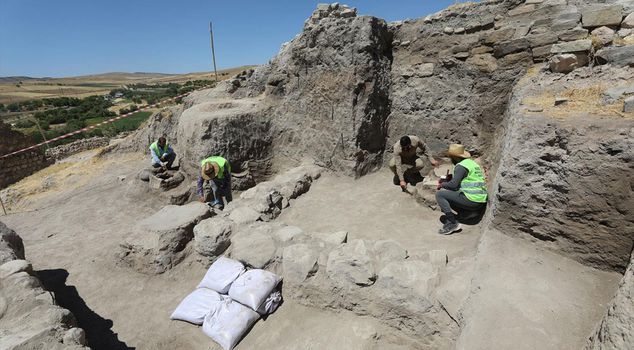
During archaeological excavations at Tadım Castle and Mound in Elazığ, a roughly 5,000-year-old temple area, altars, and sacred hearths believed to have been used in religious rituals were discovered. Governor Hatipoğlu stated that efforts to pass on the cultural heritage to future generations are ongoing. Excavation Director Emre Çayır said, "These findings hold an important place in archaeological literature."
The third season of archaeological excavations, which began in 2025 under the "Heritage for the Future Project" at the castle and mound in Tadım village, affiliated with the center of Elazığ, continues. Supported by the Ministry of Culture and Tourism, the Governorship, and the Special Provincial Administration; 7 workers and 4 experts are employed in the work carried out under the coordination of the Elazığ Museum Directorate and the Provincial Directorate of Culture and Tourism.
BRONZE AGE TEMPLE FOUND
In the excavations, a Bronze Age temple area dating back to the 3rd millennium BC, along with 2 altars and 3 sacred hearths located in this area, have been unearthed. With these latest findings, which archaeologists assess were used in religious ceremonies, the total number of temples reached across the castle and mound has increased to 2, and the number of sacred hearths to 6.
"WE HAVE MOBILIZED ALL RESOURCES FOR THE EXCAVATION"
Elazığ Governor Numan Hatipoğlu stated that all resources are being utilized to uncover the cultural heritage in archaeological sites across the province. Speaking to an AA correspondent, Hatipoğlu emphasized that archaeological work is being meticulously carried out at four different locations—Harput Castle, Tadım Castle, Palu Castle, and Salkaya—and said the following:
"We have accelerated the 2026 excavations, very important findings are emerging. We have conducted examinations regarding the newly unearthed sacred area, which has a history of approximately 5,000 years. Work on the area continues under the coordination of our Museum Directorate. As the Special Provincial Administration, we provide all necessary support to all excavations in Elazığ. Very significant findings have emerged from the excavations at Tadım Castle for both the region and human history. Conservation and restoration work for this area continues under the coordination of our Museum. We are making every effort to convey the historical and cultural heritage to future generations in Elazığ."
ARTIFACTS FROM THE BRONZE AGE TO THE OTTOMAN PERIOD UNEARTHED
Noting that traces of the Ottoman period are found at the highest points of the mound, while descending deeper reveals the marks of different civilizations, Hatipoğlu continued his words as follows:
"In the work conducted last year, we found a temple area approximately 6,000 years old. In the area where we conducted the first work this year, we discovered a temple area extending back to the 3rd millennium BC, along with an altar and a region containing 3 separate sacred hearths. We hope that very valuable studies will emerge here, both in terms of illuminating history and regarding the lifestyles, habits, and beliefs of the people of that period."
THE FINDINGS WILL OCCUPY AN IMPORTANT PLACE IN ARCHAEOLOGICAL LITERATURE
Archaeologist Emre Çayır, the Excavation Site Supervisor, stated that the work continues under the chairmanship of the Museum Directorate and in collaboration with relevant institutions, noting that 7 workers and 4 experts are working in the field. Expressing that the unearthed findings further enrich Elazığ's deep history and culture, Çayır reported the following:
"This cult area, the so-called worship area, along with the altar and sacred hearths that we are currently excavating, provide us with important information about the belief system 5,000 years ago, i.e., how belief was shaped in Elazığ during that period. These findings hold a significant place in archaeological literature. Therefore, the hearths and offering areas emerging from here shed light on the belief system of that era.
THIS PLACE HAS A DEEP HISTORY FROM THE SELJUKS TO THE OTTOMANS
This place has a deep historical past spanning from the Seljuks to the Ottomans, the Eastern Roman Empire, and descending into lower layers such as the Iron Age, Chalcolithic Age, Bronze Age, and Neolithic Age. In our current layer studies, we are in the Bronze Age and are reaching very important data."