31.10.2026 07:50
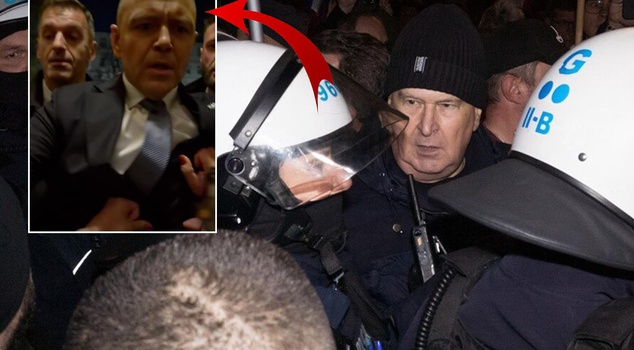
The announcement that the President of the Constitutional Court in Poland and his deputy have been suspended led to a political crisis. Three people were detained during protests in front of the court. President Karol Nawrocki, who cut short his visit to Senegal and returned to his country, had a scuffle with the acting court president who tried to stop him as he sought to enter the court building. As those moments were captured on camera, a sharp statement came from Prime Minister Donald Tusk.
In Poland, the temporary suspension of Constitutional Tribunal President Bogdan Swieczkowski and his deputy Bartlomiej Sochanski from their duties has led to a political crisis in the country. President Karol Nawrocki, who cut short his visit to Senegal and returned to the capital Warsaw, scuffled with the acting court president who tried to stop him as he sought to enter the Constitutional Tribunal building. The moments were captured on camera, while 3 people were detained during protests in front of the court. Following the developments, two ambassadors also resigned.
SUSPENSION DECISIONS TRIGGERED A CRISIS
The long-running dispute over judicial appointments in Poland gained a new dimension with the suspension of the Constitutional Tribunal's president and deputy president from their duties.
In an announcement published on the Constitutional Tribunal's website at around 18:00 local time, it was reported that Court President Bogdan Swieczkowski and Deputy President Bartlomiej Sochanski had been suspended from their duties for one month on the grounds that they obstructed the court's work.
After the decision, the Constitutional Tribunal's most senior judge, Anna Korwin-Piotrowska, temporarily took over the court's administration.
PROTESTS BEGAN IN FRONT OF THE COURT
After the suspension decision was announced, protests were held in front of the Constitutional Tribunal building in the capital, Warsaw.
A large number of people, including Law and Justice (PiS) opposition party leader Jaroslaw Kaczynski, former Prime Minister Mateusz Morawiecki and former Constitutional Tribunal President Julia Przylebska, gathered in front of the court.
Police teams took extensive security measures around the building. After some protesters climbed over the court's fences and threw various objects at police officers, police intervened.
Police announced that 3 people were detained during the protests.
PRESIDENT CUT HIS AFRICA VISIT SHORT
Amid the developments in the country, President Karol Nawrocki decided to cancel his planned visit to Senegal and return to Poland.
In a statement on his X account, Nawrocki said: 'At a time like this, the President needs to be in Poland. I am cutting my flight to Senegal short. I am returning.'
The presidential plane, which had taken off to go to Senegal, changed its route to Poland over Spain.
According to data from the flight tracking platform Flightradar24, more than 1 million people followed Nawrocki's return flight.
In a statement from the Presidency, it was announced that Nawrocki had arrived in the country.
SCUFFLE BETWEEN PRESIDENT AND JUDGE
After returning to Poland, President Nawrocki met with Bogdan Swieczkowski and Supreme Court First President Zbigniew Kapinski at the Presidential Palace.
After the meeting, Nawrocki went with Kapinski to the Constitutional Tribunal building, where protests were continuing.
However, Anna Korwin-Piotrowska, who had temporarily taken over the court's administration, tried to stop President Nawrocki at the entrance to the building.
The argument between the two turned into a brief scuffle. In footage captured by cameras, Nawrocki was seen telling the judge blocking him, 'Please step aside.'
Korwin-Piotrowska, meanwhile, tried to physically stop the President and replied, 'Sir, you cannot enter.'
Thereupon, Nawrocki reacted by saying, 'Please let me go.'
After the brief scuffle, President Nawrocki was seen entering the court building.
Supreme Court First President Zbigniew Kapinski and Constitutional Tribunal Deputy President Bartlomiej Sochanski, whose suspension had been announced, were also among those who entered the building with Nawrocki.
HARSH STATEMENT FROM PRIME MINISTER TUSK
As political tension in the country continued, Prime Minister Donald Tusk also made a statement regarding the developments.
In a post on his X account, Tusk said:
'Restoring the rule of law is our duty. After years of lawlessness under PiS rule, this is a difficult, at times painful process and requires decisive steps. There is no other way.'
CALL FOR CALM FROM US
US Ambassador to Warsaw Tom Rose expressed concern over the developments in Poland and called on all sides for calm.
Emphasizing that political tension should not turn into violence, Rose stated that the US values Poland's stability, security and democratic future.
Rose noted that the country's strength stems from its people, its institutions and its commitment to the rule of law.
TWO AMBASSADORS RESIGNED
The developments in Poland were also reflected in diplomatic missions.
Poland's Ambassador to Bucharest, Pawel Soloch, resigned from his post because of the events.
Ambassador to Beijing Jakub Kumoch also stated that after the developments in the country he had concluded it was impossible for him to continue his ambassadorial duties, and announced that he had submitted his resignation and a request for dismissal.
Deputy Prime Minister and Foreign Minister Radoslaw Sikorski reacted sharply to Kumoch's statement.
Sikorski said: 'I note that your mission has ended in an unprofessional manner. You no longer represent the Republic of Poland.'
JUDICIAL APPOINTMENTS DISPUTE LIES BEHIND THE CRISIS
At the root of the tension around the Constitutional Tribunal in Poland lies a long-running dispute over judicial appointments.
Bogdan Swieczkowski, who was elected as a Constitutional Tribunal judge in February 2022 during the Law and Justice Party's rule, was appointed court president by then-President Andrzej Duda on 9 December 2024.
Prime Minister Donald Tusk had accused Swieczkowski of preventing new judges elected to the Constitutional Tribunal by the parliamentary majority from taking up their duties.
The pro-European government led by Tusk came to power in 2023 with a promise to restore judicial independence.
The dispute over judicial appointments has effectively brought the work of the Constitutional Court to a standstill, while the latest suspension decision, the protests, and the President's intervention have further heightened political tension in the country.
.