30.10.2026 03:19
Economist Prof. Dr. Yaşar Uysal compared the economy period by period in the 103rd year of the Republic. According to Uysal, between 1924 and 1938, the economy grew by an average of 7.9 percent annually, prices declined by an average of 1.9 percent, and the Turkish lira appreciated by 1.5 percent against the dollar. The least successful periods in inflation were 1980-99 and 2000-2025.
Economist Prof. Dr. Yaşar Uysal examined the 103-year period of the Republic of Turkey through the lens of inflation, today's biggest economic problem. Noting that during the Atatürk era the increase in the gross domestic product (GDP) deflator, which defines the general price level—in other words, the inflation rate—was negative, Uysal said, "Prices declined by an average of 1.9 percent. The least successful periods in terms of inflation were 1980-99 and 2000-2025."
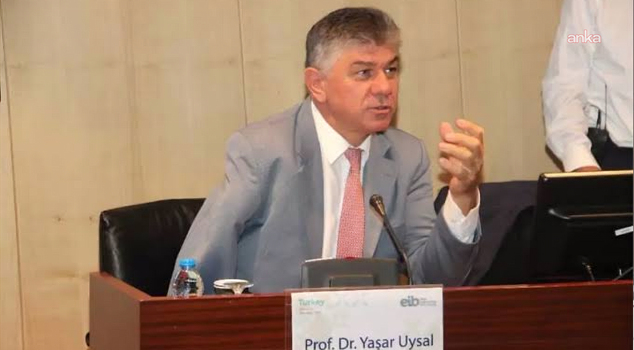
Prof. Dr. Uysal evaluated for ANKA News Agency, on the 103rd anniversary of the founding of the Republic of Turkey, the economic policies pursued during the Atatürk era and in the following years, and their results, in comparative terms.
Uysal stated that the Republic, founded on October 29, 1923, entered a process of restructuring the country from scratch with an understanding ahead of its time and a holistic approach, and said, "It was largely successful in this. Significant developments were achieved in each of the political, economic, social and cultural dimensions. One of the areas where these achievements are concretely visible is the economy."
AVERAGE ANNUAL GROWTH OF 7.9 PERCENT
Pointing to the growth of the economy between 1924 and 1938, the increase in the quantity of goods and services produced, Uysal said, "During this period, the economy grew by an average of 7.9 percent annually. No subsequent period came close to this rate. A similar situation applies at the sectoral level. During the founding period, agriculture grew by an average of 10.1 percent, the industrial sector by 9.9 percent, and the services sector by 6.7 percent. The periods that came at least somewhat close to these rates were 1950-1960 and 1963-1979." Uysal drew attention to a significant slowdown in growth rates across all sectors after 1980.
PRICES DID NOT RISE, THEY DECLINED
Uysal said that the course of inflation during the Atatürk era also had a highly distinctive character, and that the increase in the gross domestic product (GDP) deflator, which defines the general price level—in other words, the inflation rate—was negative. Uysal said, "Prices declined by an average of 1.9 percent. The least successful periods in terms of inflation were 1980-99 and the 2000-2025 period."
Emphasizing that the dollar exchange rate also declined during the 1924-1938 period, Uysal said, "The Turkish lira appreciated against the US dollar by an average of 1.5 percent. In terms of the increase in the dollar exchange rate—that is, the depreciation of the Turkish lira—1980-99 was also the least successful period."
BUDGET SURPLUS BETWEEN 1924 AND 1949
Noting that in the first years of the Republic, despite many shortages, special importance was given to maintaining budget balances, Uysal recorded that a budget surplus was run between 1924 and 1949, and that during this period a surplus of between one and three per thousand of GDP was run on average. Stating that the budget ran a deficit on average in all subsequent periods, Uysal said, "The period between 1980 and 2025 was the period with the largest deficit."
Reminding that in a country that was not yet self-sufficient even in the "three whites" (flour, sugar and calico), a foreign trade deficit of 7 million dollars on annual average was run during the 1924-1938 period, Uysal emphasized that a surplus of 19 million dollars was run during the 1939-1949 period. Uysal noted that this development could be considered a reflection of the effectiveness of the investments made and production planning. Uysal drew attention to the fact that continuous and increasing foreign trade deficits were run in subsequent periods. Uysal noted the following:
"These data reveal that very great achievements were realized in the economy as well with the founding of the Republic. Alongside these quantitative indicators, Atatürk's approach—which can be described as think analytically, act pragmatically—as the greatest and most holistic leader humanity has ever seen, must also be well understood. The importance and priority he gave to agriculture and farmers, planned industrialization, strengthening the institutional structure, and meritocracy are of a nature that will inspire today as well.
Undoubtedly, each period has different conditions. There is much to learn from the practices and developments of every period, and from mistakes. However, placing the founding of the Republic in a separate place in terms of idealism, patriotism, determination to work, the importance given to meritocracy, and the all-out development achieved is a requirement of fairness."