24.08.2026 11:41
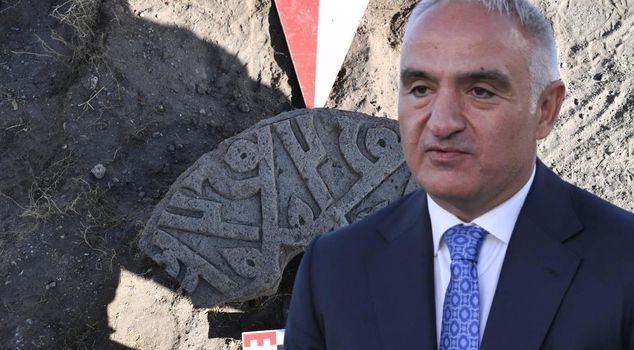
During excavations at the Ani Archaeological Site, which is on the UNESCO list, an ornamented Seljuk tombstone featuring the phrase 'Prophet Muhammad' written six times in Kufic calligraphy was unearthed. Minister of Culture and Tourism Mehmet Nuri Ersoy announced the artifact on Mevlid Kandili, saying, 'This work, considered to belong to a Seljuk tomb, is a centuries-old stone-carved testament to our ancestors' profound love for our Prophet Muhammad (peace be upon him).'
Minister of Culture and Tourism Mehmet Nuri Ersoy announced on his social media account, on the occasion of Mawlid Kandili, the unique artifact unearthed during archaeological excavations at the Ani Archaeological Site, which is on the UNESCO World Heritage List.
ANNOUNCED ON THE BLESSED NIGHT
Minister of Culture and Tourism Mehmet Nuri Ersoy announced that an ornamental stone with the name 'Prophet Muhammad' repeated six times in Kufic calligraphy was found in the Seljuk Cemetery at the Ani Archaeological Site.
The artifact, which is considered to belong to a Seljuk tomb and bears the name of our Prophet Muhammad (peace be upon him), was shared with the public on Mawlid Kandili.
"A UNIQUE ARTIFACT"
Minister Ersoy used the following statements in his post:
"On this blessed night when we experience the spiritual atmosphere of Mawlid Kandili, we have brought to light a unique artifact in Ani, which opened the door to Turkish-Islamic history in Anatolia with Sultan Alparslan's conquest in 1064. In the Seljuk Cemetery, where we have been continuing excavation work since 2021, we found an ornamental stone on which the name 'Prophet Muhammad' is repeated six times in Kufic calligraphy. The name 'Prophet Muhammad' appears three times in the inscription band around an eight-pointed star-shaped motif in its center. This artifact, which is considered to belong to a Seljuk tomb, is a centuries-old testament in stone of our ancestors' deep love for our Prophet Muhammad (peace be upon him). On this occasion, I congratulate our noble nation and the Islamic world on Mawlid Kandili, and I wish this blessed night to bring peace, tranquility, and mercy to all humanity."
THE NAME "PROPHET MUHAMMAD" IS REPEATED SIX TIMES
The ornamental stone found during archaeological excavations that have been ongoing since 2021 in the Seljuk Cemetery in Ani measures 51 x 21 centimeters.
On the stone, prepared using the relief technique, the name 'Prophet Muhammad' is repeated six times in Kufic calligraphy around an eight-pointed star. Since only half of the artifact has survived to the present day, only three of these names are visible today.
The artifact, which is considered to be an architectural piece belonging to one of the Seljuk tombs in the cemetery, bears the significance of an important archaeological document that concretely reflects Ani's Turkish-Islamic identity, the belief world of the period, and the cemetery culture.
THE FIRST TURKISH-ISLAMIC CEMETERY IN ANATOLIA
Ani, which became the gateway for the Turks' entry into Anatolia with Sultan Alparslan's conquest in 1064, is among the starting points of Turkish-Islamic history in Anatolia.
Data obtained from the excavations reveal that the Seljuk Cemetery in Ani is Anatolia's first Turkish-Islamic cemetery and the first Turkish martyrs' cemetery. Ani also holds special importance for Anatolian Turkish-Islamic civilization with its works such as the first conquest mosque, the first mosque, and the first small mosque.
Similar ornamental arrangements are also seen in the 1191-dated Mama Hatun Tomb in Tercan, the 1224-dated Malatya Grand Mosque, the Eşrefoğlu Mosque in Beyşehir, and the Tahir and Zühre Small Mosque in Konya.