17.11.2026 20:40
Foreign Minister Hakan Fidan announced that an agreement has been reached on establishing a Türkiye-Syria University in Damascus. Speaking after his meeting with his Syrian counterpart Asaad Hassan al-Shibani, Fidan stated that cooperation between the two countries in the fields of education, defense, security, and transportation has been strengthened. Al-Shibani, for his part, announced that Syria's Embassy in Ankara will open next month and that they aim to increase the trade volume between the two countries to 10 billion dollars.
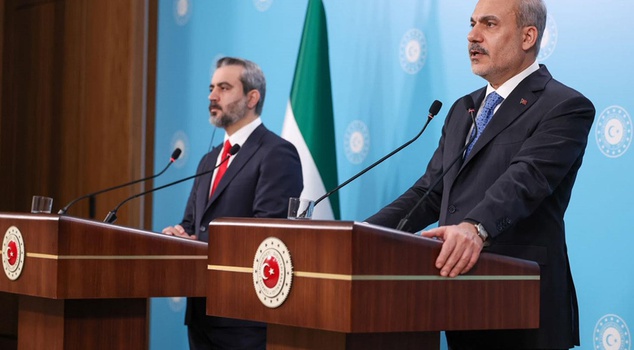
Foreign Minister Hakan Fidan spoke at a joint press conference held after his talks with Syrian Foreign Minister Asaad Hassan al-Shibani at the Ministry, which were also attended by Minister of National Defense Yaşar Güler and Syrian Defense Minister Major General Murhaf Abu Qasra.
Fidan noted that they meet frequently with al-Shibani and are pleased to see cooperation between the two countries deepen with each meeting, and said they have implemented many projects recently.
“AGREEMENT REACHED ON ESTABLISHING A TURKEY-SYRIA UNIVERSITY IN DAMASCUS”
Fidan noted that Damascus Heart Hospital has begun serving the Syrian people with its advanced facilities under the protocol signed with Syria, and said, “The Damascus International Recep Tayyip Erdoğan Turkish School began education and training last month. In addition, agreement was reached on establishing a Turkey-Syria University in Damascus. Thanks to the air navigation safety systems established at Damascus and Aleppo airports, we have all contributed to increasing Syria's air transport capacity. Of course, we still have a great many things to do.”
Emphasizing that developments in the region have clearly demonstrated the necessity of developing lasting and comprehensive cooperation among regional countries, Fidan said, “We have also implemented the Mecca Defense Alliance with this vision. The close interest shown in the Mecca Alliance is a clear indication of the positive impact our peace-focused efforts can create in the region.”
Fidan noted that they consider it extremely valuable that Türkiye's understanding of regional ownership is adopted by other regional countries as well, and stated that when the alliance's institutionalization process is completed, they will be pleased to see among them other countries in the region that want peace and respect international law.
“ISRAEL MUST NOW REALIZE THAT IT CANNOT ENSURE ITS OWN SECURITY BY HARMING ITS NEIGHBORS”
Fidan drew attention to the fact that Israel's destabilizing actions toward the region and Syria unfortunately continue today, and noted: “These activities of Israel also pose a threat to the security and connectivity architecture we are trying to establish in our region. Israel must now realize that it cannot ensure its own security by harming its neighbors and must abandon this policy. A country's security cannot be built on the instability of its neighbors. Israel must end its attacks on southern Syria and a security arrangement must be established on the basis of the 1974 Agreement on Disengagement.”
Fidan stated that thanks to the strong will demonstrated by their Syrian brothers, they look to Syria's future with confidence, and used the expression “Syria has become a country that truly makes a great contribution to stability, development, and the fight against terrorism in the region.”
Fidan stated that in his talks with al-Shibani they addressed every aspect of bilateral relations, and conveyed that they reviewed again the plans regarding cooperation in the field of defense and security.
Drawing attention to the fact that their sensitivity regarding the preservation of Syria's territorial integrity and unity is very high, Fidan continued as follows: “In particular, threats from inside and outside, threats aimed at division, and terrorism-related threats should not occupy Syria's agenda. As in the past, the region should no longer see these issues as a destabilizing factor. Therefore, comprehensive cooperation between the defense and security institutions of Türkiye and Syria also makes a great contribution in this regard.”
Fidan said that as Türkiye they are making intensive efforts for the restructuring of the Syrian army and strengthening the capacity of security institutions, and said that the problems that terrorist organizations in the region, especially the terrorist organization ISIS, will create, and certain public order problems, could cause very great difficulties for both trade and connectivity.
Fidan pointed out that developing capabilities for clearing war remnants left by the overthrown regime in Syria is also important, and conveyed that defense and security cooperation efforts between the two countries are being carried out sensitively by the relevant institutions for this purpose.
“AS TÜRKİYE, WE WANT SYRIA TO HAVE PROSPERITY AND PEACE”
“As Türkiye, we want Syria to have prosperity and peace and to live in peace with its neighbors,” said Fidan, stating that they will continue to maintain their initiatives and support in this direction. Minister Fidan emphasized that Israel's attacks and destabilizing actions are not limited to Syria.
Fidan noted that as the winter months approach, Israel has condemned Gazans to extremely severe humanitarian conditions, and recorded the following: “(Israel) continues to oppress the people of Gaza in a manner that violates international law and tramples on the conscience of humanity, especially by preventing the entry of humanitarian aid without showing any justification. Israel must abandon its policy of preventing humanitarian aid from reaching Gaza. Preventing these violations and ensuring the opening of a path to a just and lasting solution in the region is the common responsibility of the international community. As one of the countries that has provided the most in-kind humanitarian aid to Gaza, we are mobilizing all our means to deliver the needed aid.”
Fidan stated that he and his counterpart also discussed the integration process in northeastern Syria, and said their stance on this issue is clear and they support this positive process.
“It is important that terrorism comes to an end in Türkiye, Syria, and Iraq in the region, that the denial of human identity is eliminated, and that everyone focuses on their political agenda in peace and tranquility. The integration process must be completed in a way that reinforces Syria's sovereignty and territorial integrity on the basis of the understanding of one state, one army, which is the guarantee of political stability in every country,” said Fidan, emphasizing that they also attach importance to guaranteeing the rights of all components of the Syrian people and strengthening social reconciliation in this process.
Fidan underlined that they continue close cooperation with the Syrian government for the successful completion of the integration process and that they continue their work with the same determination to enrich the strong partnership between the two countries with new areas of cooperation.
MECCA DEFENSE ALLIANCE
Fidan conveyed that the number one goal of the foreign policy that President Recep Tayyip Erdoğan has led for many years toward the region is to bring lasting peace and stability.
Fidan, stating that Turkey has various strategic points to which it geographically belongs, emphasized that they need a strategic perspective toward all of them, but their top objective is permanent peace and stability.
Fidan said that the foreign policy history of AK Party governments has been stability, confidence-building, and bringing peace.
"As Turkey has grown, the stabilizing role it plays in its region has become even more effective," Fidan said, noting that at this point they have set out a vision by drawing serious lessons from recent history, especially in the Middle East basin.
Fidan stated that they are pleased that other stakeholders are included in this vision, and that the Mecca Defense Alliance is a result of this approach, continuing as follows: "These great countries—Saudi Arabia, Pakistan and Turkey—coming together from different ethnicities and different geographies of the Islamic world and with their great capabilities, this unity actually expresses the following: we will now take ownership of the problems of our own strategic basin and geography. As you know, the biggest of these problems is the security problem. When there is no security, it is not easy to build stability either."
Expressing that they no longer consider it appropriate and valid for an external hegemon or another group of countries to come to the region and solve the security problem, Fidan said that they need to develop this capacity, demonstrate this will and take this responsibility; Turkey, Saudi Arabia and Pakistan are leading this, and it is now being institutionalized.
R4+E4 MEETING TO BE HELD NEXT MONTH
Fidan stated that the R4 mechanism consisting of Turkey, Egypt, Pakistan and Saudi Arabia is an informal format in which they discuss political, social and economic issues, and emphasized the importance of Egypt's contribution and cooperation there, describing it as a country with great capacity, responsibility and proximity to vital problem areas.
Saying that it is important to stand against Israel's expansionism and to seriously discuss all the problems in the region, primarily ending the tragedy in Gaza, Fidan said, "The issue that has occupied our agenda most in recent days is, of course, the opening of the Strait of Hormuz and the conclusion of the ongoing negotiations between America and Iran in a positive way as soon as possible. Iran now needs to show the will to solve these problems without being subjected to further pressure."
Underlining that it is necessary to return to "economic, political and security normality" in which other countries in the region do not feel threatened and navigational safety is ensured, Fidan said, "R4 is also putting forward very serious proposals on this issue. The proposals and offers we bring are aimed at ensuring a permanent order."
Pointing to a strategic reality emerging in Europe, Fidan stated that the ongoing war between Russia and Ukraine, by showing the risk of spreading over a much wider area and having entered its fifth year, constitutes a major problem for Europe.
Fidan said, "On the other hand, America's redefining both its role within NATO and its role in European security and rearticulating different priorities in its foreign policy has now changed the format of European security that had been on autopilot for the last 70 years," adding that Europeans are in search of a new security environment and that Turkey is participating in the environments where these issues are addressed.
Minister Fidan said, "Then we said, why don't the E4 there (Germany, Britain, France and Italy) and the R4 (Turkey, Egypt, Pakistan and Saudi Arabia) come together? We came together in Istanbul in recent weeks and actually saw that the two strategic basins, the Middle East and Europe, view all regional and global issues in almost the same way."
Fidan conveyed that they were pleased to see that they think the same way on issues concerning Europe and the Middle East and affecting all geographies, such as the Russia-Ukraine War and the Iran-US War needing to stop as soon as possible, the Israel-Palestine issue ending with a two-state solution, humanitarian aid entering Gaza, the Bab al-Mandab Strait and the Strait of Hormuz being opened, and Syria's security and stability being ensured, and emphasized that this brings a responsibility with it.
"If these great countries come together and evaluate the problems in the same way, then they need to take common stances, from time to time share tasks, in order to manage these problems and make them less impactful," Fidan said, informing that they will hold a meeting this month for the institutionalization of the Mecca Defense Alliance.
Stating that the R4+E4 meeting will be held in Germany in December, Fidan noted that they will continue their efforts to solve regional problems with an understanding of regional ownership and that they are carrying out strategic work on this matter.
AL-SHIBAANI: SYRIA'S STABILITY IS THE CORNERSTONE OF THE MIDDLE EAST'S STABILITY
Syrian Foreign Minister Al-Shibaani also stated at the joint press conference that steps to develop relations between Turkey and Syria in the fields of trade, energy, transportation, security and reconstruction are deepening.
Emphasizing that the trade volume between the two countries approached 3 billion 780 million dollars in 2025 and recorded an increase of over 40 percent, Al-Shibaani said that their common goal is to raise the trade volume to 10 billion dollars.
Al-Shibaani reported that work is underway to increase the capacity of the electricity connection line between Turkey and Syria to 500 megawatts, that direct flights between Damascus and Antalya and Izmir have been launched, and that efforts continue to reactivate the Qamishli-Nusaybin Border Gate.
Al-Shibaani stated that they also agreed on accelerating the railway connection extending from Turkey through Syria to Jordan and the Gulf, removing obstacles to land transportation, and developing digital infrastructure.
SYRIA'S EMBASSY IN ANKARA TO OPEN NEXT MONTH
Stating that the number of those returning to Syria has exceeded 700,000, Al-Shibaani noted that housing, basic services and livelihoods must be provided so that returns can be sustainable, voluntary and dignified.
Thanking Turkey for hosting Syrians for years, Al-Shibaani said that Syria is open to the participation of Turkish companies in reconstruction projects.
Shaybani used the statement, 'I announce that Syria's Embassy in Ankara is expected to open at the beginning of next month.'
Regarding regional developments, Shaybani stated that they condemn attacks on Gulf countries and said that the security of the Gulf is an inseparable part of Syria's national security.
Shaybani stated that freedom of navigation must be protected in the Strait of Hormuz and Bab al-Mandab, and that they support a negotiated solution to end the conflicts in the region.
Emphasizing that they categorically reject Israel's attacks on Syria and violations of the country's sovereignty, Shaybani reiterated their commitment to the 1974 Agreement on Disengagement of Forces.
Noting that the European Union's (EU) lifting of sanctions on Syria paves the way for establishing a genuine partnership between the two sides, Shaybani said they aim to transform relations into an economic partnership that will contribute to Syria, especially during the reconstruction process.
Shaybani stressed that they want Syria to be seen no longer as a source of crises in the Middle East or merely as a country receiving aid, but as a reliable partner.
Recalling that high-level dialogue between Syria and the EU had previously been initiated in Brussels, Shaybani noted that the forum in Damascus also reflects the will for partnership between the two sides.
Noting that Syria's geographical location and its commercial and geopolitical importance are noteworthy for Europe, Shaybani said that both sides would assess how they can benefit from this strategic position.
.