31.10.2026 19:30
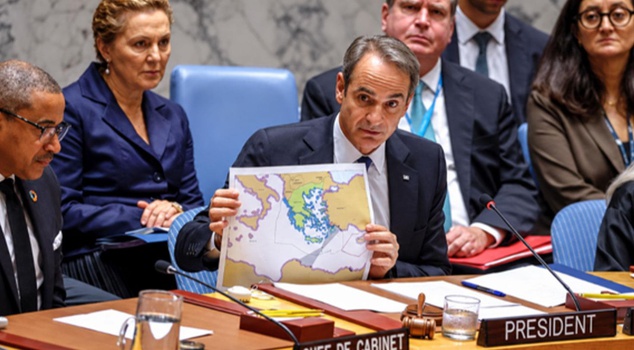
At the United Nations Security Council, Greek Prime Minister Kyriakos Mitsotakis, showing a map, targeted the maritime jurisdiction areas agreement signed between Turkey and Libya. Mitsotakis, arguing that the agreement violates Greece's sovereign rights, said, "Geography cannot be rewritten." Turkey's Permanent Representative to the UN Ahmet Yıldız responded, "This Council is not a maritime delimitation court. A map can show a claim but cannot judge it."
At the meeting in the United Nations Security Council where the effects of new technologies on maritime security were discussed, the remarks of Greek Prime Minister Kyriakos Mitsotakis regarding the maritime jurisdiction areas agreement signed between Türkiye and Libya came to the fore.
HE SHOWED A MAP AND SAID, “GEOGRAPHY CANNOT BE REWRITTEN”
Speaking at the session titled “New technologies and maritime security: Implications for peace and security,” Mitsotakis criticized the memorandum of understanding signed between Türkiye and Libya in 2019 on the delimitation of maritime jurisdiction areas.
During his speech, Mitsotakis showed a map of the Eastern Mediterranean and claimed that Türkiye and Libya did not take into account the Greek islands between them when determining their maritime borders.
Arguing that the agreement violates Greece's sovereign rights, Mitsotakis said, “Geography cannot be rewritten, and sovereign rights cannot be eliminated by arbitrary lines drawn on a map.”
Mitsotakis also argued that the approval of the memorandum by the Libyan House of Representatives would not change the legal nature of the agreement.
RESPONSE FROM TÜRKİYE: A MAP CAN SHOW A CLAIM BUT CANNOT JUDGE IT
The counter-response to Mitsotakis's claims came from Türkiye's Permanent Representative to the United Nations (UN), Ambassador Ahmet Yıldız. Yıldız said, “This Council is not a maritime delimitation court. A map can show a claim, but it cannot judge it.”
Noting that the Türkiye-Libya Memorandum of Understanding on the Delimitation of Maritime Jurisdiction Areas signed between the two sovereign states has been in force since 2019, Yıldız continued as follows: “Türkiye and Libya are two sovereign states, each with the right to conclude international agreements. This sovereign prerogative cannot be denied merely because a third state objects to the delimitation or does not participate in its outcome. The Türkiye-Libya Memorandum regulates maritime delimitation between its parties and does not determine or affect the rights of non-party states. This is exactly the principle that Türkiye has consistently upheld with regard to other maritime arrangements. These arrangements cannot be used to reduce Türkiye's continental shelf rights to its detriment. Claims to the contrary should be addressed through dialogue and equitable delimitation, rather than by questioning the sovereign capacity of states to conclude agreements.”
Also responding to the Greek prime minister's claim that the Memorandum of Understanding is “contrary to geography,” Yıldız emphasized that international jurisprudence does not automatically grant full entitlement to every island in the Aegean, regardless of coastal configuration and relevant circumstances.
“WE WANT THE PROBLEMS IN THE AEGEAN SEA AND THE EASTERN MEDITERRANEAN TO BE RESOLVED ON THE BASIS OF GOOD NEIGHBORLY RELATIONS”
The Turkish ambassador said, “Although Türkiye recognizes the UN Convention on the Law of the Sea (UNCLOS) as an important instrument, it is not a party to this convention. The Convention is neither universal nor the sole determinative legal text, and it cannot be assumed that every provision invoked against a non-party country constitutes binding customary law.”
Expressing that Türkiye favors resolving this matter through dialogue, Yıldız said, “As President Recep Tayyip Erdoğan stated in his speech at the UN General Assembly last month, we want the problems in the Aegean Sea and the Eastern Mediterranean to be resolved on the basis of good neighborly relations and in accordance with international law.”
Yıldız said, “We are ready to discuss this matter constructively. However, we understand that an inclusive and lasting approach must also take into account the legitimate rights and interests of Turkish Cypriots and the Turkish Republic of Northern Cyprus.”
“TÜRKİYE IS READY FOR MEANINGFUL NEGOTIATIONS GUIDED BY THE PRINCIPLES OF EQUALITY, MUTUAL RESPECT, AND GOOD NEIGHBORLINESS”
Noting that Türkiye has demonstrated its commitment to multilateral maritime security in practice through its work with Bulgaria and Romania at the regional level and in Somalia and Lebanon at the global level, Yıldız assessed, “Our navies have demonstrated effective cooperation under UN authority, and therefore diplomacy must also be able to address differences without turning them into disputes.”
Noting that Türkiye has demonstrated its commitment to multilateral maritime security in practice through its work with Bulgaria and Romania at the regional level and in Somalia and Lebanon at the global level, Yıldız said, “Our navies have demonstrated effective cooperation under UN authority, and therefore diplomacy must also be able to address differences without turning them into disputes.”
“INTERNATIONAL LAW CANNOT BE REDUCED TO A MAP OR A SLOGAN EITHER”
Yıldız said, “Portraying unresolved delimitation questions as hostility does not serve maritime security. Yes, geography cannot be rewritten, but international law cannot be reduced to a map or a slogan either. Türkiye is ready for meaningful negotiations guided by the principles of equality, mutual respect, and good neighborliness.”