29.10.2026 15:39
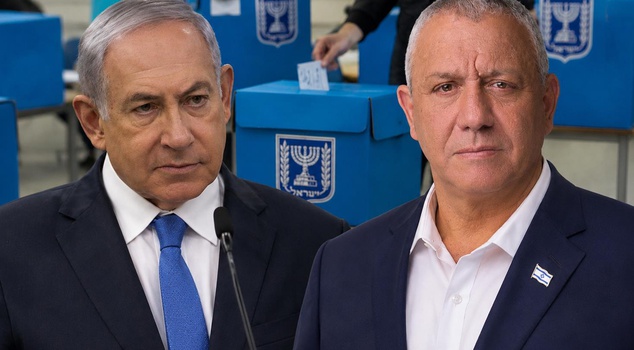
With 84.5 percent of votes counted in Israel's parliamentary elections, the ruling bloc led by Prime Minister Benjamin Netanyahu failed to reach the majority needed to form a government. Netanyahu's bloc is expected to win 54 seats, while the opposition bloc led by Gadi Eisenkot is expected to win 49 seats. Both blocs remain below the 61-seat threshold, while the Arab parties, projected to win 17 seats, have become a key position in coalition calculations.
In Israel's parliamentary elections, with 84.5 percent of votes counted, the ruling bloc led by Prime Minister Benjamin Netanyahu is expected to win 54 seats. The opposition bloc led by Gadi Eisenkot is projected to reach 49 seats. While neither bloc can secure the majority needed to form a government, the Arab parties, expected to win 17 seats, have become a critical factor.
84.5 PERCENT OF VOTES COUNTED
Vote counting continues after the parliamentary elections in Israel. According to the latest results based on Central Elections Committee data, 84.5 percent of votes have been counted.
According to the current picture, the ruling bloc led by Prime Minister Benjamin Netanyahu is expected to win 54 seats, while the opposition bloc led by former Chief of Staff Gadi Eisenkot is expected to win 49 seats.
In the 120-seat Israeli Parliament, the support of at least 61 lawmakers is required to form a government. Netanyahu's bloc is 7 seats short of a majority, while the opposition bloc is 12 seats short.
ARAB PARTIES IN A CRITICAL POSITION
According to the election results, predominantly Arab parties are projected to win a total of 17 seats.
The Joint List, which mainly represents Arab voters, is expected to win 11 seats, while the United Arab List (Ra'am) is expected to win 6.
The fact that no major bloc can reach a majority on its own makes the support of Arab parties important in the government formation process.
LIKUD FIRST, YASHAR SECOND
In estimates of the parties' seat distribution, Netanyahu's Likud Party is in first place with 27 seats.
The Yashar Party led by Gadi Eisenkot is expected to win 22 seats, while the Together alliance is estimated to reach 12 seats.
SEAT DISTRIBUTION OF OTHER PARTIES
The Democratic Party is projected to win 8 seats, and Yisrael Beiteinu 7.
Shas, United Torah Judaism, and Otzma Yehudit are also expected to win 7 seats each, while the Religious Zionist Party is estimated to reach 6 seats.
NETANYAHU NEEDS 7 MORE SEATS TO FORM A GOVERNMENT
According to the current results, the ruling bloc led by Netanyahu cannot reach the majority needed to form a government.
The opposition bloc led by Eisenkot also does not have enough seats to form a government on its own.
This picture indicates that coalition negotiations after the election may be decisive.
Meanwhile, it is noted that the announced results are provisional and that the parties' seat distribution may change as vote counting continues.
FORMER PRIME MINISTER BENNETT: WE HAVE ALREADY STARTED TALKS AND COORDINATION
Former Israeli Prime Minister Naftali Bennett argued that Netanyahu's government came out of the elections defeated.
In his statement, Bennett said: "We will do everything we can to form a Zionist government based on an alliance. Netanyahu lost; the October 7 government will be sent away! The coalition made up of draft dodgers fell from 68 seats to 50 seats."
Pointing out that the results are not yet final, Bennett said, "We will patiently wait for the official results, because many things can still change. But already now, as the leaders of the change bloc, we have begun talks and coordination."
LAPID: NETANYAHU SUFFERED A CRUSHING DEFEAT
Former Prime Minister Yair Lapid, another leader of the Together List alongside Bennett, said, "Don't let anyone confuse you. The Netanyahu bloc suffered a crushing defeat. This is a complete collapse, and the people told them to go home."
SMOTRICH REJECTED THE OPPOSITION'S CELEBRATIONS
Far-right Finance Minister Bezalel Smotrich rejected the opposition leaders' celebrations and statements that the bloc supporting Prime Minister Benjamin Netanyahu had been defeated after exit polls for the general elections were announced.
According to a report in Israel's The Times of Israel, Smotrich addressed supporters at the Religious Zionist Party's election headquarters in Jerusalem.
Referring to the biblical term used for the occupied West Bank, Smotrich said, "We will not allow your celebration. They are celebrating because they think they will succeed in reversing our settlement revolution in Judea and Samaria (the name Jews give to the West Bank)."
Arguing that the opposition in Israel will not achieve its goal, Smotrich threatened, "They will not succeed. Jewish settlements will rise in Gaza."
FORMER DEPUTY CHIEF OF STAFF GOLAN CALLS FOR COALITION WITH ARAB PARTIES
Yair Golan, leader of the opposition Democrats Party in Israel and former Deputy Chief of Staff, called for Arab parties to be included in a coalition that the opposition would form against Prime Minister Benjamin Netanyahu's government.
According to a report in Israel-based Haaretz, Golan made assessments after voting ended in the general elections.
Golan said, "Every lawmaker elected through democratic and legal processes is a legitimate part of our political system," and called for parties representing Palestinian Arabs to be included in the coalition.
Highlighting that the far-right government in Israel must change, Golan commented, "If there is a democratic majority that will change the destruction government, we must do it."
COALITION SCENARIOS ON THE AGENDA
Because the bloc supporting Netanyahu or the opposition parties cannot reach the number of seats needed to form a government, coalition uncertainty has once again emerged in Israel.
After the elections, coalition government scenarios have become a central topic in the country. In Israel, which is governed by coalition governments and is frequently associated with early elections, three scenarios stand out after yesterday's general elections.
FIRST SCENARIO: MINORITY GOVERNMENT UNDER EISENKOT'S LEADERSHIP
At the top of the scenarios being discussed in Israel is a minority government to be formed under the leadership of Yashar Party leader Eisenkot.
According to exit polls, the number of seats for Eisenkot and the parties likely to support him is shown as 52, which is not enough to form a coalition government.
In this case, it is being suggested that a minority government could be formed with outside support from parties for this bloc.
In this scenario, eyes are turning to the parties representing Palestinian citizens of Israel. The Ra'am Party led by Mansour Abbas had supported the Bennett-Lapid-led coalition to oust Netanyahu. With Abbas's outside support, a coalition government was formed in the Bennett-Lapid partnership. However, even if Abbas supports the bloc led by Eisenkot, the number of seats remains at 59 and is not enough to form a government.
Therefore, the bloc led by Eisenkot also needs the support of the Joint List to form a minority government. Whether the Joint List will provide such support, or whether Eisenkot will accept a minority government supported by Palestinian-origin people, remains uncertain for now.
SECOND SCENARIO: ROTATING PREMIERSHIP OF NETANYAHU AND EISENKOT
Another scenario stands out as Netanyahu and Eisenkot agreeing on a rotating prime ministership and forming a national unity government. In this scenario, it is said that Likud, Yashar, the Beyahad (Together) Party, the Democratic Party, and the Haredi Shas and United Torah Judaism parties would come together to form a broad-based national unity government.
These parties, expected to win a total of 81 seats, have more members of parliament than the number of seats required to form a coalition government, but there are many question marks in this scenario as well.
Because Eisenkot frequently stated in his statements before the elections that he would not sit at a coalition table with Netanyahu. In addition, Eisenkot wants the Haredim (Ultra-Orthodox Jews) represented by Shas and United Torah Judaism, which will be part of this Lapid-Bennett national unity government, to be subject to mandatory military service.
Shas and United Torah Judaism, however, state that they have long opposed this bill and will not take part in a government that wants to pass this bill.
POSSIBLE ATTACKS ON IRAN COULD BE DECISIVE IN THE COALITION GOVERNMENT
Although it seems difficult for the parties in question to come together for a national unity government, it is stated that a possible attack on Iran could change the balance.
If Tel Aviv, together with the US, resumes possible attacks on Iran, there are comments that Eisenkot could join a national unity government with Netanyahu under pressure from both US President Donald Trump and Israeli public opinion.
FINAL SCENARIO: EARLY ELECTIONS AGAIN
The third scenario mentioned in Israel stands out as the country going to early elections again if the parties cannot reach an agreement on forming a coalition government.
PRESIDENT HERZOG WILL TASK THE CANDIDATE HE SEES AS STRONGEST WITH FORMING THE GOVERNMENT
After the final results are announced, President Isaac Herzog will task the candidate he sees as closest to forming a coalition with forming the government.
The person tasked with forming the government will have a 28-day period for coalition negotiations expected to be tough, and if necessary, 14 more days can be added to this period.
If the person tasked by the president cannot form a government, the president can consult again and assign another person within the Knesset to form a government. This person must form a coalition within 28 days. If a government still cannot be formed, a 21-day period begins for a person from within the Israeli Knesset to collect the signatures of 61 members of parliament. If 61 members of parliament are secured, this person must form the government within two weeks. If they cannot, the Knesset is dissolved and the country must go to elections within 3 months. The country had gone to early general elections five times in a row between 2019 and 2022 due to similar coalition disagreements.
With the polls closing at 22:00 local time on October 27 and vote counting beginning, final results are expected to be announced by November 4 at the latest, after the evaluation of objections to be made.
.