17.08.2026 15:30
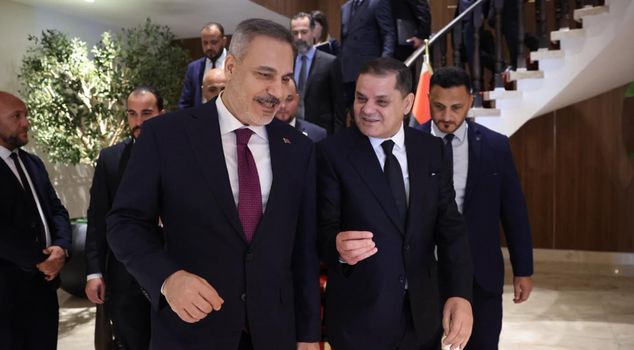
SETA researcher Tunç Demirtaş evaluated the change that has become evident in Turkey's Libya policy in recent years. He noted that Foreign Minister Hakan Fidan's visit, covering Tripoli and Benghazi between August 11-12, was one of the most visible indicators of the change in Turkey's Libya policy that has become apparent in recent years, and assessed Foreign Minister Hakan Fidan's transition from Libya to Egypt with the words, 'it completes the missing link.'
Foreign Minister Hakan Fidan's visit covering Tripoli and Benghazi between August 11-12 has been one of the most visible indicators of the transformation that has become evident in Türkiye's Libya policy in recent years.
SETA Researcher Tunç Demirtaş evaluated the transformation that has become evident in Türkiye's Libya policy in recent years in his focus article titled "Two addresses of a single Libya: Foreign Minister Fidan's visit and the new equation of the Eastern Mediterranean."
"THE MOST VISIBLE INDICATOR OF THE TRANSFORMATION"
Demirtaş's analysis is as follows:
Foreign Minister Hakan Fidan's visit covering Tripoli and Benghazi between August 11-12 has been one of the most visible indicators of the transformation that has become evident in Türkiye's Libya policy in recent years. Just before the visit, a 4.5 million liter gasoline tank at the Zawiya Refinery, 50 kilometers west of Tripoli, was set on fire by a drone attack, and the National Oil Corporation declared a state of emergency at the highest level. Foreign Minister Fidan's mention of an approach that "does not discriminate between Libya's west, east, and south" is the clearest expression of Ankara's new approach, which, while advocating for Libya's unity, does not limit its engagement on the ground to a single political and geographical center.
"DRILLS UNIFY THE ARMY, BUT THEY DO NOT UNIFY POLITICS"
One of the notable changes in the Libya file in 2026 was Washington's re-emergence as a more visible actor. Indeed, the initiative led by US President Donald Trump's advisor for Arab and African affairs, Massad Boulos, materialized in Sirte on July 14. Khalifa Haftar's son and Chief of Staff of the Libyan National Army (LNA), Khalid Haftar, and the Chief of Staff of the Government of National Unity (GNU), Salahaddin Namrush, came together under the supervision of the United Nations (UN) Support Mission and declared a "single national army." They also agreed to conduct joint drills against smuggling and migration along the Chad-Niger border line. Details reflected in the public suggest that a power-sharing formula is being discussed, in which Abdulhamid Dbeibeh remains as prime minister and a senior executive position is opened for the Haftar faction. Additionally, encouraging the return of American energy companies to Libya and planning joint military activities under the leadership of AFRICOM indicate that Washington is trying to advance the political, economic, and security dimensions of its Libya policy simultaneously. The adoption of the first unified budget since 2013 in April 2026 has been one of the most concrete outcomes of this process so far.
It can be said that Washington approaches Libya's political problem with a somewhat accounting-based logic. The Central Bank cannot finance two parallel governments indefinitely, so scarcity will force the parties to unite. This is an approach that considers the economy as the engine and regards legitimacy as a technical detail to be resolved later. The meeting of military institutions in a uniformed structure, the conduct of joint drills, and even agreement on a joint budget are real gains. However, none of these answer the question of which political authority the armed groups will be subordinate to. Indeed, the explicit rejection of the plan by armed structures in Misrata, the militia clashes in Tripoli, and the objections rising from the south show that the architecture on paper does not yet have a counterpart on the ground.
Another weakness of the Boulos initiative lies in the gap between timing and legitimacy. The 36-month transition timetable and the mentioned February 17 election date position the ballot box as a promise rather than a concrete target. The fact that the unified budget signed in April has still not been implemented shows that the compromise on paper has limited reflection on the ground. Political steps taken without an implementation mechanism do not change the power relations on the ground by themselves. Moreover, power-sharing carries the risk of increasing corruption and further feeding existing power networks by loosening current restrictions on public spending. In short, the formula of political compromise in exchange for oil revenue is sufficient to keep the two capitals at the table in the short term. However, as the size of the rent to be shared increases, the disruptive capacity of armed actors left outside the table also increases. What happened in Zawiya can also be read within this framework.
Türkiye positions itself within the plan on its own terms in this picture. Türkiye's advantage is that it maintains its strong military and political presence in western Libya while gradually deepening its relations with actors in the east. Foreign Minister Fidan's meetings in Tripoli with Dbeibeh, Menfi, and Takala, as well as Deputy Defense Minister Zubi, Interior Minister Trabelsi, Chief of Staff Namrush, and Head of Military Intelligence Mahmud Hamza; and in Benghazi with Marshal Haftar, Saddam Haftar, and Agila Saleh, show that Türkiye also reads Libya at the level of its security apparatus. Moreover, some of the names on this list, including Agila Saleh, are known as actors who keep their distance from the American initiative. Therefore, Ankara's contact network also includes actors who approach the American initiative to varying degrees. Ankara's military and political access stands out as a significant variable in making the American plan applicable on the ground. This position allows Ankara to maintain its priorities more strongly at the negotiating table while continuing its engagement with the American initiative.
SONS AND NEPHEWS: THE CONSOLIDATION OF LOYALTY AND THE FRAGILE FIELD
The most critical dynamic observed in Libya today is the progression of succession engineering rather than institutionalization. In the east, Saddam Haftar's military and political weight, Khalid Haftar's position in the General Staff, Bilgasim Haftar's management of the reconstruction budget through the Development and Reconstruction Fund; and in the west, Ibrahim Dbeibeh's positioning at the center of the file as the prime minister's national security advisor are two ends of the same pattern. In both camps, power is being consolidated through families and loyalty networks rather than institutions. In this context, it can be said that Ankara is also building relations with actors likely to be influential in the future of Libyan politics.
The fact that political and military balances in Libya never remain static makes this choice rational from a foreign policy perspective. Washington's return to the table is also reshaping calculations. The main capability produced by Ankara's decade-long experience is not the alliances established with a specific actor, but rather the flexibility to recalibrate its position as actors change. On the other hand, when it comes to Türkiye's fundamental interests, it is not possible to speak of the same flexibility. The inclusion of the Turkish Armed Forces Libya Task Group Command in Tripoli in the visit program is a deliberate reminder of the deterrence behind diplomacy.
Fragility, however, is concentrated in the west. The Zawiya refinery has long been an intersection point of fuel subsidies, smuggling, and armed group rivalry.Muhammad Bahrun, one of the key actors in the region, having become increasingly isolated after once being close to the Dbeibeh line, is turning Zawiya into one of the new tension areas between the government and local armed structures. Regardless of who carried out the attack, the current picture shows that one of the important dimensions of the struggle in western Libya is driven by rent and resource sharing. Foreign Minister Fidan's inclusion of Omar Mukhtar's mausoleum in his Benghazi program can be read as a symbolic message that Turkey's engagement in the east is not limited only to current political and military actors. Alongside military and political relations, Ankara is building a ground in the east that also leans on Libya's historical memory.
CAIRO CIRCLE: THE MECCA LINE, MARITIME JURISDICTION AREAS, AND THE EQUATION EXTENDING TO THE RED SEA
The framework that truly makes Foreign Minister Fidan's Libya visit significant is regional. The joint defense agreement signed in Mecca on August 7 by President Erdogan, Crown Prince Mohammed bin Salman, and Prime Minister Shahbaz Sharif established a collective security architecture that regards an attack on one party as an attack on all parties and remains open to the participation of other regional countries. This step, bringing together Turkey's military weight within NATO, Saudi Arabia's financial capacity, and Pakistan's security capability within the same framework, made the divergence between the different partnership networks already taking shape in the region more visible. The addition of India's increasing interest in the cooperation among Greece, the Greek Cypriot Administration, and Israel shows that rather than a single counter-bloc, overlapping partnerships are emerging that balance Turkey's regional weight. The competition area of this line could extend from the Eastern Mediterranean to the Red Sea and East Africa.
At this point, the Turkey-Libya maritime jurisdiction memorandum signed in 2019 becomes a key element of the power balance in the Eastern Mediterranean, alongside its legal nature. The political sustainability of the memorandum depends not only on the continuity of the government in Tripoli but also on Benghazi's stance toward this text. Therefore, the relationship maintained with the Haftar family is also important for preserving Turkey's legal rights and gains regarding maritime jurisdiction areas in the Eastern Mediterranean. Ankara's developing relations with Benghazi offer a significant opportunity for the maritime jurisdiction memorandum to gain acceptance in eastern Libya as well.
The missing link in this equation was Cairo. Foreign Minister Fidan's move to Egypt after Libya completes the missing link. The topics to be discussed reveal the map of the regional strategy. In addition to Gaza, Syria, Libya, Sudan, and the Eastern Mediterranean, hydrocarbon and electricity grid integration, the defense industry, and the trade volume targeted to increase from $8 billion to $15 billion form the details of this map. Foreign Minister Fidan's signal that Egypt could join the Mecca Joint Defense Agreement moves this visit beyond a technical consultation. Turkey and Egypt becoming able to articulate the same sentence in Libya could weaken one of the most important elements of the rival patrons equation that has long fueled the east-west divide in Libya.
It is no coincidence that the Sudan file is also addressed at the same table. Egypt is the key country of the corridor connecting the Eastern Mediterranean to the Red Sea and East Africa. The search for stability in Libya and the containment of conflict in Sudan are the two ends of the same geopolitical line. The defense architecture signed in Mecca on August 7, the contacts in Tripoli and Benghazi between August 11-12, the hosting of Mahmoud Abbas in Ankara on August 12, and the Cairo visit on August 13 demonstrate an intense diplomatic traffic packed into one week. Reading this calendar as completely independent developments would be incomplete.
Turkish foreign policy today increasingly treats the Eastern Mediterranean, North Africa, and the Red Sea basin as an interconnected security area. Ankara's emphasis on a 'single Libya' is actually the diplomatic expression of seeing a holistic, not fragmented, strategic equation in the Eastern Mediterranean. Within this equation, Libya constitutes a strategic ground where not only the achievement of gains but also their continuous preservation is critical.