16.05.2026 22:40
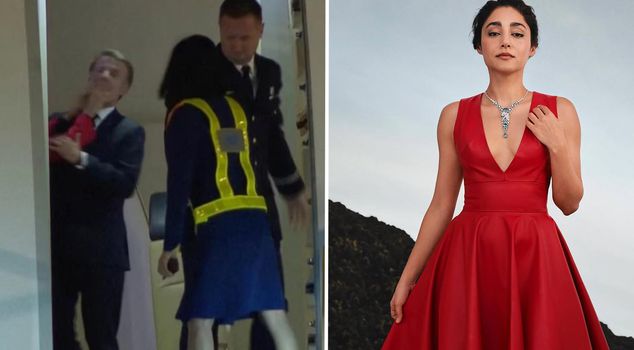
Iranian famous actress Golshifteh Farahani has become a topic of discussion after claims of flirtatious messages with French President Emmanuel Macron, which were also cited as the reason for First Lady Brigitte Macron slapping her husband during their trip to Vietnam. While the allegations of a 'closeness' continue to be debated, attention has turned to Farahani's extraordinary life story, from her childhood stardom in Iran to her exile in Hollywood.
Iranian famous actress Golshifteh Farahani, who stirred Parisian circles with claims of an "emotional closeness" with French President Emmanuel Macron, has become the focus of the world press in recent days. While discussions continue over allegations that the beautiful actress was the reason First Lady Brigitte Macron punched the French leader on a plane, attention has turned to Farahani's extraordinary life story, which began in childhood in Iran, reached Hollywood, and then led to political exile.
The book "Un Couple (Presque) Parfait" (Almost a Perfect Couple) by French journalist Florian Tardif claimed that flirtatious messages were exchanged between French President Emmanuel Macron and Iranian actress Golshifteh Farahani.
THE REASON FOR THE FAMOUS SLAP!
It was alleged that these messages were behind the slap Brigitte Macron gave her husband while disembarking from the plane during the Vietnam visit in May 2025, which was captured on camera.
According to the claim, Farahani said to Macron, "I find you very attractive," to which Macron reportedly replied, "I find you very beautiful too."
While the parties firmly deny the allegations, the spotlight has once again turned to Farahani's political and cinematic life.
KNOWN AS "IRAN'S MOTHER"
Born in 1983, Golshifteh Farahani entered Iranian cinema at just 14 years old with the film "The Pear Tree" and became a star at a young age, winning the "Best Actress" award in her country. Known for her intellectual identity and libertarian stance, Farahani became such a strong cultural figure that renowned author Marjane Satrapi described her as "Iran's mother." However, the opening of Hollywood's doors in 2008 marked the beginning of an irreversible turning point for her.
HEADSCARF CRISIS ON THE RED CARPET
Farahani gained international attention by starring in Ridley Scott's film "Body of Lies," featuring Leonardo DiCaprio and Russell Crowe. However, this global success drew the ire of the Iranian government. At the film's premiere in New York, Farahani appeared on the red carpet without a headscarf, and the Iranian regime accused her of "open defiance." With her passport confiscated and subjected to interrogation, the famous actress was declared a "persona non grata" in her country overnight and was forced into a life of exile.
SHE DESCRIBED EXILE AS "LIKE DEATH"
Farahani, who first settled in the USA and then in France, was hit with heavy fines by the Iranian government. Continuing her career successfully in French cinema, the actress raised her voice against pressures on the female body through her involvement in the 2012 Cesar Awards project and by posing nude for a magazine in 2015. Targeted by conservative circles in her country and threatened with harm to her family due to these actions, Farahani described being in exile in an interview with The Guardian newspaper with these words:
"Exile is not something that can be understood without experiencing it. Everyone wants to see you as a victim. But I am just an actress who wants to work."
SYMBOL OF THE WOMEN'S RIGHTS STRUGGLE
Now 42 years old and living between Ibiza and Portugal, Golshifteh Farahani is considered not only a cinema artist but also one of the strongest international voices in the struggle for women's rights in Iran. Continuing to support protests in Iran through her millions of social media followers, Farahani maintains her place on both the art and world political agenda with her uncompromising profile in political stance and advocacy for freedom of expression.