16.05.2026 23:01
US President Donald Trump's highly anticipated visit to Beijing ended in a fiasco against China. Failing to secure targeted deals on economic issues such as Boeing aircraft sales and AI chips, Trump also received no commitments from the Beijing administration on critical political demands like the Iran crisis, industrial overcapacity, and the release of opposition leader Jimmy Lai, returning to Washington empty-handed.
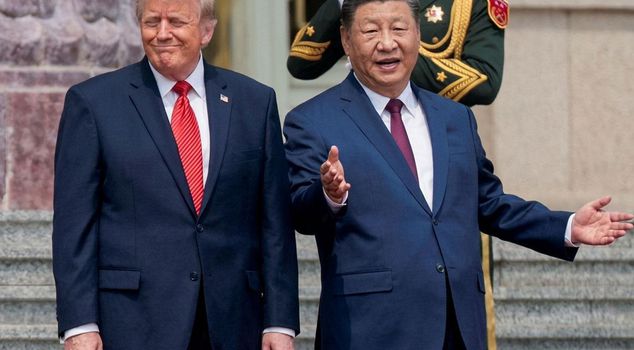
US President Donald Trump's critical visit to China's capital Beijing this week has opened the door to a new era in relations between the two giant powers.
The two-day summit, held after the severe trade war last year that shook global markets, revealed that competition on the Washington-Beijing line has settled on a more predictable footing, although it fell short of expectations in terms of concrete economic gains.
This new era, described by Chinese President Xi Jinping as "constructive strategic stability," signals the parties' determination to manage the process by acknowledging long-term competition and disagreements between them, rather than returning to the old "cooperation-focused" days.
FRAGILE TRUCE IN THE TRADE WAR
Scott Kennedy, a China expert from the Washington-based Center for Strategic and International Studies, stated that the Trump administration's backtracking from severe tariff threats of up to 145% in early 2025 strategically positioned China favorably. Kennedy noted that the US, which a year ago sought to force radical changes on the world, is now seeking stability again.
Although Trump arrived at his meetings in Beijing with some of the most powerful figures in American business, such as Tesla CEO Elon Musk and Nvidia CEO Jensen Huang, the summit did not yield deals large enough to satisfy the business world.
Craig Singleton, a China expert from the Foundation for Defense of Democracies, emphasized that the summit projected an image of stability outwardly but did not change structural deadlocks, with the parties only able to produce limited manageable results under current conditions.
ECONOMIC RESULTS FELL SHORT OF EXPECTATIONS
The commercial achievements from the summit fell well short of Trump's first-term deals in Beijing in 2017, which amounted to $250 billion. Trump announced an agreement for Boeing to sell 200 aircraft to China, but this figure remained below the aviation industry's expected 500 planes and the 300 planes previously promised.
No progress was made on the sale of Nvidia's advanced H200 AI chips to China during the talks, a development welcomed by China hawks in Washington.
Although the White House announced the creation of a new Trade Board as a joint mechanism to lower tariffs on non-sensitive products, it did not share details about the board's operation.
Former Deputy US Trade Representative Wendy Cutler described the resulting picture as falling significantly short of expectations in terms of economic outcomes.
RARE EARTH ELEMENTS THREAT BROUGHT A FRAGILE BALANCE
According to analysts, Trump was overly optimistic that tariffs would force China to make unilateral concessions, but Beijing's retaliatory tariffs and threats to restrict supply of critical rare earth minerals pushed the parties into a fragile balance.
The White House is assessed as reluctant to play harsher technological and financial cards that could shake the global economy, such as sanctions on Chinese banks.
TRUMP COULD NOT GET A CLEAR COMMITMENT OF HELP FROM BEIJING ON IRAN
The issue of China's industrial overcapacity, which is claimed to flood global markets with cheap products, was never publicly raised at the summit. Moreover, it was reported that Trump could not get a clear commitment of help from Beijing to end the war in Iran, which affects global markets. China, struggling with its own internal economic issues and wanting to maintain its long-term technological power, is said to be pleased with the current ceasefire environment.
'JIMMY LAI' DEMAND ALSO NOT ACCEPTED
Trump's call for Xi Jinping to consider releasing Jimmy Lai, a Hong Kong-based media leader and Beijing opponent, also went unanswered. China's Ministry of Foreign Affairs stated that there is no such situation as Lai's release.
TRUMP DESCRIBED THE VISIT AS A "GREAT SUCCESS"
Trump, upon returning to Washington after his 2-day China visit, described the trip as a "great success." Trump stated: "This (visit) was a great success. We made very good deals and trade agreements. We have good relations (with China). It was a tremendous success. I think it was truly a historic moment."