15.10.2026 15:40
The downpour that killed 3 people in Istanbul and the collapse of a two-story villa by the stream in Sapanca in floodwaters brought construction in stream beds back onto the agenda. The Turkish Civil Code stipulates that waters allocated for public benefit cannot be subject to private ownership. In floods experienced in recent years from Bozkurt to İğneada, buildings built on stream beds and banks were also destroyed, and dozens of people lost their lives.
The downpour that affected the Marmara Region once again exposed the flood risk of buildings constructed in and along stream beds. Although laws protect stream beds, similar scenes occur with every heavy rainfall due to zoning plan changes and unpermitted construction.
RAINFALL IN ISTANBUL REACHED 272.2 KILOGRAMS PER SQUARE METER
Minister of Interior Mustafa Çiftçi announced that in the downpour effective on October 14, rainfall in Istanbul reached 272.2 kilograms per square meter in places. Istanbul Metropolitan Municipality (IMM) reported that this rainfall was among the highest values seen in the city since 1985. According to the Governor's Office's initial assessment, 1,277 flood reports were made in the city. Three people died in the flood.
In the Boğazköy area of Arnavutköy, Alibey Stream overflowed and submerged the garden of a primary school. In Ayazağa, hundreds of people were stranded when studios were flooded.
VILLA BY THE STREAM COLLAPSED IN SAPANCA
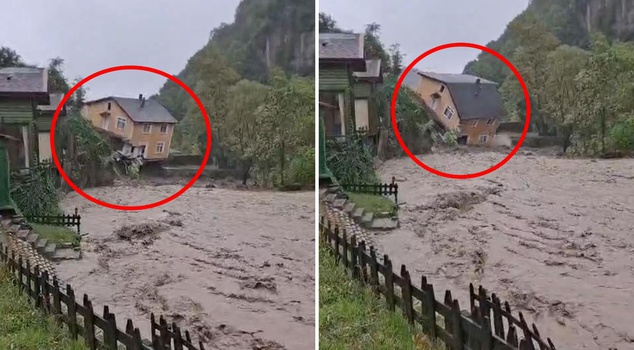
In Sakarya, where the downpour was effective, in the Fevziye Neighborhood of Sapanca, a two-story villa by the stream collapsed and fell into the stream as the flow rate increased. The moment of collapse was recorded with a mobile phone camera. In the district, the Sarp, Keçi, İstanbul, Kurtköy, and Yanık streams overflowed. Some bridge crossings collapsed, and some bungalows by the stream faced the danger of collapse.
WHAT DOES THE LAW SAY?
According to Article 715 of the Turkish Civil Code, unowned places and goods for public benefit are under the State's control and disposal. According to the article, unless proven otherwise, waters, rocks, hills, and mountains for public benefit and the springs emerging from them are not considered to belong to anyone and cannot be subject to private ownership.
Article 16/C of the Cadastre Law also stipulates that “general waters such as the sea, lakes, and rivers” are not subject to registration and delimitation. The article also includes the phrase “exceptions are reserved.”
CIRCULAR: STRUCTURES NARROWING THE CROSS-SECTION SHALL BE REMOVED IMMEDIATELY
The Prime Ministry Circular No. 2006/27 on “Stream Beds and Floods,” published in the Official Gazette on September 9, 2006, regulates the issue in more detail. According to the circular, the measures and recommendations of the State Hydraulic Works (DSİ) must be followed in zoning plans. Without DSİ permission, streams absolutely cannot be covered for the purpose of creating usage areas.
The circular stipulates that no permits or licenses shall be granted to natural and legal persons for structures that narrow the water flow cross-section. Structures found during inspection to narrow the flow cross-section must be removed immediately by the authorized municipality or provincial special administration. In cadastral work, naturally formed stream beds are also excluded from registration and left to the stream's natural flow.
STREAMSIDE IN BOZKURT WAS OPENED TO DEVELOPMENT IN 1982
The heaviest price of construction in stream beds was paid on August 11, 2021, in the Bozkurt district of Kastamonu. In the flood that hit the Western Black Sea, 82 people died in Kastamonu, Sinop, and Bartın. In Bozkurt alone, 65 people died, and 7 people could not be reached.
The Ölçer Apartment Building on the bank of Ezine Stream collapsed when the stream scoured its foundations, and 20 people died in the building. According to the expert report, the stream bed where the building was located had been opened to development in 1982. In the expert report prepared by Istanbul Technical University (İTÜ) experts, it was stated that it was known before the disaster that the building was at flood risk.
FROM AYAMAMA TO İĞNEADA
Istanbul had previously suffered major losses from stream floods. In the flood on September 9, 2009, when the Ayamama and Tavukçu streams overflowed, more than 30 people died in Istanbul and Tekirdağ. In İkitelli, 7 female workers in a shuttle vehicle stranded on Basın Express Road were swept away by floodwaters and died.
On September 5, 2023, Değirmen Stream overflowed in İğneada, connected to the Demirköy district of Kırklareli. Floodwaters swept away bungalows in a campsite determined to be operating without a license, and 6 people died. In the case, facility operator Bülent B. was sentenced to 18 years in prison for the offense of “causing the death and injury of more than one person by negligence.”
In Rize, in the downpour effective on the night of September 19-20, 2025, 2 bungalows by the stream in Çamlıhemşin were swept away by floodwaters and destroyed. Rize Governor İhsan Selim Baydaş had announced a year earlier that unlicensed bungalows in Fırtına Valley polluted the stream bed and promised demolition. However, the flood came before the bungalows were demolished.
FLOOD RISK MANAGEMENT MANDATORY IN EUROPE
The European Union's Floods Directive 2007/60/EC obliges member states to assess flood risks, prepare flood hazard and risk maps, and establish flood risk management plans. Plans are reviewed every 6 years. According to the Directive, these plans may also include the controlled flooding of certain areas during floods, along with measures promoting sustainable land use and water retention. The Directive does not directly prohibit construction in flood zones. Member states determine which areas construction is allowed in through their own legislation.
THE NETHERLANDS “MADE ROOM FOR THE RIVER”
The Netherlands launched the “Room for the River” program after the floods in the Rhine delta in 1993 and 1995, in which more than 200,000 people were evacuated. In the program, which cost approximately 2.2 billion euros between 2006 and 2015, dikes were moved away from the river, floodplains were lowered, side channels were deepened, and flood bypasses were created through about 40 projects.
Amphibious houses that can rise with the water level are also among examples of adaptation to flood zones in the country. Amphibious houses built in Maasbommel on the banks of the Maas River are one of the known examples of this practice.
“SEQUENTIAL TEST” MANDATORY IN ENGLAND
In England, which left the EU, a “Sequential Test” is applied under the National Planning Policy Framework (NPPF). According to this test, if there is suitable land with lower flood risk, construction in a high-risk area is not permitted.
In areas defined as “functional floodplain” where water must flow or accumulate during a flood, sensitive structures, especially housing, are not permitted. In these areas, only water-compatible structures and essential infrastructure facilities, provided they pass an additional “exception test,” are permitted.