30.10.2026 23:30
In Poland, the power struggle between President Karol Nawrocki and Prime Minister Donald Tusk has brought the Constitutional Court to a breaking point. The deployment of police to the court building, the removal of the President of the Court from office, and President Nawrocki’s reaction—“This is a coup”—after cutting short his trip to Senegal and returning to the country escalated the crisis. The deep polarization that erupted over judicial appointments and has continued since 2015 has dragged the country to the brink of a constitutional deadlock.
The political struggle between President Karol Nawrocki and Prime Minister Donald Tusk in Poland has turned into a new crisis through the Constitutional Tribunal. On October 30, the deployment of police to the court compound in Warsaw and the suspension of court president Bogdan Swieczkowski led Nawrocki to cut short his visit to Senegal and return to his country, further increasing tensions in the country. However, behind what happened lies the ongoing debate over judicial independence and judicial appointments since 2015.
THE FOUNDATION OF THE CRISIS WAS LAID IN 2015
The beginning of the judicial crisis in Poland dates back to the Law and Justice Party (PiS) coming to power in 2015. During its first term in power, the PiS government made regulations that changed the structure and working system of the Constitutional Tribunal.
In this process, a dispute arose between the previous parliament and the new government over determining the judges to be appointed to the court. While PiS tried to invalidate some judicial appointments made by the previous parliament, regulations that made it harder for the court to take decisions were also implemented.
In the following years, changes made to the judicial system drew reactions from the European Union and legal organizations. At the center of criticisms were the appointment of judges, disciplinary processes, and the growing political influence over judicial institutions.
THE TUSK GOVERNMENT WANTED TO REORGANIZE THE JUDICIARY
After the 2023 elections, PiS handed over power to the coalition led by Donald Tusk. The Tusk government, which took office in December 2023, promised to reorganize the legal system, arguing that judicial independence had been damaged during the previous government's term.
The government prepared reforms aimed at reducing political influence in the appointment and promotion processes of judges and strengthening the independence of judicial institutions. However, these initiatives brought with them debates over the status of judges appointed during the previous period and the legitimacy of the current court administrations.
TENSIONS ROSE AGAIN WITH NAWROCKI TAKING OFFICE
Karol Nawrocki, supported by PiS, won the presidential election held in 2025. Thus began a new period in which political and legal disputes between the Tusk government and the presidency deepened.
In Poland, the president has the power to veto laws and refer certain regulations to the Constitutional Tribunal. Since a three-fifths majority in parliament is required to override a presidential veto, it became difficult for the Tusk government to implement its reforms.
In February 2026, Nawrocki vetoed a regulation that envisaged changing the method of electing judges. While the government argued that the reform would strengthen judicial independence, Nawrocki claimed that the regulation would create discrimination among judges and bring the judiciary under the influence of political groups.
THE APPOINTMENT OF SIX JUDGES DEEPENED THE CRISIS
At the center of the latest crisis in the Constitutional Tribunal, however, are judicial appointments. A dispute arose between the presidency and the court administration over the taking office of six new judges elected by the parliamentary majority.
Nawrocki did not accept the oath of three of those judges. Court president Bogdan Swieczkowski also did not allow the judges elected by the new parliamentary majority to take up their duties.
Thus, the debate over which members the Constitutional Tribunal would work with and on what legal legitimacy basis turned into a crisis affecting the institution's functioning.
POLICE SURROUNDED THE COURT BUILDING, THE COURT PRESIDENT COULD NOT ENTER THE BUILDING
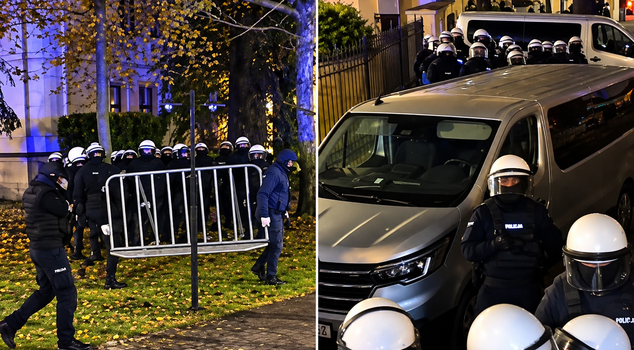
On October 30, a large number of police officers were deployed to the Constitutional Tribunal compound in Warsaw. Although Court President Bogdan Swieczkowski wanted to enter the building, it was seen that the police did not allow him to do so. While security measures were increased around the court, police officials reported that the teams did not enter the building and were present at the compound due to security risks and concerns regarding public order.
Meanwhile, an announcement was published on the court's website stating that the duties of Swieczkowski and Deputy President Bartlomiej Sochanski had been suspended for one month. However, in a statement made on the court's social media account, it was argued that the announcement was unlawful and the events were described as a "coup attempt." Thus, the dispute over authority over the court's administration deepened further.
NAWROCKI CUT SHORT HIS SENEGAL VISIT
During the developments, President Karol Nawrocki, who had set off for an official visit to Senegal, decided to cut his trip short and return to Poland because of the events in his country.
In a statement on his social media account, Nawrocki said, "At a moment like this, the president should be in Poland. I am cutting short my flight to Senegal. I am returning."
Prime Minister Donald Tusk's government, meanwhile, argues that the judicial system and constitutional order must be re-established. As the parties' mutual accusations continue, how the dispute over authority and legitimacy in the Constitutional Tribunal will end remains uncertain.