05.11.2026 19:02
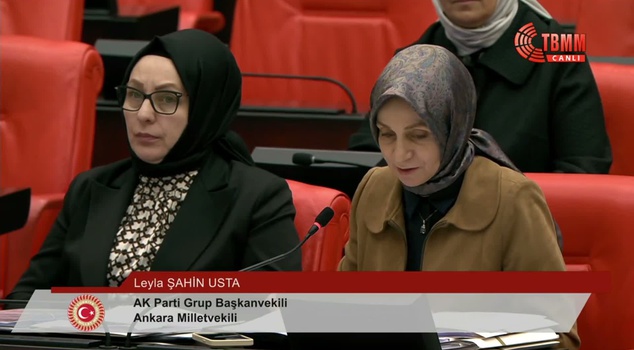
The reduction of the consumption limit in electricity support from 5 thousand kilowatt-hours to 3 thousand kilowatt-hours caused a debate in the General Assembly of the Grand National Assembly of Turkey. CHP Deputy Parliamentary Group Chair Serkan Sarı said that with the regulation bills would increase and the burden would fall on low-income citizens. AK Party Deputy Parliamentary Group Chair Leyla Şahin Usta, on the other hand, argued that a study had been carried out for 44.2 million residential subscribers according to income and consumption levels, and that the mechanism would provide more support to those in need.
(TBMM) -
CHP Group Deputy Chair Serkan Sarı said, regarding the reduction of the consumption limit in electricity support from 5,000 kilowatt-hours to 3,000 kilowatt-hours, “Thanks to you, the poor citizen cannot consume.” AK Party Group Deputy Chair Leyla Şahin Usta said, “Depending on this income level and consumption level, it will be operated as a mechanism that fully protects energy savings and our citizens and can truly provide more support to those in need.”
At the TBMM General Assembly, the regulation on the consumption limit in electricity support came to the agenda. AK Party Group Deputy Chair Leyla Şahin Usta provided information about the regulation. Then CHP Group Deputy Chair Serkan Sarı took the floor and, making criticisms, said the following:
SARI: BILLS ARE MULTIPLYING
“Ms. Şahin clarified this issue, but she explains it so nicely that, I mean, ‘It’s not a hike, it’s a price adjustment,’ ‘We are making just this much, such small touches.’ The 5,000-kilowatt support limit has been lowered to 3,000 kilowatts, and here savings are being mentioned. Then, when the 5,000 kilowatts were being calculated, didn’t these cross your minds; didn’t your minister at the time know this? The result of every regulation you make is reflected on citizens as a heavy bill. There is no reason to downplay it this much. In recent weeks you made a tiered regulation on natural gas; if natural gas bills exceed this limit, if they exceed it by 1 cubic meter, they double. Now you are reducing support in electricity, you lowered it from 5,000 kilowatts to 3,000 kilowatts, and again bills are multiplying.
You said ‘We found oil in Gabar’; right now the price of oil has reached 100 lira. So the sentences you give—‘Not a hike, a regulation,’ ‘discount,’ and so on—do not reflect the truth. Do you have any idea about the realities of the street? I am very curious. Electricity, natural gas, oil—all these products are vital products and are basic necessities that the nation, our citizens, use to heat their homes.”
TEMELLİ: THIS IS ACTUALLY A TAX
DEM Party Group Deputy Chair Sezai Temelli also stated that the issue of tax expenditures was exactly this, and when he directed the question ‘Why are you making these tax expenditures?’ to Minister of Treasury and Finance Mehmet Şimşek, he relayed that Şimşek said ‘Because of exemptions and exceptions.’ Temelli said, “The tax system has become so lax that exemptions and exceptions have almost suffocated the system. Now, this is actually the reason why electricity prices have risen so much. If, on the one hand, you make so many tax expenditures, that is, if you do such favors for capital, the sole way to close that deficit is indirect taxes, that is, raising electricity prices. So the entire burden is on the backs of workers, on the backs of retirees. The budget expresses this to us in all its starkness. That is why natural gas prices and electricity prices are presented to the public at such high prices. In fact, this is a tax.”
44.2 MILLION RESIDENTIAL SUBSCRIBERS WERE EXAMINED
Taking the floor to respond to Sarı, Usta said that there were approximately 44.2 million residential subscribers and that the Ministry had conducted a one-by-one study on this. Usta spoke as follows: “If you ask ‘on what basis did it determine 3,000 kilowatt-hours,’ yes, it identifies the residences for which it can support the capacity to meet heating needs with their own income, and above that—that is, there is a different group with higher income, living in larger houses and larger residences, for heating or lighting those large residences.” In response, Sarı replied, “This is not a support you provide based on income; it is reflected on the home of the poor citizen who lacks insulation, is unprotected, has high electricity consumption, and has high heating expenses.” Sarı emphasized that if a regulation were made based on income level, the explanation would be very accurate, but the regulation was not based on income level.
Usta said, “Right now the Ministry contributes to and supports the energy consumption of your homes, our homes, all of our homes. Why? Because the limit of consumption capacity is specified. This limit study has been done? Why should it support the energy consumption of the capacity of your and our homes?” To Sarı’s question of whether it was determined based on families’ income level, Usta answered, “Yes.”
USTA: MORE SUPPORT FOR THOSE IN NEED
Usta said, “We all have the capacity to understand that consumption is also linked to income level. Depending on this income level and consumption level, it will be operated as a mechanism that fully protects energy savings and our citizens and can truly provide more support to those in need.” Thereupon Sarı said, “Thanks to you, the poor citizen cannot consume; that’s right.”