15.10.2026 16:57
Istanbul Technical University (ITU) Department of Climate Science and Meteorological Engineering faculty member Prof. Dr. Mikdat Kadıoğlu said, "In the heavy rainfall in Istanbul, the combination of the Black Sea's water temperature reaching about 19.5-20 degrees with the cold air coming from the Balkans and the northeasterly wind carrying moisture over the sea was effective."
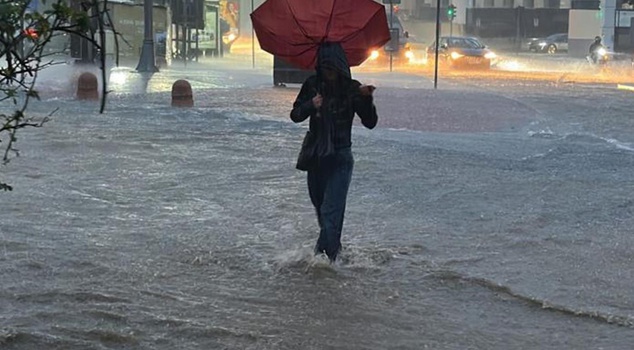
Evaluating the downpour that caused loss of life and major damage in Istanbul, Prof. Dr. Mikdat Kadıoğlu said that the warm waters of the Black Sea and the cold air coming from the Balkans were effective in the severe rainfall. Noting that faulty construction and inadequate infrastructure increase the effects of the flood, Kadıoğlu said, “Climate change enlarges the danger somewhat; we enlarge the disaster.”
Stating that the differences on the same day in the same city showed that, in the formation of the disaster, besides the amount of precipitation, the characteristics of the place where it fell and the city's infrastructure were also determining, Kadıoğlu said, “As of October 14 at 23:03, according to the last 24-hour preliminary precipitation data, 230.3 kilograms of rain fell per square meter in Istanbul's Beykoz district. This amount corresponded to nearly 3.5 times the city's October average total precipitation of 66.3 kilograms.”
Drawing attention to the impact of the severe rainfall that fell in a short time in the northern districts, Kadıoğlu emphasized that, for this reason, issuing a single yellow warning for the entire city would not be enough to convey the location and severity of the risk.
Pointing out that precipitation amount is measured based on the height of water falling per square meter, Kadıoğlu gave the information: “1 millimeter of precipitation means 1 liter, that is, 1 kilogram of water falls per square meter. 100 kilograms of precipitation per square meter creates a layer 10 centimeters high if the water does not flow or seep away. The precipitation measured in Beykoz means that approximately 24 tons of water falls on a 100-square-meter roof.”
3 FACTORS COMBINED, A DISASTER OCCURRED
Mentioning the factors behind the record rainfall, Kadıoğlu made the following assessments:
“In the severe rainfall in Istanbul, the Black Sea's water temperature reaching about 19.5–20 degrees, combined with the cold air coming from the Balkans and the northeasterly wind carrying moisture over the sea, was effective. Warm seas can feed heavy precipitation by supplying moisture to the atmosphere, but to directly link a single precipitation event to climate change, a special attribution study must be conducted. Climate change may increase the severity of extreme weather events. Even if there were no climate change, a building built in a stream bed would still take on water, the panel in the basement would still deliver electricity, and the underpass would still fill up. Climate change enlarges the danger somewhat; we enlarge the disaster. El Niño cannot be shown as the direct cause of the rainfall in Istanbul either.”
Kadıoğlu touched on the fact that on concrete and asphalt surfaces, almost all precipitation turns into surface runoff without seeping into the soil and flows by gravity to the lowest points, stream beds, underpasses, and basements.
Pointing out that extreme rainfall alone does not cause a disaster, and that incorrect land use, construction in stream beds, inadequate infrastructure, and delayed administrative decisions enlarge the damage, Kadıoğlu used the following expressions: “Rain is a hazard. Disaster is the result that emerges when that hazard meets our city, which is unprepared, built in the wrong place, and operated incorrectly. According to this definition, what happened in Istanbul is a disaster on a local scale. But let's not call it a 'natural disaster.' Rain is natural; disaster is man-made.”
“STORMWATER AND WASTEWATER MUST BE SEPARATED FROM EACH OTHER”
Explaining that the floods in Istanbul are shaped not only by meteorological conditions but also by the structure of the basin and human intervention, Kadıoğlu drew attention to the fact that turning stream beds into roads, parking lots, and residential areas increases the risk.
Mentioning that the largely combined operation of stormwater and wastewater systems in Istanbul also creates a problem, Kadıoğlu also warned that during heavy rainfall the sewer system can back up and that water entering basements poses a health risk.
Emphasizing that infrastructure solutions are not limited to laying larger pipes, Kadıoğlu noted the following:
“Streams that have been covered over and turned into roads, parking lots, and residential areas must be reopened, and the fill that narrows stream beds must be removed. Roof water must be stored, and parks and squares must be designed to temporarily hold water during rainfall. Stormwater and wastewater lines must be separated from each other. Flood maps must be prepared, and construction in risky areas must not be allowed without taking these maps into account. The problem is not only inadequate pipes, but the blocking of the natural flow paths of water and the failure to plan cities accordingly.”
Recommending that electrical panels and generators be moved above flood level, that basement use in risky areas be limited, and that water barriers be installed at parking lot entrances, Kadıoğlu noted that a “flood building regulation” based on flood hazard maps should be prepared.
Calling for the publication of maps through which citizens can learn the flood risk for their addresses, Kadıoğlu proposed installing barriers that close automatically when the water level reaches 15 centimeters in underpasses and early warning systems along streams.