17.07.2026 11:50
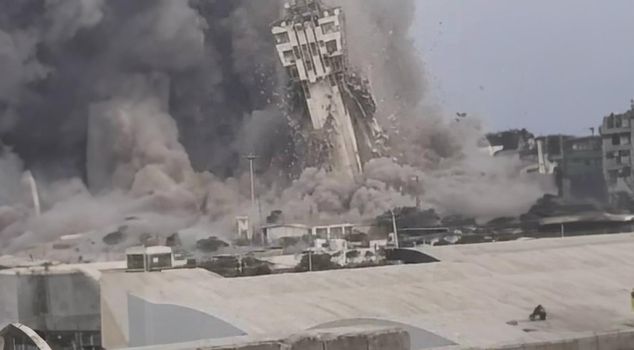
Iranian media reported that the US struck the naval traffic control tower at Chabahar Port for the third time in over a week, and that the structure collapsed after the latest attack. Chabahar, Iran's strategic gateway to the Sea of Oman, is also critically important for India's connectivity to Afghanistan and Central Asia. It is assessed that the attack could negatively impact ship traffic and navigation safety at the port.
According to reports citing Iranian state media, the United States targeted the maritime traffic control tower at Chabahar Port in southeastern Iran again on Friday. It was reported that the same structure was hit for the third time in over a week, with images released after the attack showing the tower collapsed. U.S. Defense Secretary Pete Hegseth also shared a video purportedly showing the moment the tower was destroyed on his social media account. However, an independent and detailed technical report on the full extent of the damage caused by the attack has not yet been released.
THIRD ATTACK IN A WEEK
The maritime traffic control center in Chabahar had previously been damaged in earlier attacks. Sources linked to Iran's Islamic Revolutionary Guard Corps announced that the tower was damaged in an attack on July 8. The Sistan and Baluchestan Ports and Maritime Administration stated that the structure was hit again in an attack on July 15, but no casualties or equipment losses occurred. With the latest attack, the tower was reported to have been targeted for the third time in over a week.
HAVE PORT OPERATIONS STOPPED?
In statements made by Iranian authorities after previous attacks, it was noted that loading and unloading operations continued at Shahid Beheshti and Shahid Kalantari ports. There is no confirmed statement that all port operations have been halted following the latest attack. However, the disabling of the maritime traffic control tower could pose a serious operational risk in terms of monitoring ship movements, coordinating port entries and exits, and navigational safety. Iranian newspaper Etemad also emphasized that the tower is a critical infrastructure for safe maritime transportation.
WHY IS CHABAHAR SO IMPORTANT?
Located on the Gulf of Oman coast, Chabahar is Iran's only deep-water port with direct access to the open ocean. Its position outside the Strait of Hormuz makes the port not only commercially but also strategically important for Iran as an alternative. The port is critically significant for trade and transit routes between Iran, India, Afghanistan, and Central Asian countries.
Another key feature of Chabahar is that it allows India to reach Afghanistan and Central Asia without using Pakistani territory. Therefore, the port is central to New Delhi's regional connectivity plans.
INDIA HAS MILLIONS OF DOLLARS IN INVESTMENT
India and Iran signed a 10-year agreement in May 2024 for the development and operation of the Shahid Beheshti terminal in Chabahar. Under the agreement, India Ports Global Limited was to invest approximately $120 million. The Indian government also took on the responsibility of managing the terminal's general cargo and container operations for 10 years. Thus, the attack not only affects Iran's port capacity but also directly concerns India's long-term economic and geopolitical interests in the region.
US EXPANDS TARGET LIST
According to assessments in the foreign press, the recent attacks were not limited to military facilities. In addition to the control tower in Chabahar, bridges, railway links, electrical infrastructure, and airports in southern Iran were reportedly targeted. The Financial Times reported that the U.S. attacked targets in Iran for the sixth consecutive night and that operations were spreading over a wider geographical area.
In previous statements, the U.S. Central Command argued that the attacks aimed to weaken Iran's missile, drone, air defense, and coastal surveillance capabilities. While Washington cited Iran's threats to commercial ships passing through the Strait of Hormuz, Tehran characterizes the attacks as a violation of its sovereignty and civilian infrastructure.
IRAN: CIVILIAN INFRASTRUCTURE TARGETED
Iranian media claimed that in the attacks on Chabahar, besides port infrastructure, power transmission lines and some civilian structures were also damaged. It was reported that three power transmission lines were disabled in previous attacks, leading to electricity outages in the region. Iran argued that the U.S. attacks on coastal surveillance facilities violated a previously reached agreement.
IS THE TARGET IRAN'S CAPACITY TO CONTROL MARITIME TRAFFIC?
Analyses in the foreign press suggest that the repeated targeting of the Chabahar control tower is no coincidence. Maritime traffic control centers play a critical role in monitoring vessels approaching the port, establishing safe routes, regulating port traffic, and coordinating emergencies. Therefore, the collapse of the tower could weaken Iran's ability to centrally track and manage maritime traffic, even if the port does not fully close.
The targeting of Chabahar, located outside the Strait of Hormuz, is also notable. This indicates that the U.S. is not limiting its operations to the Persian Gulf and the Strait of Hormuz area but is also putting pressure on Iran's alternative trade gateways to the Gulf of Oman. This is an assessment based on current news and the locations of targets.
NEW RISK FOR REGIONAL TRADE
Damage to Chabahar has the potential to affect not only Iran's foreign trade. The port is seen as a key hub for transporting humanitarian aid and commercial goods to Afghanistan, for India's access to Central Asia, and for diversifying regional transit networks. If attacks continue, there is a possibility of rising insurance costs, ships altering their routes, and decreased commercial demand for the port.