08.11.2026 13:30
In Sakarya, 3.5-year-old Deniz Açıkgöz, who was taken to the hospital by her family after they attributed the bruises on her body to her being active, was diagnosed with leukemia. Five-year-old Deniz, who recovered from the disease with 1.5 years of chemotherapy treatment and was discharged, started kindergarten. Assoc. Prof. Dr. Mehmet Fatih Orhan said that fatigue, bruising on the body, persistent fever, weight loss, and night sweats can be signs of leukemia in children.
Deniz Açıkgöz, who was diagnosed with leukemia at the age of 3.5 in Sakarya, recovered her health by beating the disease after 1.5 years of treatment.
Deniz, who was taken by her family last April to the Pediatric Hematology and Oncology Service of Sakarya Training and Research Hospital (SEAH) with a complaint of bruising on her body, was diagnosed with leukemia after tests.
Deniz, whose treatment was started in the hospital and who received chemotherapy, overcame the disease with 1.5 years of treatment.
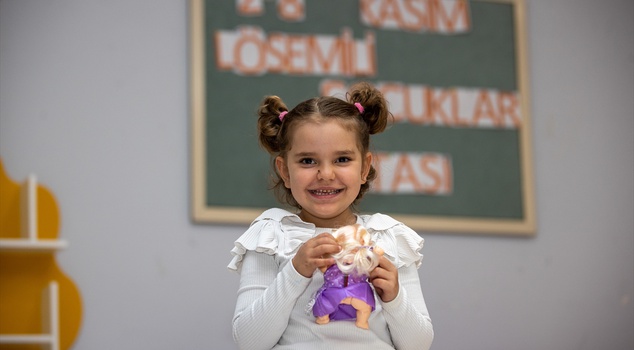
Five-year-old Deniz, who was discharged and whose outpatient treatment and check-ups continue, has started kindergarten.
PAY ATTENTION TO THESE SYMPTOMS
Assoc. Prof. Dr. Mehmet Fatih Orhan, a faculty member in the Department of Pediatric Hematology and Oncology at the Faculty of Medicine of Sakarya University (SAÜ), told the AA correspondent that leukemia, as in Deniz's case, has symptoms in children such as fatigue, bruises on the body or a fever that does not go down, weight loss, and night sweats.
Orhan, stating that the treatment of the disease is mostly continued with chemotherapy drugs and that children need blood during the treatment process, said: 'For public awareness of leukemia, every citizen of the Republic of Turkey needs to be conscious about donating blood to the Turkish Red Crescent (Kızılay), because blood is not something obtained or produced externally. Our people need to somehow go to the Kızılay and make a donation so that we can deliver that blood to these patients. In the treatment part, our state already covers all expenses, including medications.'
EVEN THE NAME OF THE DISEASE IS FRIGHTENING
Mother Ebru Açıkgöz also noted that bruises suddenly appeared on Deniz's body, and because her daughter was active, they thought these could be caused by falling or bumping into something.
Açıkgöz, explaining that when the bruises increased over time they applied to the hospital last April and that after some tests in the emergency department her daughter was hospitalized, said: 'It was something we never expected. We saw our daughter as very healthy. Until just a week before, she was really a child who ran and played. We applied to the hospital because of the bruises that formed on her body. We had no other complaints. Since she was also an active child, we could not attribute it to that; even after receiving the diagnosis, we had difficulty believing for a while that she was ill.'
Açıkgöz, stating that from the moment the diagnosis was made they were researching the treatment, said: 'Such a thing happened to us for the first time. It is not in our family, not in our circle; we were scared. We entered a period in which we felt helpless in every way. One day we were sitting healthily at home, and the next day we ended up in the hospital. Even the name of the disease is frightening, and the possibility was frightening too. We received the diagnosis within two days.'
Then, stating that the treatment process began, Açıkgöz continued as follows:
'Treatment is already a very difficult process. We have been researching from the very beginning. We considered taking her abroad if necessary, changing cities. Those around us said that if Fatih hoca was there, we should not go anywhere else. He is a very good doctor, and his team is very good too. Even Fatih hoca's mercy, compassion, and approach are very different. When Deniz's hair began to grow back, I saw a light and a smile in Fatih hoca's eyes. Just as a person is happy when their own child recovers, I saw that same happiness in Fatih hoca's eyes. And this was not something specific only to my child.'
FATHER: IT WAS A DIFFICULT PROCESS
Father Hakan Açıkgöz, on the other hand, said that because he was working, his wife took care of their daughter more during the difficult treatment process.
Açıkgöz, explaining that because he had worked abroad for a while, he saw that healthcare services in Turkey were better, and they decided for the treatment to continue here, said: 'I was abroad for a while. Turkey is truly very advanced in healthcare; I say this because I was abroad. It was a difficult process. As long as she was in the hospital, I was truly very at ease. Our doctor explained everything to us in every respect. I believed she would get better and recover. I thank our doctor, the staff, and our nurses very much for supporting us during this process.'