09.11.2026 11:20
In the Selçuk district of İzmir, craftsman Osman Can, who began producing root-dyed handmade carpets despite his father's warnings that "you can't do it," brings the works he creates with a half-century-long passion that resists mass production to world palaces and international museums.
In the Selçuk district of İzmir, craftsman Osman Can, who brings traditional root-dyed hand-woven carpets to palaces and museums around the world, carries the thousand-year-old Turkish carpet culture into the future by challenging mass production and synthetic yarns.
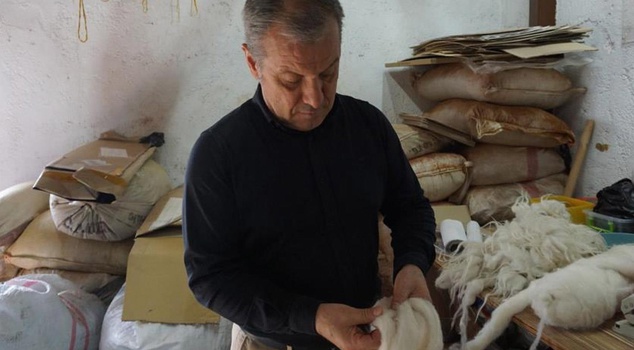
Osman Can, who has continued his father's profession in Selçuk for half a century, despite all his father's warnings made a radical change in his business and began producing with natural dyes and hand-spun wool. Osman Can's determined journey turned into a success story extending to world-famous international museums, primarily the Budapest Parliament Building and the historic Black Church in Romania.
HIS FATHER WARNED, BUT...
Emphasizing the importance of traditional motifs passed down from the past to the present, Osman Can described the transformation process between him and his father with these words: 'My father said, 'It is a very difficult job, you cannot handle it; finding the dye, the pattern, the weaver is impossible.' He warned, 'You will lose everything.' But I wanted to try. People do good while they live, and after they die, 'hasenat' remains behind them. I see these carpets as cultural heritage and a hasenat I leave to the future.'
DEPICTION OF POWER, MANHOOD AND FAITH
Stating that the 16th-century motifs in his collections carry deep meanings, Can explained the symbols in the works as follows: 'The depiction told here is power, manhood and faith. There are two Anatolian lion figures. It is a reflection onto the carpet of a type of amulet sewn onto Chinese fabrics by Ottoman-era princes and captains. It is a symbol embroidered so that children may be strong, faithful and protected.'
THAT QUESTION BECAME A TURNING POINT
Expressing that he always prioritizes quality in his products, Master Osman Can recounted the life-changing memory he experienced with a German customer 30 years ago: 'Thirty years ago, a German customer asked me, 'Why should I buy a carpet from you?' I said, 'Carpets are cheap at my place.' He said, 'Cheap is not a good word; anyone can say it.' I said, 'Mine are very beautiful,' and he said, 'There are beautiful carpets everywhere.' Then he asked, 'What of you is in this carpet? What do you add to this craft?' I could not sleep that night until morning. The answer to that question pushed me to do this work in the most perfect form.'
'I COMPARE MYSELF TO SALVADOR DALI'
Emphasizing that they produce entirely with natural materials in opposition to mass production, Can made the following statements about the health and artistic aspects of the carpets: 'Because we use natural dye and hand-spun wool, our carpets almost distribute healing. When a person with sciatica or rheumatism lies on this carpet, when they touch it, a freshness comes to their body. We did not aim for money. I compare myself to Salvador Dali; we invest every penny we earn in R&D, in making the dye more perfect. Perhaps we will not be rich while we are alive, but those who buy these carpets will possess very valuable works in the future.'
'WE BRING IT TOGETHER WITH SUSTAINABLE DESIGNS'
Hatice Can, a city planner and bride who joined the family to carry the craft into the future, stated that they combine traditional art with a modern and sustainable understanding. Hatice Can said, 'Instead of simply stepping into this great experience passed down for two generations, I preferred to enter the sector by producing something new on the basis of sustainability.'