05.11.2026 13:01
Although floods, hail, and tornadoes damaged greenhouses in Antalya, tomato and pepper prices fell by 10-20 percent in the last week as highland and coastal production continued simultaneously. While the price of a kilo of tomatoes at the wholesale market fell to as low as 25 lira, brokers said the same product could be sold for 75 lira in supermarkets and that the effect of the flood could be seen a month later.
In ANTALYA, although severe rainfall, flooding, hail and tornadoes that have been effective in recent weeks have caused damage to many greenhouses, vegetable prices, especially tomatoes and peppers, have fallen by 10-20 percent. The continuation of production in highland greenhouses due to warm weather and the start of new-season harvest in coastal greenhouses lowered prices.
Turkey's most important covered vegetable production center, Antalya, experienced severe rainfall in recent weeks, causing great damage to agricultural areas. In particular, greenhouses in the districts of Kaş, Demre, Kumluca and Finike were submerged, while hail and a tornado were effective in Manavgat, and heavy rainfall in Aksu and Serik. Many greenhouses were damaged by flooding in the Çevreli and Üçağız neighborhoods of Demre. In Manavgat, 381 decares of agricultural land were affected by hail, and 10,540 square meters of greenhouse area by the tornado. After the disasters, a decrease in production and an increase in vegetable prices were expected, but the opposite picture emerged at the Antalya Wholesale Market.
In Antalya, vegetables are produced in coastal greenhouses in autumn, winter and spring, and in greenhouses in high-altitude plateau regions in summer. Because temperatures this year have been above seasonal norms, production continues in plateau regions, while new-season products have begun to be harvested in coastal greenhouses for about 15-20 days. Products coming to market from both production regions at the same time caused tomato and pepper prices in particular to fall despite the flood disasters. Production continuing in the Fethiye and Ortaca districts of Muğla, as well as Antalya, increased the amount of product on the market.
20-LIRA DROP IN TOMATOES, 15 LIRA IN PEPPERS
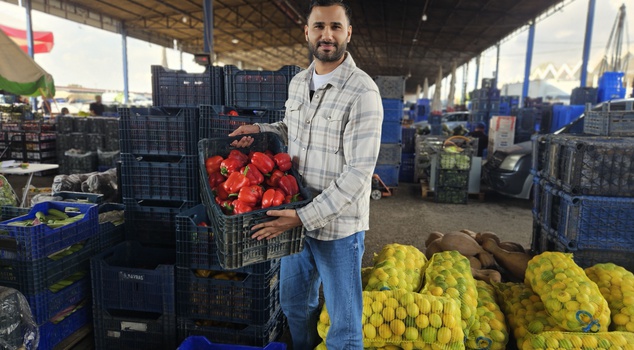
According to the daily price list dated November 4 of the Antalya Metropolitan Municipality Wholesale Market, tomatoes were traded at prices ranging from 25 to 100 lira per kilogram depending on quality and variety. The kilogram price of standard tomatoes was recorded at 25-55 lira, and cluster tomatoes at 50-100 lira. Stuffed peppers were priced at 35-50 lira, çarliston peppers at 80-150 lira, kapya peppers at 45-95 lira, and pointed peppers at 30-60 lira. Sector representatives working as brokers in the market stated that in the last week there was a decrease of about 20 lira per kilogram in tomatoes and 10-15 lira in pepper varieties.
Nevzat Akcan, President of the Antalya Wholesale Market Fresh Vegetable and Fruit Brokers Association (ANTKOMDER), noted that harvesting began in coastal greenhouses about 15-20 days ago and said that tomato prices had risen some time ago due to a decrease in plateau production. Akcan said, 'Our plateau regions had a difficult season this year. When production in the plateaus decreased, an artificial movement occurred in tomato prices. This was not because we found a new market or made exports, but because of a lack of product. The price of tomatoes in the market had risen to 50, 60, 70, even 80 lira. Now new-season production in Antalya is increasing day by day. Products have begun to be harvested in covered greenhouses. The tomatoes you see today are 25 lira. This price means a loss for the producer.'
Akcan, stating that the fall in vegetable prices creates serious problems for producers, said that costs in agricultural production have risen greatly. Akcan said, 'A difficult year awaits us as the agricultural sector. Evaluations about inflation are constantly made through vegetable prices. But the producer's cost is not calculated. I am also a farmer. Previously our biggest inputs were seed, seedlings, pesticides and fertilizer. Now labor, diesel and energy have surpassed all of these. As long as production costs continue this way, it is not possible for the sector to get out of trouble.'
25 LIRA AT THE WHOLESALE MARKET, 75 LIRA AT THE SUPERMARKET
Akcan explained that there is a big difference between wholesale market prices and supermarket prices, noting that transportation, labor and product losses are reflected in consumer prices. Akcan said, 'Even if we send a tomato sold here for 25 lira to Istanbul or Ankara for free, transportation and other costs amount to about 20 lira. People can no longer keep up with expenses. In supermarkets, prices are much higher. A product that is 25 lira here can be sold for 75 lira in a supermarket. However, some of the products in supermarkets go to waste before they can be sold. Supermarkets also reflect the cost of these losses on consumers. In marketplaces, prices are not as high as in supermarkets.'
Stating that prices could fall further with the increase in new-season production, Akcan said that problems in exports also affect the market. Akcan said, 'Last week tomatoes were in the 50-70 lira band. Today they have fallen to the 40-50 lira band. They may fall further. Because production is increasing. There are also serious problems in exports and customs. While producer costs are rising, such a fall in product prices is not sustainable.'
Selahattin Yılmaz, who works as a broker at the Antalya Wholesale Market, also said that they expected prices to rise after the heavy rains, but this did not happen. Yılmaz said, 'We thought the rains would raise prices in a short time. But right now prices are low, especially for peppers. Although tomatoes are slightly higher than in the same period last year, there has been a serious drop in the last week. Around this time last year we were selling tomatoes for 25-30 lira. After that there had been a sudden rise. Last year plateau tomatoes ended early due to weather conditions. This year, plateau tomatoes are still continuing. This has an important effect on prices.'
Explaining that high air temperatures extend the production period, Yılmaz noted that products are also available in the Fethiye and Ortaca regions outside Antalya. Yılmaz said, 'Right now there are tomatoes both in the plateau and on the coast. Pepper production has also begun. Production continues in Fethiye and Ortaca because the weather is good. Supplier companies that provide products to supermarkets can buy from Fethiye or Ortaca instead of Antalya. Everyone prefers affordable products. For this reason, prices in the regions are approaching each other. Prices are generally falling in the Antalya wholesale market as well.'
THE FLOOD'S IMPACT MAY BE SEEN 1 MONTH LATER
Pointing out that the impact of the flood disasters on vegetable prices has not yet fully emerged, Yılmaz said that problems may be experienced especially in pepper production in the coming weeks. Yılmaz said, 'Kumluca is one of the regions where pepper production is intense. The damage caused by rain and excessive humidity to the plant may not appear immediately. Even if it does not damage the peppers to be harvested now, it may affect the products that will be harvested 1 month later and are still small. For this reason, we may feel the impact of the flood as a shortage of products 1 month later. Right now prices are falling, but in the coming period the effect of production losses may be seen.'
Explaining that the decline in vegetable prices has become evident in the last week, Yılmaz said, 'Since last week there has been a decrease of at least 10-15 lira per kilogram in all pepper varieties. In tomatoes, there has been a decrease of about 20 lira.In general, we can say that there has been a decline of 10-20 percent compared to last week. However, price changes are occurring depending on the varieties and qualities of the products," he said.
SHIPPING PROBLEMS IN EXPORTS
Noting that problems experienced in export markets also affect prices, Yılmaz said that there are difficulties in shipments to Ukraine. Yılmaz said, "Last year, ship transportation via the Black Sea was preferred for sending products to Ukraine. However, due to the war, serious problems are being experienced in sea transportation. We hear that shipping prices have also risen a lot. For some shipments that previously cost 4-5 thousand dollars, figures above 10 thousand dollars are now being discussed. This situation restricts exporters from buying products from here," he said.
.