15.11.2026 07:40
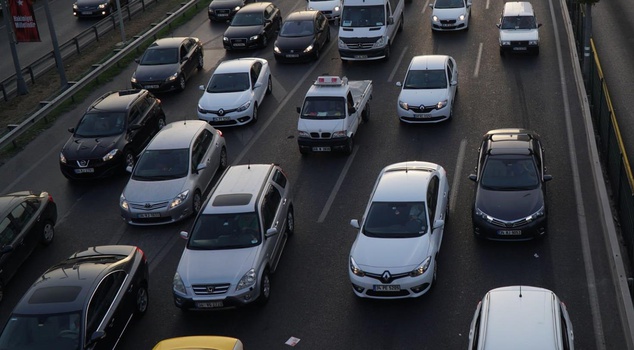
The mandatory winter tire requirement for commercial vehicles began as of November 15. Under the measure, which will continue until April 15, 2027, vehicle operators who do not comply with the rule will be fined 6,000 lira. While there is no nationwide general obligation for private cars, tire replacement fees have risen from 1,500 lira to as much as 3,000 lira depending on wheel rim size.
Under the regulations of the Ministry of Transport and Infrastructure, the mandatory use of winter tyres on commercial vehicles began as of 15 November 2026. The measure will continue until 15 April 2027.
While there is no nationwide general obligation for private cars, drivers are advised to use winter tyres so they can travel safely during the winter months.
Decisions regarding the measure within provincial boundaries can be taken by the governorships. Depending on weather conditions, the mandatory period can be extended by up to one month at the beginning or at the end.
THOSE WHO DO NOT FIT WINTER TYRES FACE A 6,000 LIRA FINE
Operators who do not use winter tyres on their vehicles despite being within the scope of the obligation will be subject to an administrative fine of 6,000 lira for 2026.
Carrying or using chains on the vehicle will not remove the obligation to fit winter tyres. Therefore, drivers need to check whether their vehicles are within the scope of the obligation.
TYRE CHANGING FEES HAVE INCREASED
With the start of the winter tyre season, there has been activity at tyre shops, and the removal and fitting fees have also been announced. The processing fees, which vary by rim size, start at 1,500 lira and rise to 3,000 lira.
Accordingly, 1,500 lira is charged for 13, 14 and 15 inch rims, 1,750 lira for 16 and 17 inch rims, 2,000 lira for 18 inch rims, 2,250 lira for 19 inch rims, 2,500 lira for 20 inch rims and 3,000 lira for 21 inch rims.
Last year, 1,300 lira was paid for the tyre changing process on vehicles with 13, 14, 15 and 16 inch rims.
The cost of the tyre hotel service, which ensures that unused tyres are kept under suitable conditions, is also at the same level as the fee charged for changing all four tyres.
PAY ATTENTION TO THESE MARKINGS WHEN CHOOSING WINTER TYRES
Drivers who will buy winter tyres should consider not only the price but also the markings and technical specifications on the tyre.
The M+S marking on tyres indicates suitability for mud and snow conditions, while the three-peak mountain and snowflake symbol known as 3PMSF shows that the tyre has successfully passed specific winter performance tests.
The M+S marking is used by the manufacturer, while the 3PMSF symbol appears on tyres that meet specific test criteria.
According to the communiqué in force, in winter tyre inspections, M+S, M+S together with a snowflake, or a snowflake alone are accepted. Therefore, tyres bearing only the M+S marking can also meet the requirements in terms of markings.
Experts recommend paying attention not only to performance on snowy ground but also to road-holding characteristics on dry and wet roads when choosing winter tyres.
CHANGE FOUR TYRES, NOT TWO
One of the mistakes made in winter tyre use is fitting winter tyres only to the wheels that provide traction.
Regardless of whether the vehicle is front-wheel drive or rear-wheel drive, all four tyres must be suitable for winter conditions for balanced road holding and braking performance.
Especially on slippery surfaces, using tyres with different characteristics can negatively affect the vehicle's balance and driving safety.
TYRE TREAD DEPTH SHOULD BE CHECKED
It is important for drivers who will reuse tyres left over from last winter to have the tread depth checked.
In Turkey, the legal minimum specified for winter tyres is applied as 1.6 millimetres for cars, vans and minibuses, and 4 millimetres for trucks, tractor units, tankers and buses.
Drivers can check the wear condition of the tyres with a measuring device. The simple check made using a 1-lira coin is only for preliminary assessment purposes.
Since the amount of wear may vary at different points on the tyre, it is recommended that the measurement be made at more than one point.
HOW SHOULD WINTER TYRES BE STORED?
Storage conditions are also of great importance so that winter tyres can preserve their service life.
Winter tyres, which are especially preferred during periods when the air temperature drops below 7°C, must be kept in cool, dry environments that do not receive direct sunlight during the seasons when they are not used.
Tyres can be stored vertically or horizontally under suitable conditions. Tyres on rims can be hung on the wall with suitable hanging systems.
Vehicle owners who do not have enough space at home or in their garage can also benefit from businesses that provide tyre hotel services.