25.10.2026 16:30
In Artvin, on the approximately 30-kilometer section of the Black Sea Coastal Road between Arhavi and Sarp, 6 serious rockfall and landslide incidents, 3 of them fatal, have occurred in the last 5-6 years. Prof. Dr. Hakan Ersoy from KTÜ's Landslide Application and Research Center, noting that rock blocks exceeding 500 tons are moving in the region, said that the route, through which thousands of trucks pass daily, should be examined not with local measures but with a holistic approach.
In Artvin, landslides and rockfalls that have occurred in recent years along the approximately 30-kilometer section of the Black Sea Coastal Road between Arhavi and Sarp have caused loss of life and material damage. While there have been fatalities and vehicle damage in incidents in recent years, Prof. Dr. Hakan Ersoy, a member of the Board of Directors of the Karadeniz Technical University (KTÜ) Landslide Application and Research Center, stated that rock blocks exceeding 500 tons are moving in the region and said that the route needs to be examined holistically.
The Black Sea Coastal Road, which provides Turkey's access to the Georgian border and is used in international transport, frequently comes to the agenda with rockfalls and landslides in the sections between the Hopa, Kemalpaşa, and Arhavi districts of Artvin. While rock fragments breaking off the slopes sometimes reach the highway, they cause disruption of transportation, damage to vehicles, and loss of life.
ROCK FELL ONTO TRUCKS AND A CAR
The landslides and rockfalls that have occurred in the region in recent years have revealed the extent of the danger on the route. On July 1, 2022, at the Kopmuş location between Hopa and Kemalpaşa, as a result of rocks falling onto trucks, an Azerbaijani national driver lost his life, 2 people were injured, and 4 trucks were damaged.
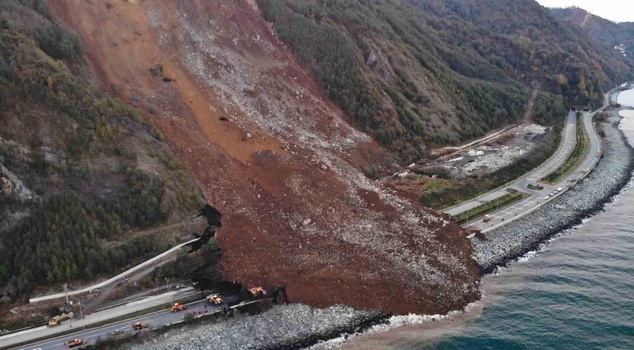
In the landslide that occurred on December 8, 2024, at the Kıyıcık location of Arhavi district, a large mass of soil and rock breaking off the slope slid onto the Black Sea Coastal Road. In the incident, which caused the road to be closed to traffic, 4 people in the car buried under the soil lost their lives. In the examinations carried out, it was determined that the moving soil mass was approximately 100 thousand tons.
In the landslide that occurred on May 6, 2026, in Kemalpaşa district, rock fragments breaking off the slope fell onto the highway and caused a truck to be damaged. In the landslide that occurred on October 8, 2026, at the truck park in the Esenkıyı location of Hopa district, a person struck by rock fragments lost his life, and damage occurred to parked vehicles.
NO MAN-MADE MEASURE CAN PREVENT A 500-TON BLOCK
Following the rockfall and landslide incidents on the section of the Black Sea Coastal Road between Arhavi and Sarp in Artvin, an examination was carried out in the region by the Karadeniz Technical University (KTÜ) Landslide Application and Research Center. Evaluating the rockfall incidents on the Arhavi-Sarp section of the Black Sea Coastal Road, Prof. Dr. Hakan Ersoy noted that serious cases have occurred along the approximately 30-kilometer line in the last 5-6 years and said, “In the last 5-6 years, we have experienced 6 very serious cases, especially within the 30-kilometer Arhavi-Sarp highway. Three of these were fatal cases. We are a country of floods, landslides, and earthquakes, but we especially see the risk of rockfall on highways. With the incident in Tonya 7-8 years ago in which 4 people lost their lives, rockfall work was started in our country, but in a 30-kilometer area we again see that in 5-6 years we have seen 7-8 landslide and rockfall incidents. In the work we carried out there, we see that the blocks exceeded 500 tons. One person lost his life there. Eight trucks were materially damaged. We see that blocks larger than trucks are moving. The question comes before us: should we fight nature or stand alongside it? No man-made measure can prevent a 500-ton block. Therefore, in such situations, perhaps by taking avoidance measures in those areas without interfering with nature at all, we should move away from those areas.”
NEARLY A THOUSAND-TON BLOCK FELL IN 2019
Noting that in the Eastern Black Sea, especially on near-vertical slopes, roads pass very close to the slopes, Ersoy said, “In fact, the Black Sea Coastal Road is one face of our region. When going to the Georgian border and especially to the countries toward the east, this road is used. It is a highway over which thousands of trucks pass daily. But recently, 3-4 years ago, an Azerbaijani citizen lost his life in a rockfall incident. The mass moving there was the size of 4-5 rooms. It was an enormous mass. In the rockfall incident that occurred in 2019, we again saw that a block of nearly a thousand tons fell. In the Eastern Black Sea, I think we are fighting nature. Especially on near-vertical slopes, because roads pass very close to the slopes, we do not leave a buffer area. When a rock falls, it falls directly onto the vehicle or person. This needs to be considered. In 2020, in the United Nations disaster definition, it says events that cannot be solved locally. Therefore, yes, it develops locally in our region, but we cannot solve this with local measures. Just as we have now accepted earthquakes as a national problem through a national integrated system, we have seen that in Istanbul, in a completely unexpected place, it can receive as much rainfall at once as Turkey's rainiest region. We must address all nature-induced disasters—floods, rockfalls, and landslides—by making them a nationwide issue and pursuing them with integrated and strategic approaches. Local solutions remain far behind. In Hopa, along 30 kilometers, there are rockfall cases of various sizes at every location. These need to be urgently studied not locally but holistically, as an approximately 50-kilometer line, by public institutions and universities, whether or not there is rockfall.”