21.10.2026 10:02
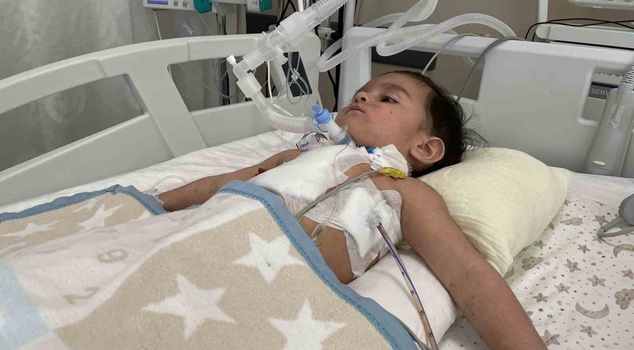
In Konya’s Kulu district, 1-year-old Cabir Ata Kıran was left unable to breathe after swallowing one of the walnuts his older sister was playing with. The baby, whose left lung collapsed and whose oxygen level dropped to 50 percent, was connected to an ECMO machine at Konya City Hospital. The walnut was broken into pieces and removed in an operation that lasted until morning; the baby, whose lung improved, was taken off the machine.
In Konya's Kulu district, a 1-year-old baby who swallowed one of the walnuts his older sister was playing with stopped breathing. The baby, who was taken to hospital, was connected to an ECMO device; the walnut that reached his lung was broken up and removed in a long, successful operation.
Edanur and Nafis Kıran's second child, 1-year-old Cabir Ata Kıran, suddenly stopped breathing after his birthday celebration when he took one of the walnuts his sister, who is 11 months older than him, was playing with and swallowed it. After his family called the 112 Emergency Call Center, medical teams were dispatched to the address. After the initial intervention, baby Cabir Ata was taken to hospital, and as his condition worsened, he was transferred to the Pediatric Intensive Care Unit of Konya City Hospital.
CONNECTED TO ECMO DEVICE
Due to his left lung collapsing and his blood oxygen level dropping, a heart-lung support device called ECMO was used for baby Cabir Ata, who was in life-threatening danger. Because the baby's oxygen level was at a critical level, device support was provided first, and then he underwent a bronchoscopy procedure. Due to severe edema in the airway, a tracheostomy was opened for the baby. Then, during the bronchoscopy, a walnut was detected in his left lung. The walnut was broken into pieces and removed in an operation that lasted until morning.
OPERATION LASTING UNTIL MORNING
Op. Dr. Murat Şimşek, Head of the Pediatric Cardiovascular Surgery Clinic at Konya City Hospital, who performed the surgery to remove the walnut from the baby's lung, said: 'Our baby was brought to the emergency department after teams responded following a call to the 112 Emergency Call Center due to respiratory arrest at home. From there, he was taken to the pediatric intensive care unit. On Saturday night, we were informed that his left lung was closed, his oxygen saturation had dropped seriously, and his general condition had deteriorated greatly. They told us he needed ECMO. We connected the child to extracorporeal circulation, that is, the heart-lung machine that takes over the function of the heart and lungs. Because bronchoscopy could not be performed while the child's oxygen saturation was at 50 percent. Intervening in the lung at this level could have worsened the child's condition. Therefore, we first connected him to ECMO and then began the bronchoscopy procedure. Because there was very severe edema in the upper airway, in the areas we call the larynx and trachea, we had to open a tracheostomy. After opening the tracheostomy, we entered the left lung. In the left lung, we saw a mass that we initially thought was a walnut. Then we broke up this mass and removed it, and understood that it was a walnut. After removing the walnut, the lung improved and the child woke up. We separated the baby from the heart-lung machine we call ECMO. In the following period, his follow-ups became routine. We will now take him to ward follow-up,' he said.
WARNING FROM DOCTOR TO FAMILIES
Expressing that foreign objects should not be left in places within reach of small children, Op. Dr. Murat Şimşek said: 'On Saturday night, we tried to remove the walnut until morning. The walnut could only be removed by breaking it up. Especially in babies, soft-textured materials and small objects should not be left around. Children can aspirate these objects directly. This situation can result directly in death. Therefore, our baby was lucky; at least by keeping oxygen saturation at a certain level, we were able to protect the baby with the support of the heart-lung machine we call ECMO and perform our intervention more safely. In this way, we were able to remove the foreign object. In the following period, the follow-up phase began. Do not leave foreign objects in places within reach of small children,' he said.