21.10.2026 10:42
A warning has been issued for buildings whose basements and ground floors were flooded in the downpour in Istanbul on October 14. Prof. Dr. İbrahim Yüksel from Istanbul Rumeli University said that in columns, beams, and foundations without waterproofing, decay and corrosion could be seen within 6 months to 6 years, and the concrete could lose its strength. Yüksel asked those who see swelling and discoloration to consult an expert.
In ISTANBUL, during heavy rain, water flooded the basements and ground floors of some buildings. In buildings without waterproofing, the risk of dampness came to the fore. Head of the Department of Civil Engineering at Istanbul Rumeli University, Prof. Dr. İbrahim Yüksel, said, 'Floods do not kill; if we are not prepared for floods, they kill. Dampness also kills the building. If water has flooded the basement and ground floors, under the effect of this water, within 15-20 days, swelling and dark mercury-colored changes occur. Due to dampness, the death of the building is in question. In columns, beams and foundations without waterproofing, if there is no insulation and they have been exposed to flooding, decay and rusting manifest themselves within 6 months to 6 years, and that concrete loses its strength,' he said.
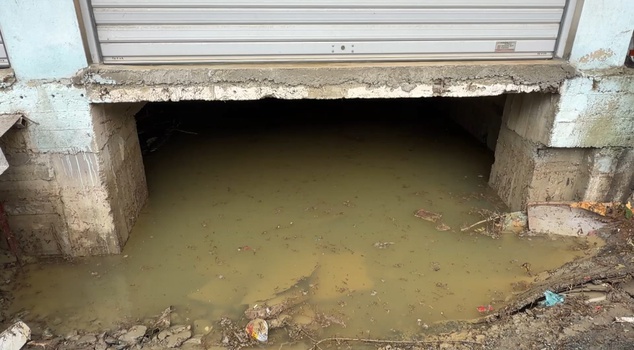
After the downpour that was effective in Istanbul on October 14, water flooded the basements and ground floors of many homes and workplaces. As the waters receded, mud, sludge and a strong smell of dampness remained behind. Citizens whose homes, workplaces and belongings were damaged by the flood are worried about the condition of their buildings while they continue cleaning work. Especially in buildings without waterproofing, dampness occurs on walls and floors, and there is a risk that this dampness will damage certain parts of the building.
DAMPNESS KILLS THE BUILDING
Head of the Department of Civil Engineering at Istanbul Rumeli University, Prof. Dr. İbrahim Yüksel, said, 'Floods do not kill; if we are not prepared for floods, they kill. Dampness also kills the building. If, while constructing the building, during construction, we do not make a waterproofing against water from the foundation up to the roof, do not bring it up to the flood level, and at the same time do not drain the surroundings of the building, and if we do not build a drainage channel or drainage system against future rainfall, snowmelt and downpours, the building takes in water. Therefore, this water present in the basement, if there is no insulation, will ultimately rise up to the roof of the building. They absolutely need to have it checked whether there is waterproofing in the foundation, basement and building, especially whether there is waterproofing in the columns and beams in the -1st, -2nd and -3rd basement floors. In a building without waterproofing, there will be dampness. Even if nothing else, floods, rainfall, downpours—these are already visible parameters. Even if nothing else, the building absorbs hydrogen from the air. When it absorbs it, this in itself over the years leads to dampness, rusting and moisture. Floods and overflow are, of course, the icing on the cake. Therefore, dampness definitely kills the building, and in buildings where it does not exist, it must somehow be installed, provided or designed. Dampness kills the building. It kills just like a malignant cancer tumor in a body. As I said, this manifests itself in 6 months and is completed in 6 years; after 6 years, because the concrete strength in the building, with the reinforcement rusting and decaying due to rust worms, the wall thickness, that is, its diameter, becomes thinner and it has now lost its strength, after 6 years the building gradually loses strength. Sometimes it can itself enter a process of collapse,' he said.
SWELLING BEGINS IN 15-20 DAYS
Prof. Dr. Yüksel said, 'If water has flooded the basement and ground floors, under the effect of this water, within 15-20 days there will be swelling, color changes, dark gray and mercury-colored changes. Due to dampness, the death of the building is in question. Dampness kills the building. In columns, beams and foundations without waterproofing, if there is no insulation and they have been exposed to flooding, they show decay and rusting within 6 months to 6 years. That concrete loses its strength. This building is taking in water. The plaster bursting and concrete spalling are caused by dampness. Over time it absorbs moisture and swells; then, when that moisture evaporates, it contracts. When it contracts, that plaster falls off. When it falls off, the iron is exposed, and this iron rusts and corrodes. In a building exposed to flooding, when columns and beams, concrete and plaster begin to burst and fall off, it means the risk has begun. As I said, this begins within 6 months. Whenever water has entered their buildings, the moment they see mercury-like color changes and darkening on columns and beams, or even, if the basement walls are exposed, mosquitoes flying and grass growing, they should understand that their building has taken in water and continues to take it in and that their building has been damaged by water, and they should immediately apply to an expert or a university.' he stated.
FLOOD VICTIMS ARE WORRIED: WE CANNOT STAY AT HOME
Mümin Tozlu, whose home's ground floor remained under water, said, 'The ground part of the building was covered with boards, but the water took the boards and carried them away. Whatever there was, it brought stones, rubble, soil and water here, into the building. İSKİ and the fire brigade removed the bulk water here. Beneath it, the muddy water remained completely with mud of about more than 1-1.5 meters, along with soil, stones, all the rubble, the rubble inside. No matter how solid we build this building, even if the incoming water is clean and not acidic, as long as this water remains here together with this mud, it will damage both my building and the concrete. The mud and soil need to be removed and cleaned as soon as possible in a way that will not damage my building. If this remains too long, because there are columns, beams, a base slab and a radial foundation, all the iron/reinforcement could be damaged by the flood disaster. To prevent damage, this place needs to be cleaned as soon as possible. On the ground floor, the columns and beams of my building are being damaged and the moisture level is rising. As it rises, the iron/reinforcement, together with the rust, weakens the building. That is why we requested that it be cleaned as soon as possible,' he said.
Fatma Ünlü, who stated that her home on the entrance floor filled with water during the flood, said, 'I live on the entrance floor. Rainwater filled my garden within 4 minutes and entered my house rapidly in the 5th minute. We tried to create a small barrier to save our home, but unfortunately, as you can see, our home ended up like this. Water came up to our height in our home. We barely saved ourselves and our lives. After this flood, collapses occurred at the back. That is why our friends and neighbors upstairs are also very uneasy; all of us are in fear. Right now we are not staying at home, but there is a smell of dampness. That is also a situation caused by the parquet flooring, by the damage it suffered due to wear.' she said.