22.07.2026 10:20
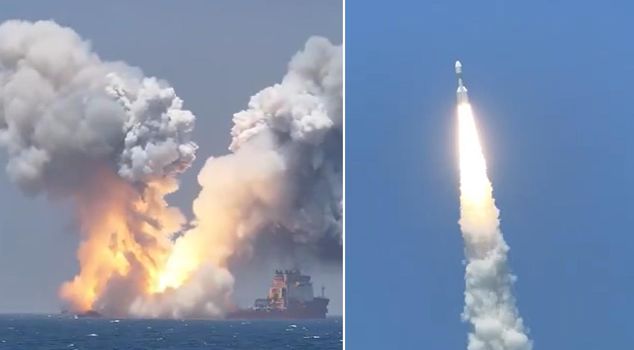
China successfully launched nine satellites into orbit by firing the Gravity-1 Y4 rocket from a sea platform off the coast of Shanghai. This mid-ocean launch, due to its mobility and tracking difficulty, is seen as a direct threat to the US commercial space monopoly and global security. Allowing for the rapid replenishment of military satellites during potential crises, this move proves that the space race is reaching an increasingly dangerous level for the world.
China has taken another remarkable step in its space endeavors, maintaining its claim in the space race. The Gravity-1 Y4 carrier rocket, launched from waters off the coast of Shanghai, was successfully ignited toward the sky. This historic launch moment, which was reflected in Chinese media and took place on a ship platform in the middle of the sea accompanied by massive smoke clouds, was recorded second by second by cameras.
9 SATELLITES SUCCESSFULLY PLACED INTO ORBIT
As part of the launch mission carried out on Wednesday, the 9 different satellites carried by the carrier rocket were successfully sent into their predetermined orbits. This challenging ignition from the sea platform once again highlighted the strategic importance of sea launches as an alternative to land-based launch sites and China's capability in this field.
GRAVITY-1 ROCKET'S THIRD SUCCESSFUL MISSION
This critical operation, which turned into a visual spectacle, was recorded as the third official mission carried out by the Gravity-1 carrier rocket. China, which is accelerating its moves in space and satellite technologies, found wide resonance in the foreign press and aviation circles with this latest launch activity carried out in the middle of the ocean.
WHAT MESSAGE DOES CHINA'S SEA MOVE GIVE TO THE WORLD?
China's successful launch of the Gravity-1 Y4 rocket from a sea platform goes far beyond being just a scientific or commercial step; it has shaking effects on global geopolitics and the new generation space race. When we read the background of this event from a news editor's perspective, we can see that the military, commercial, and strategic reflections, especially for the US and other global powers, will be quite profound.
A DIRECT THREAT TO THE US COMMERCIAL AND MILITARY SPACE MONOPOLY
From the US perspective, the biggest impact of this test is that China is becoming an increasingly tough competitor in the global space transportation market dominated by companies like SpaceX. Sea launches provide much greater flexibility compared to land bases in terms of launch direction and orbit selection (especially the advantage of launching near the equator). China's maturation of this technology will significantly reduce commercial satellite launch costs and threaten the US market share in this area.
From a military and strategic standpoint, alarm bells are likely ringing for the US Space Force. Sea launches show that China can quickly replenish damaged military satellites using mobile platforms at sea even if land-based launch sites are targeted during a crisis or potential conflict. This means China has proven its "responsive space capability."
A NEW ALTERNATIVE AND SECURITY CONCERN FOR THE WORLD
On a global scale, this development makes China a much more attractive partner for developing countries that want to launch their own satellites but cannot afford the high costs of the US or Europe (ESA). By offering sea launch technology cheaply, China will strengthen its hand in "space diplomacy" and expand its network of allies.
However, on the other side of the coin lie the militarization of space and global security concerns. The mobility of sea platforms makes it difficult to predetermine rocket launch points and timings. International intelligence and defense agencies will have to reassess their defense strategies from scratch, considering these rockets that can be suddenly launched from any ocean as a potential ballistic threat or surprise intelligence move.
THE MULTIPOLAR SPACE AGE OFFICIALLY GAINS MOMENTUM
China's successful test in the middle of the ocean clearly declares to the world that the traditional leadership of the US in space is being shaken. We are entering a new era where competition is intensifying, both with price wars heating up in commercial space transportation and with military surveillance satellites being able to be placed into orbit much more flexibly from the seas.