19.10.2026 12:01
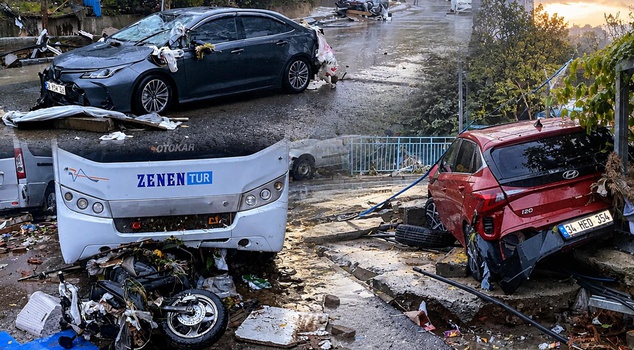
The flood that affected Istanbul caused material damage to many vehicles, while also raising the question of who will cover the damage. Lawyer Mehmet İlker Birgan noted that vehicle owners without comprehensive insurance can also request compensation for their damages under certain conditions, drawing attention to the fact that infrastructure deficiencies and disruptions in public services may give rise to the legal liability of the administration.
The severe downpour and flood that affected Istanbul on October 14, 2026 negatively impacted life across the city, while significant financial losses occurred due to vehicles submerged in water and heavily damaged. After the disaster, discussions began about how vehicle owners could cover their losses, in which cases comprehensive insurance would apply, and whether public institutions had any liability.
Lawyer Mehmet İlker Birgan, who made legal assessments on the matter, stated that in vehicle damage caused by floods, not only insurance policies but also the conditions that led to the damage should be examined. Birgan pointed out that situations such as inadequacies in rainwater drainage systems, uncleaned drains, drainage problems, and failure to take necessary safety measures could raise the issue of the administration's compensation liability.
ATTENTION THOSE WITH COMPREHENSIVE INSURANCE: NOT EVERY POLICY COVERS FLOOD DAMAGE
Stating that citizens whose vehicles were damaged by the flood should first review their comprehensive insurance policies, Birgan expressed that having comprehensive insurance alone does not mean all losses will be covered. According to the General Conditions of Land Vehicles Comprehensive Insurance, damage caused by flood and inundation can be included in coverage through an additional agreement. Therefore, whether this risk is included in the policy is important in determining the insurance company's compensation obligation.
According to Birgan's assessment, vehicle owners whose policies include flood and inundation coverage must notify the insurance company of the damage without delay. Recording the damage with photographs, video, service records, and other documents is also important in the compensation process. Drawing attention to the fact that vehicles submerged in water should not be started, Birgan stated that restarting the engine could increase the existing damage and that expert inspection should therefore be awaited.
THE 'FIVE BUSINESS DAYS' DETAIL IN DAMAGE NOTIFICATION
Under the General Conditions of Comprehensive Insurance, the insured must notify the insurance company within at most five business days from the date they learned of the damage. Birgan stated that exceeding this period does not automatically eliminate the right to compensation in every case and that the consequences of the delay should be assessed according to the circumstances of the concrete event. Noting that it is also important for vehicle owners to take necessary measures to prevent the damage from increasing, Birgan pointed out that if the damage grows because the insured acts contrary to their obligations, the amount of compensation may be affected.
CAN VEHICLE OWNERS WITHOUT COMPREHENSIVE INSURANCE CLAIM THEIR DAMAGES?
One of the most important questions after the flood disaster was whether vehicle owners without comprehensive insurance could cover their losses.
Recalling that compulsory traffic insurance, as a rule, covers damage caused to third parties through the operation of a vehicle, Birgan stated that damage to the vehicle owner's own vehicle caused by flood and inundation is not within the scope of this insurance.
However, stating that legal remedies for citizens without comprehensive insurance are not completely closed, Birgan noted that compensation may be requested if the relevant public institutions are liable for the occurrence of the damage. Pointing to the obligation in Article 125 of the Constitution for the administration to pay for damage arising from its own actions and transactions, Birgan stated that service fault may arise in cases where a public service does not operate at all, operates late, or operates poorly.
IF DRAINS ARE NOT CLEANED AND INFRASTRUCTURE IS INADEQUATE, THE ADMINISTRATION MAY BE LIABLE
Drawing attention to the importance of infrastructure and measures taken in determining the liability of public institutions in flood disasters, Birgan stated that situations such as failure to clean rainwater channels and drains, inadequate drainage infrastructure, failure to take necessary measures in areas known to be at risk of flooding, and failure to close dangerous roads to traffic in time could be considered within the scope of service fault. However, emphasizing that the administration cannot be held liable in every flood event, Birgan stated that it must be investigated whether the damage resulted from a deficiency in the public service and whether there is a causal link between that deficiency and the damage that occurred. In this context, for damage arising from rainwater infrastructure and drainage systems, the liability of the relevant municipalities and the Istanbul Water and Sewerage Administration (İSKİ) may arise, while for damage connected with the construction, maintenance, and safety of roads, the liability of the relevant municipality or the General Directorate of Highways may arise. Birgan stated that in determining the responsible institution, the place where the damage occurred, the nature of the road, and the deficiency alleged to have caused the damage should be taken into account, and that in some cases the liability of more than one public institution may be at issue.
DOES HEAVY RAINFALL ELIMINATE THE ADMINISTRATION'S LIABILITY?
Stating that the flood's being a natural disaster does not in every case eliminate the legal liability of public institutions, Birgan drew attention to the need for a separate assessment regarding the predictability of the rainfall and preventable damage. Birgan assessed, 'The occurrence of heavy rainfall and flooding does not by itself eliminate the administration's liability.'
Stating that elements such as the extraordinary nature of the rainfall, whether it could have been foreseen in advance, the measures public institutions could take, and the effect of infrastructure deficiencies on the occurrence of the damage should be examined together, Birgan expressed that the assessment of force majeure could also be made within the framework of these conditions. Birgan also pointed out that even in some cases where there is no service fault, if the legal conditions are met, the administration's strict liability may arise.
TO WHICH INSTITUTION AND WHEN SHOULD ONE APPLY FOR COMPENSATION?
Stating that citizens whose vehicles were damaged by the flood should pay attention to legal application periods, Birgan reminded that in compensation disputes arising from administrative actions and falling within the jurisdiction of administrative courts, a written application must first be made to the relevant administration.
Under Article 13 of the Administrative Procedure Law No. 2577, an application must be made to the relevant administration within one year from learning of the administrative action alleged to have caused the damage and, in any case, within five years from the date of the action.
If the administration rejects the compensation claim in whole or in part or fails to respond to the application within thirty days, judicial recourse may be sought within the period for filing a lawsuit prescribed by law.
Birgan, who stated that in disputes within the jurisdiction of administrative courts, a full remedy action may be filed for the purpose of compensating the damage, noted that during the proceedings the amount of damage, the responsibility of the administration, and the causal link between the damage and the public service will be examined, and that expert assessment may be resorted to when necessary.
NOT EVERY COMPENSATION CASE IS FILED IN AN ADMINISTRATIVE COURT
Birgan emphasized that correctly determining the competent court in disputes concerning vehicle damage is also of great importance. He drew attention to the fact that some disputes, particularly those related to the construction, maintenance, or operation of the highway, may fall within the jurisdiction of civil courts under the Highway Traffic Law No. 2918.
In the Decision of the Court of Jurisdictional Disputes dated January 29, 2018, E. 2017/787 and K. 2018/19, it was also ruled that civil courts have jurisdiction in a compensation dispute concerning a traffic accident with material damage arising from a lack of maintenance and safety on the highway. Birgan stated that for this reason, the location of the vehicle damaged in the flood alone is not sufficient to determine the competent court, and that depending on the source and legal nature of the damage, either the administrative or civil judicial remedy may come into question.
CRITICAL WARNING FOR VEHICLE OWNERS: DOCUMENT THE DAMAGE, DO NOT MISS LEGAL DEADLINES
Lawyer Mehmet İlker Birgan, pointing out the importance for citizens whose vehicles have suffered material damage due to the flood to document their damages and not miss the application deadlines, emphasized that the right to compensation does not arise automatically in every case.
Birgan, stating that vehicle owners with comprehensive insurance coverage may apply to insurance companies, while those without comprehensive insurance may investigate whether public institutions have responsibility for the occurrence of the damage, expressed that the damage condition of the vehicles, infrastructure conditions, and the measures taken at the place where the incident occurred may be decisive in the legal process.
According to Birgan's assessment, who will bear the material losses arising from the flood is not solely dependent on the intensity of the rainfall. Whether there is a preventable infrastructure deficiency or a disruption in public service in the occurrence of the damage is among the fundamental elements in determining possible compensation liability.
.