06.11.2026 20:12
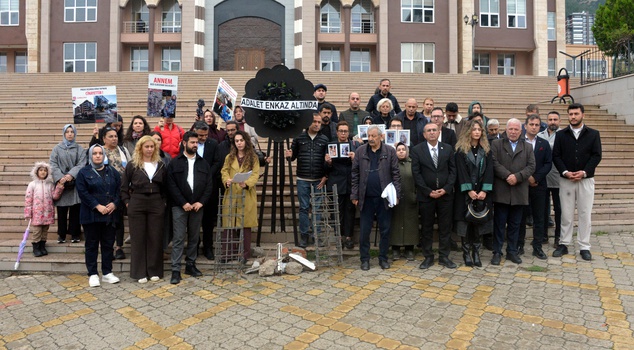
Families who lost relatives in the February 6 earthquakes gathered in front of the Kahramanmaraş Courthouse to protest the acquittals and low sentences handed down in the earthquake trials. The families, who came with photographs of their relatives, rebar, and rubble, left a black wreath reading "Justice is buried under the rubble" at the courthouse; they criticized the imposition of sentences at the lower limit and the reductions applied.
Those who lost their relatives in the February 6 earthquakes left a black wreath in front of the Kahramanmaraş Courthouse with the words 'Justice was left under the rubble' written on it, reacting to acquittals and low sentences issued by the court.
Those who lost their relatives in buildings that collapsed in Kahramanmaraş and Hatay gathered in front of the Kahramanmaraş Courthouse. Holding photographs of their lost relatives and collapsed buildings, a black wreath with the words 'Justice was left under the rubble' written on it, and rubble, those gathered in front of the courthouse reacted to the decisions issued by the courts in earthquake cases.
EARTHQUAKE IS NOT FATE
Tuğçe Demir, who spoke on behalf of the families and lost her relatives in Ebrar Site, said that before they could even experience the pain of losing their loved ones, they began to fight in courthouse corridors and courtrooms in the hope of justice. Stating that as families they collected evidence for justice to be served, uncovered the negligence experienced in the collapsed buildings and presented it to the court, Demir said, 'We followed one by one the projects of the collapsed buildings, the documents of the inspections that were not carried out, and the signatures of those responsible. We knew we could not bring our loved ones back. But we wanted to believe that at least other people would not die in the same way. Because an earthquake is not fate. The deaths of thousands of people are the result of unsafe urbanization, lack of inspection and negligence that was ignored for years.'
WHY ARE SENTENCES GIVEN AT THE LOWER LIMIT?
Noting that while, as those who lost their relatives in the earthquakes, they expected deterrent sentences in the cases, the sentences were both given at the lower limit and reductions were made, Tuğçe Demir said the following:
'But today, as we enter the fourth year, in the face of successive acquittal decisions, sentence reductions and sentences given at the lower limit whose deterrent effect is debatable in Kahramanmaraş, we ask in horror: if even after the deaths of thousands of people those responsible will not be held accountable as they should be, how many more people need to die? Why are sentences imposed at the lower limit on defendants found primarily at fault in expert reports? In cases where human life has been lost so severely, why does the deterrent effect of sentences remain so much in the background? Consider that public officials obliged to protect people's safety of life grant permits to buildings that do not even have mandatory projects. Then, in courtrooms, they defend themselves by saying 'We only signed,' and it can be decided that their responsibilities have no counterpart under criminal law. Those signatures were not put only on paper. Beneath those signatures were people's homes, lives, children, families! Those who do not bear the responsibility of the signature they put today, who will decide tomorrow which building is safe? Who will inspect urban transformation? With what assurance will we put our children to sleep in those buildings? The successive decisions coming out of Kahramanmaraş show that in earthquake cases, sentences are being tried to be confined within a kind of invisible limit. We will never accept this.'
Later, the families ended the action by leaving the black wreath they had brought with them on the wall of the courthouse.