11.11.2026 21:02
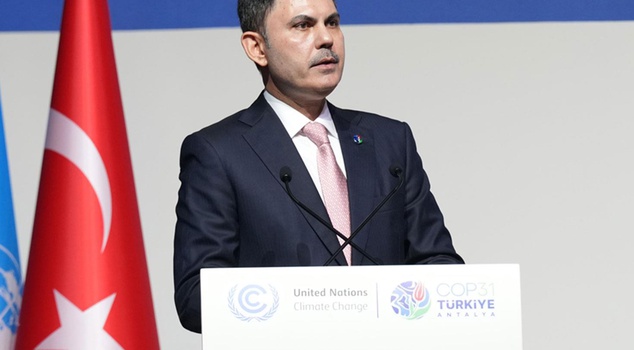
Speaking at the COP31 Leaders Summit, Minister of Environment, Urbanization and Climate Change Murat Kurum called for turning the commitments made in the fight against climate change into concrete investments. Reminding of Turkey's 2053 net zero emissions target, Kurum drew attention to the initiative aiming to increase the share of electricity in global energy consumption to 35 percent by 2035. Kurum also said they were ready to share their reconstruction experience in the earthquake region with other countries.
COP31 President and Minister of Environment, Urbanization and Climate Change Murat Kurum, in his speech at the Opening of the High-Level Segment of the COP31 Leaders' Summit, recounted that in the 16th century Suleiman the Magnificent commissioned Mimar Sinan and produced a solution that would serve Istanbul's water needs for centuries.
Drawing attention with this story to the importance of considering the needs of the future from today, Kurum stated that the Türkiye Century vision put forward by President Recep Tayyip Erdoğan also looks at the second century of the Republic with the same long horizon.
Kurum said that this understanding, which targets net zero emissions by 2053, carries the will to shape cities, energy, industry, technology and the environment by taking future generations into account.
"WE LAUNCHED ONE OF THE LARGEST CONSTRUCTION MOBILIZATIONS IN WORLD HISTORY"
Stating that the importance of this long-term perspective was experienced once again in the Kahramanmaraş-centered earthquakes that occurred on February 6, 2023, Kurum said, "After that great pain, we launched one of the largest construction mobilizations in world history to raise our cities back up. At thousands of construction sites, our architects, engineers, workers, public institutions and local governments worked together."
Minister Kurum recalled that they rebuilt housing, workplaces, infrastructure, roads, schools and hospitals, and delivered 455 thousand homes to their rightful owners.
Noting that geopolitical balances and trade routes are now changing, and that technology and artificial intelligence are transforming production, Kurum said that while energy security is gaining importance, indebtedness is narrowing the space for development, and water and food issues are rising on the national security agenda.
Explaining that climate change permeates all these topics, Kurum continued as follows: "As the world's issues become interconnected, the horizon of state governance also expands. Climate is becoming an inseparable part of the agenda of energy, industry, agriculture, development and even security. Therefore, when we talk about the future of the climate, we are talking about the future of our states, our energy system, the competitiveness of our industry, the safety of our cities and the world our children will live in. That is why the political will in this hall is extremely valuable."
"THERE IS A STRONG INTERSECTION BETWEEN CLIMATE ACTION AND OUR NATIONAL INTERESTS"
COP31 President Kurum reported that the 1.5-degree target is the common compass, but in 2024 the global average temperature rose to 1.5 degrees above the pre-industrial level on an annual basis, and disasters also began to come one after another.
Touching on disasters experienced in many parts of the world, Kurum continued his words as follows: "A small island state in the Pacific is trying to protect its future in the shadow of rising seas. Natural climate events such as El Niño also have the potential to temporarily raise global temperatures. We must appreciate the value of time and increase our implementation capacity as soon as possible. Of course, each country's conditions, resources, economic capacity, development needs and responsibilities are different. Our common success depends on our ability to find our common interests within these differences.
There is a strong intersection between climate action and our national interests. Energy efficiency strengthens energy security, water investments strengthen food security. Clean technologies open up areas for industry and employment, resilient cities strengthen the economy. Properly designed climate action is an investment in prosperity, security and competitiveness. That is why, since the day we began the COP31 Presidency, together with Australia, which holds the negotiations presidency, we have been making efforts to reveal three strong wills in Antalya. "
First, stating that national climate targets need to be transformed into investment programs, Kurum expressed the importance of targets having corresponding allocations in budgets.
Kurum, noting that the 35 by 35 Global Electrification Commitment reveals the will for a just energy transition, explained that they see the goal of increasing the share of electricity in final energy consumption to 35 percent by 2035 as an area of global cooperation for energy security and technological transformation.
Pointing out that a development understanding which sees resources as unlimited and the world as consumable cannot be sustained, Kurum said, "For this reason, we see the Zero Waste movement initiated under the leadership of Her Excellency Emine Erdoğan, the circular economy and the reduction of methane emissions as concrete objectives of climate action."
Second, stating that in climate finance there is a need to move from commitment to access, Kurum expressed that projects wait for financing for years, and if resources do not turn into investment or countries face heavy debt burdens, this means a loss of time and capacity for common solutions.
Underlining that mechanisms that will make financing faster, more accessible and more applicable urgently need to be strengthened, Kurum spoke as follows: "As the COP31 Presidency, the Climate Implementation Bridge we have developed will respond to this need. We will support the transformation of political will into concrete investments that will bring national plans together with projects, projects with financing, and financing with technology and expertise. Third, let us place resilience at the center of our national development policies. Let us prepare our cities, water resources, agricultural systems and critical infrastructure for the risks of the future. Türkiye is ready to share its reconstruction experience gained in earthquake regions, with 500 thousand climate-resilient homes built in 2 years, with countries fighting climate-induced disasters. "
"LET US MAKE ANTALYA THE SYMBOLIC CITY OF THE TRANSITION FROM PROMISES TO IMPLEMENTATION"
COP31 President Kurum, stating that the fundamental value on which these three wills must rise is "justice," expressed that climate justice requires a system in which each country can advance toward the common goal within its own means, capacity and development conditions.
"We can establish an order that respects the right to development of developing countries, facilitates access to finance and technology for vulnerable countries, and in which everyone benefits from the transformation. Türkiye, under the leadership of our President, is ready to contribute to this consensus with its historical and geographical experience between east and west, north and south." Saying this, Kurum continued as follows: "States can compete and can resolutely defend their national interests. However, there is no competition in areas where water, food, disasters and climate risks know no borders. Developing common wisdom is in all of our interests. Today, such an opportunity lies before us. An energy decision we make can serve a country's energy security half a century later. A water basin we protect can become abundance for the tables of unborn children. A city we make resilient can protect the lives of thousands of people years from now. A technology we set in motion can change the lives of millions of people in another corner of the world. This is where the horizon of leadership begins: being able to make decisions that will live longer than our term of office.
Kanuni saw the future of a city from a few drops. The Century of Türkiye also carries the will to think of future generations. Today in Antalya, our responsibility is to look at the common future of all humanity with the same horizon. Come, let us read the needs of tomorrow from the signs of today. Let us leave our children a future where they will live the consequences, not one where we explain our decisions to them. Come, let us make Antalya the symbol city of the transition from promises to implementation. Years from now, when future generations look back at the era of those of us in this hall, let them be able to say this sentence: 'They saw the future, took responsibility, and made decisions that will live longer than their lifetimes. '"
.