07.08.2026 16:40
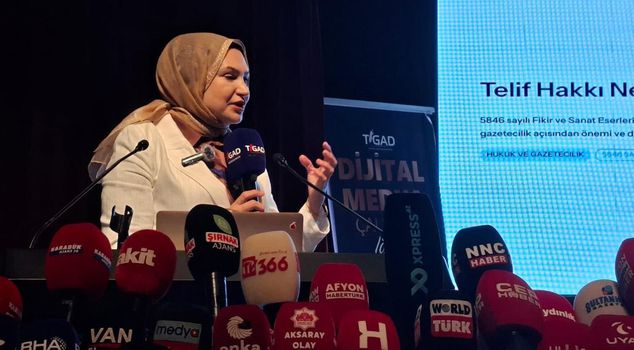
Speaking at the 13th Digital Media Workshop organized by TİGAD in Iğdır, Haberler.com Editor-in-Chief Attorney Bedia Teymur evaluated the issue of news copying in digital publishing and the boundaries of copyright. Stating that events cannot belong to a single media outlet, but that original expression and labor are protected, Teymur said, "The real issue is not who broke the news first, but whether the labor put forward has been used without permission."
The 13th Digital Media Workshop organized by the Turkish Internet Journalism Association (TİGAD) has started in Iğdır. Haberler.com Editor-in-Chief Attorney Bedia Teymur, in her speech at the workshop, drew attention to the vital importance of protecting intellectual and labor products under the title "New Generation Copyrights."
Attorney Bedia Teymur, who took part as a speaker at the workshop moderated by Haberler.com Chairman of the Board Ekrem Teymur, evaluated the news copying processes that have accelerated with the development of digital publishing and the boundaries of ownership over news from a legal perspective.
"HUNDREDS OF JOURNALISTS CAN FOLLOW THE SAME EVENT"
Referring to the effects of the spread of content within seconds with digitalization on the sector, Attorney Bedia Teymur said, "With the growth of digital publishing, the ability to copy news content within seconds has brought along an important debate for journalism: Who does a news item belong to, and what exactly does copyright protect in journalism? In copyright law, the fundamental distinction emerges between the event itself and the journalist's original narration of the event. An earthquake, election results, a court ruling, an official statement, or any development on the public agenda does not belong to a single journalist or media outlet. Dozens, even hundreds, of journalists can follow and report on the same event. However, this situation does not mean that a journalist's original labor can be used without limits," she said.
"THE SUBJECT OF THE NEWS BELONGS TO EVERYONE, THE ORIGINAL NARRATION BELONGS TO THE JOURNALIST"
Emphasizing that the journalism profession is not merely about conveying news but involves serious construction and labor, Teymur stated, "Journalism is not just about conveying obtained information to the public. The journalist decides which information to highlight, which sources to consult, under which headline to present the news, how to structure the text, and which visuals to use. This is precisely where copyright protection begins. The journalist's original news text, exclusive interview, self-taken photographs, prepared graphics, analysis, and original narrative style can benefit from copyright protection insofar as they meet the necessary legal conditions. Therefore, from a journalistic perspective, the distinction can be summarized in a single sentence: 'The subject of the news does not belong to me; however, my original presentation of that news belongs to me."
"THE SAME EVENT CAN BE REPORTED, THE TEXT CANNOT BE COPIED"
Pointing out that directly taking original journalistic texts belonging to others will result in legal sanctions, Attorney Bedia Teymur said, "Another publisher who learns about the event in a news item published by a media outlet can also research the same development, consult their own sources, and prepare their own news. However, directly taking the original text, photographs, graphics, or original elements of the news brings a different legal evaluation to the forefront. Therefore, in digital journalism, the main debate is not so much about the question 'Who first reported this event?' but rather revolves around the question 'Has another person's original journalistic labor been used without permission?'"
"JOURNALISTIC LABOR IS AT THE CENTER OF THE COPYRIGHT DEBATE IN THE DIGITAL AGE"
In the final part of her speech, Teymur stated that copyright is the most fundamental mechanism protecting the economic value of journalistic labor and concluded her words as follows: "With the internet and digital platforms, the much faster circulation of news content has made this distinction more important than in the past. A news story, exclusive interview, or analysis prepared by a journalist through hours of research can be republished on other platforms within seconds. Therefore, at the core of the digital copyright debate, there is not only an 'issue of content ownership.' At the center of the debate also lies the protection of the economic value of journalistic labor and original production. If journalism is the activity of researching, verifying, and presenting the truth to society in an original way, then copyright emerges as one of the tools through which the original labor produced at the end of this process is recognized by law."