21.07.2026 19:50
Egyptian photojournalist Ferid Kutub photographed the 2026 FIFA World Cup using a bellows camera from around 1930, approximately 96 years old.
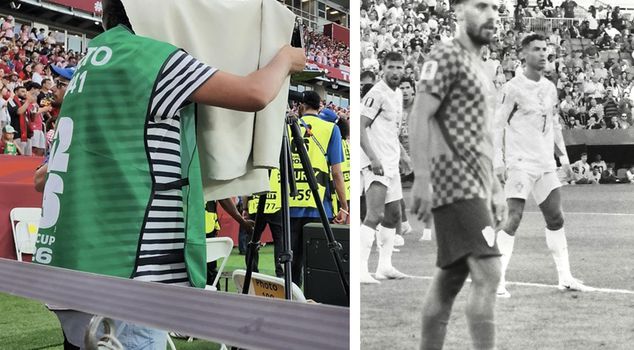
Egyptian photojournalist Farid Qutb became a center of attention at World Cup stadiums by photographing the 2026 FIFA World Cup with an approximately 96-year-old historical bellows camera produced in 1930, the year the first World Cup was held.
PHOTOGRAPHED THE WORLD CUP WITH A 96-YEAR-OLD CAMERA
Egyptian photojournalist Farid Qutb, assigned to the 2026 FIFA World Cup, organized jointly by the USA, Canada, and Mexico, which lasted about a month and concluded with the final match, shared his adventure of documenting the tournament using an almost century-old historical camera, which he named "Project 1930," in an era where green fields are captured with high-quality digital cameras.
Qutb, who has worked as a photographer within the Confederation of African Football (CAF) since 2019, said he aimed to find a camera produced in 1930, the year the first World Cup was held, stating, "My search lasted a full year, and I finally found a professional camera."
He said he wanted to try a different approach by photographing his third World Cup, which he follows professionally, with a Zeiss Kon 250/11 brand/model camera.
"I FEEL LIKE I'M TAKING MY SON FOR A WALK"
Qutb, who noted that after finding the camera, he worked to make it reusable, continued as follows:
"Then I started researching how to operate it. I converted the system that captured images on glass into a negative film system. Thank God, I succeeded, and I began using it in Canada, first for the Portugal-Croatia match and then for the Switzerland-Colombia match. The camera attracted a lot of attention there. I feel it's a part of me. I feel a strong harmony between us. When I travel with it, I feel like I'm taking my little son for a walk. Yet it had been shut away all this time."
Qutb, who previously photographed the 2018 Russia and 2022 Qatar World Cups, as well as the Olympic Games, said, "For my third World Cup, I wanted to do it differently."
Describing his experience at World Cup stadiums, Qutb said, "I feel happy looking at my camera during the match. I feel like it's from another time. My camera suddenly finds itself in the middle of modern technology and looks around in amazement."
"ONE MINUTE FOR ONE PHOTO"
Qutb, pointing out that the biggest difference between the old camera and digital cameras is the shooting time, recorded the following:
"With a digital camera, for example, you can shoot at a speed of one-thousandth of a second. The moment you press the shutter, the photo is taken. With this camera, I first open the machine, and the image appears inverted. Then I adjust the frame. I put a black cloth over my head to see the image better. Then I insert the film and switch from viewing mode to shooting mode. This whole process takes about a minute for a single photo."
Qutb, who also mentioned that his working method changed, stated that he cannot move the camera instantaneously to follow a moment or a player to take a photo during the match, saying, "I choose a specific point on the field and wait to see what I'll encounter there. Sometimes it's a corner kick, sometimes a situation in front of the goal. It was a huge challenge for me. Thank God, I achieved good results in the end."
The Egyptian photojournalist said, "My goal was not just to use an old camera; it was to recreate the shooting experience from the early days of photography and connect the first World Cup organization with the latest one, through a tool from the same era. This project was an attempt to show that the value of a powerful photo is determined not only by technological advances but by the idea, patience, and the photographer's perspective."
Egyptian photojournalist Farid Qutb said that after shooting, the photos were developed by experts, and later scanned to be transferred to digital format and finalized.