11.11.2026 21:40
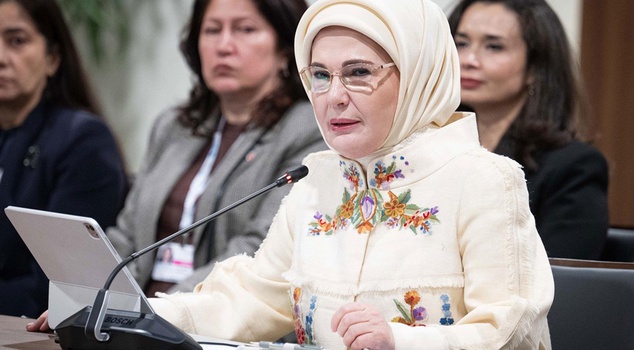
Emine Erdoğan, wife of President Erdoğan, spoke at the High-Level Meeting of Leaders' Spouses of the Global Zero Waste Alliance held within the scope of COP31 in Antalya. Erdoğan, noting that Turkey's recovery rate increased from 13 percent to over 37 percent, introduced the Global Zero Waste Alliance and invited the leaders' spouses to work together. Erdoğan emphasized that large companies must assume global responsibility for their environmental impacts.
Emine Erdoğan, wife of President Recep Tayyip Erdoğan and Chair of the United Nations (UN) High-Level Advisory Board of Eminent Persons on Zero Waste, stated that the Global Zero Waste Alliance is an expression of their will to transform shared responsibility into lasting partnerships.
A “Global Zero Waste Alliance First Spouses High-Level Meeting” was held in Antalya under the auspices of Emine Erdoğan within the scope of the 31st Conference of the Parties (COP31) to the United Nations Framework Convention on Climate Change.
Speaking at the opening of the meeting, Emine Erdoğan stated that she was very pleased to welcome participants to Türkiye on the occasion of COP31, and said that with more than 100,000 participants from 195 countries and more than 100 leaders, they were together to shape humanity’s common future.
“OUR COUNTRY’S RECOVERY RATE ROSE FROM 13 PERCENT TO OVER 37 PERCENT”
Stating that such broad participation demonstrated the power of common will as well as reminding them of the magnitude of the responsibility they had assumed, Erdoğan said, “For decades, at climate summits, we have been talking about temperature rise, drought, and forest loss, and listening to scientists’ warnings. These efforts have undoubtedly created a global awareness. However, we are now in a period when we need to go beyond reports, warnings, and targets that reveal the dimensions of the climate crisis. Because the value of knowledge is also measured by which decisions we can turn it into.”
Emphasizing that the main issue is not not knowing what to do, but demonstrating the will to implement what is known, Emine Erdoğan noted: “This is why, as Türkiye, we define COP31 as an action COP. We want to measure success not only by the commitments made, but by the change these create in people’s lives, in our cities, and in our modes of production. The Zero Waste Movement, which we launched 9 years ago, is a concrete example of this understanding. The awareness that began in homes has today turned into a system extending from schools to municipalities, and from public institutions to factories. In this process, our country’s recovery rate rose from 13 percent to over 37 percent. More importantly, a sense of responsibility that resonates in the daily lives of people of all ages has developed.”
Stating that learning that waste begins not in the trash can but in the decision was the most important lesson they gained in this process, Emine Erdoğan said that whether a product is truly necessary, how it is produced, and how much it is used determine the waste that will arise.
“WE SHOULD ALSO MEASURE OUR SUCCESS BY THE WASTE WE PREVENT FROM BEING GENERATED”
Recalling that for years producing more, developing, and consuming more were regarded as indicators of prosperity, Emine Erdoğan then stated that recycling waste was considered a success.
Expressing that recycling is valuable but that even the best-managed waste consumes soil, water, energy, and labor in its production, Erdoğan said, “We should measure our success not only by the waste we recover but also by the waste we prevent from being generated. Achieving a higher quality of life with fewer resources must be at the center of our understanding of development.”
Saying “If waste begins with a decision, we must ask this question: who makes these decisions?” Erdoğan continued as follows: “A significant part of the pressure on our natural resources arises from global production and consumption patterns. We talk about the health harms of tobacco. However, according to the World Health Organization, the tobacco industry causes the loss of 600 million trees and the consumption of 22 billion tons of water every year. Similarly, in a world where the fashion and textile sector produces 92 million tons of waste annually, we cannot explain the increasingly shortened lifespan of products solely by consumers’ choices. In the digital world, alongside business models that aim to keep us in front of screens longer, we must also question the energy and water needs of the growing infrastructure.”
“COMPANIES’ RESPONSIBILITY MUST ALSO BE GLOBAL”
Pointing out that artificial intelligence offers great opportunities to reduce waste, make production efficient, and find new solutions to environmental problems, Emine Erdoğan noted: “However, we cannot evaluate technological progress separately from its environmental costs. We cannot build the technologies of the future on the waste habits of the past. The price of a company’s economic gain must not be another society’s depleted water resources or polluted soil. For this reason, we must develop common standards that make large companies’ resource use transparent, open their environmental impacts to independent assessment, and strengthen accountability. The responsibility of companies operating on a global scale must also be global.”
Stating that the decisions determining the future of nature are not limited to production and consumption, Erdoğan recalled that war, one of humanity’s heaviest decisions, also inflicts wounds on nature that last for generations, and that this is seen everywhere conflict continues, from Ukraine to Sudan.
In Gaza, where the destruction has emerged in its heaviest form, according to the United Nations Environment Programme, 61 million tons of rubble have accumulated, Erdoğan said, drawing attention to the fact that 97 percent of fruit orchards and olive groves have been destroyed and most of the remaining fresh water resources have been polluted.
Pointing out that the recovery from this destruction could take generations, Erdoğan said, “While world military spending has reached a historic record level of 2.9 trillion dollars, let us think for a moment about what could be possible if even a small portion of these resources were allocated to humanity’s common problems. Destroyed cities could be rebuilt, barren geographies could be revived, and peace could become the climate of all continents.”
“WE WILL ENCOURAGE THE ESTABLISHMENT OF NEW PARTNERSHIPS”
Stating that no country alone can change the decisions made at home, in production, and in politics, Erdoğan continued her speech as follows: “The Global Zero Waste Alliance, which we are introducing today, is an expression of our will to transform this shared responsibility into lasting partnerships. With our Alliance, we aim to create a strong ground for cooperation where countries learn from each other’s successful practices, develop joint projects, and disseminate local solutions on a global scale. We foresee carrying out work in 5 priority areas: zero waste and the circular economy, plastic and packaging waste, zero waste regions, food and organic waste, and education and youth. We plan to develop these efforts through 3 complementary structures.
Erdoğan, stating that they will address common priorities and solution proposals at the Zero Waste Forum held every year, reported that through the Istanbul Platform they will contribute to turning these proposals into concrete projects and implementation partnerships.
Emine Erdoğan, expressing that with the Global Zero Waste Alliance they will encourage these efforts to reach wider geographies and new collaborations to be established between countries, said, "In this way, we aim to bring international organizations, local governments, academia, the private sector and civil society together around common goals. The solution to these problems is not possible through the efforts of a single country; we must bring together our knowledge, means and experience."
"JOINT WORK" INVITATION
Pointing out that each leader's spouse present here today has an area of influence that can make significant contributions to this transformation, Erdoğan stated that the spouses of leaders can reach different segments of their societies and can bring public institutions, civil society and the business world together around common goals.
Emine Erdoğan, pointing out that support given to a small local initiative can be the beginning of a much broader change, therefore invited the spouses of leaders to become effective stakeholders of the Global Zero Waste Alliance and to bring their countries' experience and successful practices to this joint work.
Erdoğan, expressing that after this meeting they wish for new collaborations to be established, joint projects to be developed and their progress to be demonstrated with concrete results, called on the spouses of leaders to take with them, as they leave Antalya, not only a new list of commitments for their countries but also the joint efforts they have launched together.
Thanking the spouses of leaders for their participation and their sensitivity to our shared future, Erdoğan wished the Global Zero Waste Alliance to be beneficial for countries and all humanity.
MANY SPOUSES OF LEADERS ATTENDED
After Emine Erdoğan, Janja Lula da Silva, spouse of the President of Brazil; Ziroat Mirziyoyeva, spouse of the President of Uzbekistan; Ancelly Simina, spouse of the President of Micronesia; Sajidha Mohamed, spouse of the President of the Maldives; Gueta Selemane Chapo, spouse of the President of Mozambique; Nilden Bektaş Erhürman, spouse of the President of the TRNC; Francine Ntakarutimana, spouse of the Head of Government of Burundi; Zubaida Rahman, spouse of the Prime Minister of Bangladesh; Zainab Suleman, daughter-in-law of the Prime Minister of Pakistan; Alexander De Croo, Administrator of the UN Development Programme; and Ancaludia Rossbach, Executive Director of UN-Habitat, also made speeches.
The program was attended by Mariem Dah, spouse of the President of Mauritania; Latife El Durubi, spouse of the President of Syria; Valerie Whipps, spouse of the President of Palau; Mirela Becirovic, spouse of the Chairman of the Presidency of Bosnia and Herzegovina; Tunku Azizah Aminah Maimunah, spouse of the Sultan of Pahang State, Malaysia; Ambari Daroueche Azali, spouse of the President of the Comoros; Philile Dlamini, spouse of the Prime Minister of Eswatini; Zinash Tayachew, spouse of the Prime Minister of Ethiopia; Amina El-Dilawi, spouse of the Prime Minister of the Government of National Unity of the State of Libya; Ann Marie Davis, spouse of the Prime Minister of the Bahamas; Tausaga Teo, spouse of the Prime Minister of Tuvalu; Leyla Aliyeva, daughter of the President of Azerbaijan; Zahra Pezeshkian, daughter of the President of Iran; Samed Ağırbaş, President of the Zero Waste Foundation; and members of the UN Zero Waste High-Level Advisory Board of Eminent Persons.
.