13.08.2026 22:50
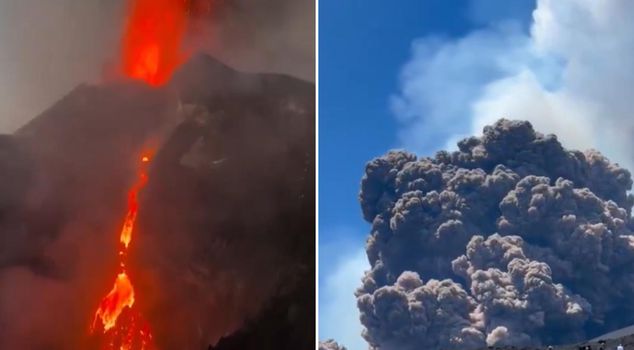
The intense volcanic activity at Europe's most active volcano, Mount Etna, has spread beyond the borders of Sicily into the Mediterranean. The ash cloud rising from the volcano, carried by the wind, reached as far as North Africa via Malta, causing significant disruptions, particularly to air travel. While flights at Catania Airport were halted, hundreds of flights were canceled or diverted to other airports.
The activity at Etna, Europe's most active volcano located on the Italian island of Sicily, has brought effects extending to the southern Mediterranean. The volcanic ash cloud rising into the atmosphere from days of ongoing eruptions has been carried south and southwest by the wind, reaching as far as Malta and the northern coasts of Libya in North Africa. The impact of the ash cloud on air traffic has been growing steadily.
ASH CLOUD ADVANCED AS FAR AS MALTA AND LIBYA
According to data published by the Toulouse Volcanic Ash Advisory Center (VAAC), the ash cloud rising from Etna has moved southward. In the center's warning dated August 12, it was stated that the region with the highest ash density was between southeastern Sicily and Malta, while lower-density ash extended from east of Malta to northern Libya. The aviation warning level was also shown as red.
Etna's ash cloud has also made its presence felt in Malta. The Malta Meteorological Service reported that due to wind conditions, the islands could be affected by the ash cloud and the situation could last until Friday. A thin layer of volcanic ash formed on vehicles, roofs, and balconies in some areas of Malta.
FLIGHTS SUSPENDED AT CATANIA AIRPORT
Due to the ash cloud created by Etna, flight operations at Catania-Fontanarossa Airport, one of Sicily's most important transportation hubs, have been halted repeatedly. According to the latest developments, flight restrictions at the airport are expected to continue until Friday morning, August 14.
The disruption in Catania, one of Italy's busiest airports, has affected thousands of passengers, especially during the peak tourist season in August. According to Reuters, hundreds of flights have been canceled or diverted to other airports in the past week.
HUNDREDS OF FLIGHTS CANCELED
The burden of air traffic in Sicily has also been shifted to surrounding airports. Palermo Airport accepted numerous flights that needed to be diverted to Catania, while Comiso and Trapani airports were also used as alternatives. It was reported that some passengers experienced serious problems with their transportation connections.
It was reported that approximately 700 flights in Catania were canceled or affected. The airport operator called on passengers to check the latest status of their flights with airlines before traveling.
Etna's impact was not limited to Sicily. Due to the ash cloud reaching Malta, disruptions also occurred in flights at Malta International Airport.
ALARM LEVEL RED AT ETNA
The Italian National Institute of Geophysics and Volcanology (INGV) states that the risk to aviation continues due to the ongoing activity at Etna. While activity at different points of the volcano generates lava flows and ash emissions, the aviation warning is kept at the red level.
Experts note that it is not possible to determine in advance exactly when the eruption will end, and it is stated that the direction of the ash cloud may change depending on wind conditions. Therefore, it is indicated that new restrictions may occur in air transportation in Sicily and its surroundings.