12.11.2026 00:31
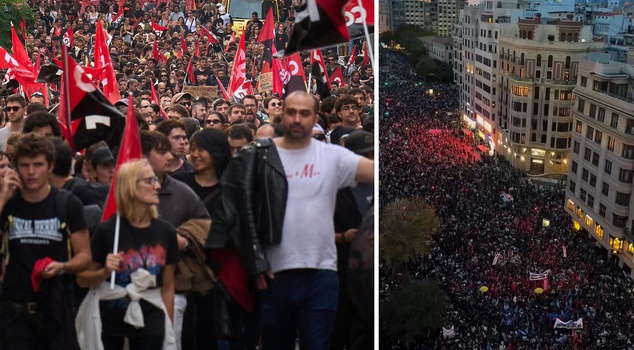
Life came to a standstill in Spain’s first general strike in 14 years against rising rents and the deepening housing crisis. Work stopped in many sectors, from ports to factories, while thousands took to the streets. At least 25 people were injured and more than 50 were detained in clashes between police and protesters.
{"text":"
Workers protesting rising rents and the housing crisis in Spain went on a general strike with the joint support of unions after 14 years, while work stopped in many sectors across the country, from ports to factories.
For the first time in Spain after 14 years, a general strike was held with the joint support of the country's two major unions UGT and CCOO, as well as other workers' organizations and tenants' associations.
PEOPLE FLOCKED TO SQUARES
Thousands of workers across the country stopped work to protest rising rents, housing shortage and evictions. Within the scope of the strike held ahead of the upcoming snap general elections, protest demonstrations were organized in many cities, while activities in ports, factories and various sectors came to a standstill.
HIGH PARTICIPATION RATES DREW ATTENTION
According to UGT and CCOO, participation reached 90 percent in ports and the automotive sector in the first hours of the strike. It was reported that a “complete work stoppage” occurred in some factories, including the Volkswagen factory in the Navarre region and the SEAT factory in Barcelona. Unions announced that participation in the first phase of the strike was 85 percent in the meat sector, 82 percent in the waste collection sector and 75 percent in the energy sector. It was stated that participation remained at 38 percent in health and social services and 35 percent in postal services.
50 PEOPLE DETAINED, 25 INJURED
According to information the Interior Ministry gave to the press, the National Police and Civil Guard reported 919 incidents across the country by 17:00 local time due to the general strike. The number of those detained exceeded 50 in Barcelona, Madrid, San Sebastian, Vitoria, Malaga, Almeria, Granada, Zamora, Valencia, Valladolid and Alicante, where demonstrations were intense, and in the Rioja and Navarra regions. Actions such as road closures and blocking entrances to wholesale markets and ports stood out in Catalonia, Madrid, the Basque and Andalusia regions. The Spanish press stated that at least 25 people were injured in incidents between police and demonstrators.
“WE WILL NOT STOP UNTIL WE TRANSFORM THE HOUSING MODEL FROM TOP TO BOTTOM"
Madrid Tenants' Union spokesperson Alicia del Rio said as the strike began at midnight: “We will not stop until we transform the housing model from top to bottom. Houses should be used for living instead of serving the minority that profits.”
TENSION AT WHOLESALE MARKET
Police intervened in about a thousand protesters gathered at the Mercamadrid wholesale market in Madrid. Police, who used pepper spray in the clash, detained one person. It was learned that 13 people needed medical treatment.
HOUSING SHORTAGE EXPECTED TO EXCEED 1 MILLION BY 2028
According to the Bank of Spain, the country has a housing shortage of about 750 thousand and this number is expected to exceed 1 million by 2028. Because fewer people can own homes, demand for rental housing increased sharply, and this increased pressure on the rental market. According to the Spanish Youth Council, the average rent of 1,176 euros ($1,315) corresponds to about 98.7 percent of the average monthly salary of young people in the country.
SANCHEZ HAD DECIDED ON A SNAP ELECTION ON NOVEMBER 29
The death of an 87-year-old woman after being evicted from her home in the capital Madrid led to weeks of protests and tent actions. Parliament's rejection last month of the government's decrees aimed at preventing evictions and limiting rent increases also increased reactions to the crisis. Following the developments, Prime Minister Pedro Sanchez decided on a snap election on November 29.
The government held regional and municipal governments largely run by the right-wing opposition responsible for rising rents and insufficient housing supply. However, union leaders and protesters argued that the central government also had responsibility in the housing crisis. Demonstrators also reacted to the government over the second deadly train accident in Spain this year.
It was assessed that Sanchez, leader of the Socialist Party who trails in public opinion polls, aimed to turn voter reaction to the housing crisis in his favor and move the political agenda away from corruption investigations concerning his inner circle and the train accident in which 69 people died last month. On the other hand, train drivers also went on strike on Tuesday demanding increased maintenance and safety investments, and the action caused major disruptions in transportation across the country.
Source: İHA/ AA
"}