16.07.2026 17:10
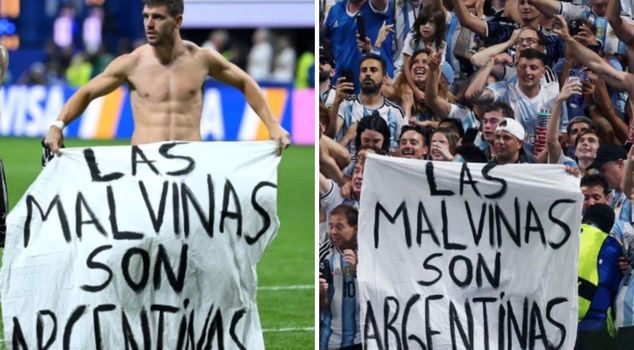
Argentina defeated England 2-1 to advance to the 2026 FIFA World Cup final. A banner reading 'Las Malvinas son Argentinas' unfurled by Argentine players on the field drew a strong reaction from England. The UK government has asked FIFA to investigate the matter.
The political controversy following Argentina's 2-1 victory over England in the semi-finals of the 2026 FIFA World Cup, propelling them to the final, has overshadowed the sport itself. After the match, Argentine players unfurled a banner on the field reading "Las Malvinas son Argentinas" (The Falkland Islands are Argentina's), sparking strong reactions from the UK government and many British politicians.
The UK Prime Minister's Office (Number 10) argued that FIFA should investigate the incident, making a notable statement in its response:
"The World Cup may not be ours, but the Falkland Islands certainly are."
This development has sparked a new debate about the intertwining of sports and politics.
Argentine Players Unveil Controversial Banner
After defeating England in the semi-final, Argentine players greeted their fans by holding a banner reading "Las Malvinas son Argentinas."
The phrase on the banner translates to "The Falkland (Malvinas) Islands belong to Argentina." This message, reflecting Argentina's long-standing sovereignty claim, has become a focal point of controversy as FIFA prohibits political demonstrations in its events.
Argentina's national team captain Lionel Messi, Tottenham star Cristian Romero, and Manchester United defender Lisandro Martinez were among the players holding the banner.
Following the match, midfielder Leandro Paredes further escalated the controversy with these remarks:
"The Falkland Islands will always be Argentina's."
UK government and opposition representatives have issued successive statements in response.
Cabinet member Peter Kyle described the Argentine players' behavior as "completely inappropriate," calling for FIFA to thoroughly investigate the matter.
Similarly, the Prime Minister's Office stated, in line with the same sentiment:
"The World Cup trophy may not be ours, but the Falkland Islands certainly are."
The British government has requested FIFA to initiate a disciplinary investigation into this politically charged action.
Politicians React in Succession
Leaders of various UK political parties have also strongly condemned the Argentine players' banner.
Reform UK leader Nigel Farage reacted to the incident, arguing that the UK must further strengthen the Royal Navy to protect the Falkland Islands.
Conservative Party leader Kemi Badenoch stated in her remarks:
"The Falkland Islands are British territory. The Conservative Party will always defend these lands."
Liberal Democrat leader Ed Davey sent an official letter to FIFA demanding that the players who carried the banner be banned from the World Cup final.
In a social media post, Davey commented:
"In 2024, Rodri and Alvaro Morata were suspended for one match due to chants of 'Gibraltar is Spanish.' The same rule should apply to the Argentine players."
FIFA Has Imposed Penalties Before
This incident is not the first of its kind for FIFA.
In 2014, the Argentine national team displayed a banner with the same message before a friendly match against Slovenia, resulting in a fine of approximately £20,000 from FIFA.
FIFA is known to prohibit political banners, flags, and slogans during tournaments. As a result, Argentina is expected to face a new disciplinary penalty.
Additionally, political flags and banners referencing the Falkland Islands are banned from being brought into stadiums during the World Cup.
Why Are the Falkland Islands a Point of Contention?
The Falkland Islands, located in the South Atlantic Ocean about 480 kilometers east of the Argentine coast, are governed as a British Overseas Territory.
Argentina, however, claims the islands under the name "Islas Malvinas" and has long asserted its sovereignty.
The dispute between the two countries escalated into war in 1982 when Argentina invaded the islands.
The war lasted approximately ten weeks, with the UK regaining control of the islands. It resulted in the deaths of 255 British soldiers, 649 Argentine soldiers, and three Falkland Island residents.
Since the war, the UK has maintained control over the islands, while Argentina has never relinquished its sovereignty claim.
New Statements from Argentina
Following the semi-final victory, Argentina's Vice President Victoria Villarruel also made a notable post on social media.
Sharing a video featuring images of Argentine soldiers, Villarruel said:
"This was not just a football match. The Falkland Islands are Argentina's. They may ban banners from stadiums, but they cannot erase them from our hearts and blood."
Before the match, Villarruel had described the UK as "land-grabbing pirates," heightening tensions.
Tensions Also Escalate at Sea
The controversies on the football field have also spilled over into the diplomatic arena.
The Argentine government recently issued an official protest note to the UK, claiming that HMS Medway, a Royal Navy warship operating near the Falkland Islands, had entered Argentine territorial waters without authorization.
Argentina's Ministry of Foreign Affairs argued that the UK did not inform the Buenos Aires administration in advance about the ship's passage.
The UK Prime Minister's Office denied this claim, stating that the Royal Navy had provided the necessary prior notification to the Argentine government regarding its movements.
As these latest developments become one of the most talked-about events of the 2026 FIFA World Cup, all eyes are now on whether FIFA will launch a disciplinary investigation into the Argentine national team.