11.07.2026 16:51
Brain-eating amoeba cases are increasing worldwide. Experts pointing to climate change say the amoebas are starting to spread to regions that were previously too cold for them to survive. In a case in Costa Rica, 11-year-old Jordan Smelski, who was on vacation with his family, began having hallucinations after going down water slides and died seven days later.
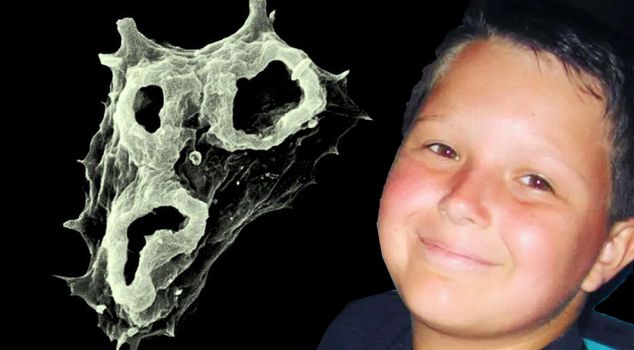
11-year-old Jordan Smelski died from a brain infection caused by Naegleria fowleri (known as the "brain-eating amoeba") while on vacation in Costa Rica.
This type of amoeba, commonly found in warm lakes, hot springs, and neglected swimming pools, enters the body through the nostrils when people jump into the water and rapidly begins attacking brain tissue. Speaking to the BBC World Service, 67-year-old Steve described his shock, saying: "Jordan swam one day, just once, and now he's gone."
WORRYING INCREASE IN CASES WORLDWIDE
Last year, more than 200 cases of Naegleria fowleri infection were detected in India. This was recorded as the largest outbreak worldwide. However, new cases continue to emerge in the country in recent months. Fewer than 500 cases had been detected globally until today. The recent outbreak has reignited researchers' concerns. Experts point out that the organism is appearing in places where it was rarely seen before.
Dr. Anastasios Tsaousis, a molecular parasitology expert from the University of Kent in the UK, expressed his concern, saying: "I think there will be more cases in the future. We will see this worldwide."
HIS HEAD BEGAN TO ACHE, HE STARTED SEEING HALLUCINATIONS
Steve Smelski, who lives in the US state of Florida, was on vacation with his son in Costa Rica. After spending hours sliding down water slides at a natural hot spring near their hotel, Jordan began to have a headache. After returning home, his pain worsened and he started vomiting. His family decided to take him to the hospital immediately. There, hallucinations began, and the young child told them he saw bugs crawling on the ceiling.
Steve recounted his experience, saying: "He was looking at us but didn't know who we were. I don't think he knew who he was either."
"HE DIED 7 DAYS AFTER SWIMMING THERE"
As doctors tried to figure out what Jordan's illness was, the child suffered a seizure and died in the intensive care unit where he was taken. His father Steve said: "He had no problems before this. He was perfectly healthy. He died seven days after swimming there."
INITIALLY MISTAKEN FOR MENINGITIS
Jordan died from primary amebic meningoencephalitis (PAM), a brain infection caused by Naegleria fowleri. Like many victims of PAM, Jordan was initially thought to have meningitis because the symptoms of the two conditions can be similar in the early stages.
By the time doctors realized the situation, it was too late. The infection had caused severe swelling and irreversible damage to his brain.
Describing what his son went through, his father Steve says: "It distracts your mind, takes away your thoughts, takes away who you are."
WHY IS IT APPEARING IN NEW PLACES?
According to a review published in 2025 in the Journal of Infection and Public Health, 488 cases were reported worldwide between 1962 and 2023, mostly in the southern US states, Pakistan, and Australia. Approximately 97% of these individuals died.
However, in the last 20 years, these cases have been increasingly detected in countries in the northern hemisphere, including Italy and Belgium. In the last 15 years, new infection cases have also been reported in colder northern US states, including Minnesota. Last year, the first confirmed case of Naegleria fowleri infection was recorded in Slovakia. Cases have also been linked to environments outside of lakes and rivers, with which the amoeba is traditionally associated.
In Taiwan in 2023, a man died after being exposed to the Naegleria fowleri amoeba at an indoor surf facility. In the same year in the US, a child was infected in a contaminated water playground and passed away.
"AS THE WATER WARMS UP, THE AMOEBA BECOMES MORE ACTIVE"
As climate change causes lakes and ponds to reach higher temperatures, the amoeba is beginning to spread to regions where it previously could not survive due to cold. Molecular parasitology expert Tsaousis says: "As the water warms up, the amoeba becomes more active," and continues: "Then the likelihood of people engaging in recreational activities becoming infected increases."
Tsaousis says there is no need for panic, but people should be "vigilant" about the increasing risk.
He also believes scientists have become more successful at detecting the amoeba, which may contribute to the rise in recorded cases. Tsaousis says: "My hypothesis is that the numbers may have always been high; we are only now realizing these numbers are increasing because we know how to test."
CHILDREN ARE AT GREATER RISK
According to experts, children are more likely to contract Naegleria fowleri infection than adults. Prof. Ian Wright, a water science expert from Western Sydney University, says: "The age group most affected by this disease is 12, because children love playing in warm water."
Some scientists also think children may have a higher risk of infection because the amoeba can more easily cross the barrier between the nose and brain in children.
HIGH MORTALITY RATE
Professor Wright says: "It's like a nightmare, like a horror movie, or like a Stephen King novel," and adds: "Your chance of getting this disease is very low, but if you get it, you will probably die."
If the disease is diagnosed at an early stage, doctors treat patients with various medications and take measures to reduce brain swelling. Nevertheless, the survival rate remains extremely low.
However, a recent outbreak in Kerala, a popular tourist destination in the southern Indian state, has questioned assumptions about how deadly the disease is. According to a new study published in the journal Communications Medicine, more than half of 200 people with known outcomes survived. This rate is far higher than the historical survival rate of about 3%.
RECENT FINDINGS ON TREATMENT ARE ENCOURAGING
The findings suggest that infections caused by the brain-eating amoeba may not be as untreatable as previously thought. The international team behind the study states that earlier diagnosis, greater awareness among healthcare workers, and more consistent treatment protocols may have contributed to improved outcomes.