10.08.2026 23:21
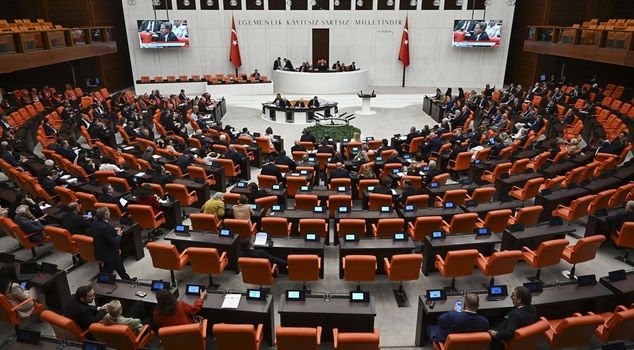
The Law Proposal on Strengthening National Solidarity and Social Integration, prepared within the scope of the 'Terror-Free Turkey' process, was accepted and enacted by the Grand National Assembly of Turkey (TBMM) General Assembly. Following intense deliberations lasting approximately 12 hours, the regulation passed in Parliament with 468 'yes' votes, 88 'no' votes, and 6 'abstentions.' The historic 12-article law, which aims to strengthen social integration, covers legal processes to be carried out on the condition that the terrorist organization is dissolved and lays down its arms.
The bill prepared within the scope of the "Terror-Free Türkiye" process, the Law on Strengthening National Solidarity and Social Cohesion, was accepted and enacted by the General Assembly of the Turkish Grand National Assembly (TBMM). The regulation, which lasted approximately 12 hours of discussions in the General Assembly, passed with 468 "yes" votes, 88 "no" votes, and 6 "abstention" votes. The 12 prominent articles of the law, which aims to reinforce Türkiye's social peace, unity, and solidarity, are as follows:
ARTICLE 1- The purpose of this Law is to determine the procedures for postponing investigations and prosecutions, and the execution of final sentences, as well as other procedures to be carried out, following the determination by security institutions that the PKK/KCK terrorist organization and all affiliated structures have ceased their actual presence and have surrendered all weapons and ammunition under their control, and following the publication of the National Security Council Decision confirming this determination in the Official Gazette.
The provisions of this Law cover the crimes of establishing or managing the PKK/KCK terrorist organization, being a member of the organization, knowingly and willingly aiding it, and making propaganda for the organization, as well as crimes committed within the scope of the organization's activities and crimes committed in favor of the organization as regulated in the Law on the Prevention of the Financing of Terrorism No. 6415 dated 7/2/2013.
Definitions
ARTICLE 2- In this Law;
a) Organization: Refers to the PKK/KCK terrorist organization and all its affiliated structures,
b) Commission: Refers to the Commission to be established pursuant to Article 7 of this Law.
Postponement of investigations and prosecutions
ARTICLE 3- Provided that security institutions have determined that the organization has ceased its actual presence and surrendered all weapons and ammunition under its control, and the National Security Council Decision confirming this determination has been published in the Official Gazette, investigations and prosecutions conducted for crimes within the scope of Article 1, except for the crime of premeditated murder committed within the framework of organization activities and crimes requiring life imprisonment or aggravated life imprisonment committed before 1/6/2005, shall be postponed for five years if the upper limit of the penalty is fifteen years or less, and for ten years if the crime requires a prison sentence of more than fifteen years, life imprisonment, or aggravated life imprisonment. The statute of limitations for prosecution shall not run during the postponement period. Files and evidence useful for proving the crime related to these crimes shall be preserved throughout the postponement period from the date of the postponement decision. A liquidation decision shall be made together with the postponement decision regarding goods and asset values subject to confiscation, and they shall be recorded as revenue to the Treasury. The decision shall be notified to those who have the right to appeal. The decision shall indicate the right to appeal or object, the period, and the authority.
Those who have the right to appeal against decisions made by the chief public prosecutor pursuant to the first paragraph may apply to the peace criminal judgeship within two weeks. Decisions made by the court regarding the postponement of prosecution pursuant to the first paragraph may also be objected to within two weeks.
For crimes committed before the publication of the National Security Council Decision in the Official Gazette and falling within the scope of Article 1, initiating investigations after this date shall be subject to the permission of the Commission.
Protective measures and files under legal review
ARTICLE 4- Protective measures regarding detention and judicial control imposed for crimes for which a postponement decision will be made pursuant to Article 3 shall be evaluated by the authorized judge or court at the current stage of the investigation or prosecution, as well as by the regional court of appeal or the relevant criminal chamber of the Court of Cassation, and if conditions exist, a decision shall be made to lift these measures.
Regarding files under review by appeal or cassation related to crimes for which a postponement decision will be made pursuant to Article 3, a reversal decision shall be made.
Recording of postponement decisions and re-commission of crimes
ARTICLE 5- Postponement decisions made pursuant to Article 3 shall be recorded in a dedicated system. These records may only be used for the purpose specified in the second paragraph if requested by the chief public prosecutor, judge, or court in connection with an investigation or prosecution.
If one of the terrorist crimes is committed within the postponement period from the date of the postponement decision, the postponement decision shall be lifted and the investigation and prosecution shall continue. In case of conviction, the execution of the sentence shall not be postponed pursuant to Article 6, and all consequences of the conviction shall arise. If the specified period is spent without committing a crime, a decision of no place for prosecution or dismissal shall be made.
Postponement of the execution of final sentences
ARTICLE 6- Provided that security institutions have determined that the organization has ceased its actual presence and surrendered all weapons and ammunition under its control, and the National Security Council Decision confirming this determination has been published in the Official Gazette, except for those convicted of premeditated murder committed within the framework of organization activities and those sentenced to life imprisonment or aggravated life imprisonment for crimes committed before 1/6/2005, for crimes within the scope of Article 1;
a) The execution of sentences of convicts sentenced to a total of fifteen years or less of imprisonment shall be postponed for five years,
b) The execution of sentences of convicts sentenced to a total of more than fifteen years of imprisonment, life imprisonment, or aggravated life imprisonment shall be postponed for ten years, by the decision of the execution judge. The application of this paragraph shall not prevent the execution of confiscation decisions. The statute of limitations for the execution of the penalty shall not run during the postponement period.
Objection may be made against postponement decisions made by the execution judge pursuant to the first paragraph.
Postponement decisions made pursuant to the first paragraph shall be recorded in the system established according to the first paragraph of Article 5. These records may only be used for the purpose specified in the fourth paragraph if requested by the chief public prosecutor, judge, or court in connection with an investigation or prosecution.
If one of the terrorist crimes is committed within the postponement period from the date of the postponement decision, the execution judge shall lift the postponement decision and decide to continue the execution of the sentence. If the specified period is spent without committing a crime, the sentence shall be considered executed. The follow-up of postponement decisions shall be carried out by chief public prosecutor's offices.
Follow-up, coordination, and implementation
ARTICLE 7- The follow-up and evaluation of the implementation of activities within the scope of this Law shall be carried out by the Commission, following the publication of the Law in the Official Gazette, composed of the Minister of Justice, Minister of Foreign Affairs, Minister of Interior, Minister of National Defense, Secretary-General of the Presidency, Head of the National Intelligence Organization, and Secretary-General of the National Security Council, under the chairmanship of the Vice President.
If necessary, the Board may establish sub-committees, and representatives of ministries, institutions, and organizations, as well as individuals deemed necessary, may be invited to Board and committee meetings.
The Board may assign tasks to sub-committees to ensure the progress of the process within the organization.
It is accepted that the secretariat services of the Board will be carried out by the Presidency General Secretariat.
Regulations on the delivery of weapons and materials
ARTICLE 8- It is accepted that the weapons, ammunition, vehicles, equipment, explosive substances, and all kinds of materials brought by or declared by members of the organization within the scope of the Law will be recorded.
It is stipulated that the procedures and principles to be applied regarding the recording process and the weapons, ammunition, vehicles, equipment, explosive substances, and all kinds of materials recorded will be determined by the Ministry of Interior and the Ministry of National Defense, upon obtaining the opinion of security institutions.
Application and notification procedure
ARTICLE 9- It is regulated that the provisions of this Law may be applied to persons who, within six months following the publication of the National Security Council Decision specified in Article 1 in the Official Gazette, notify in writing to the chief public prosecutor's offices at their location or to the institutions assigned by the Board that they wish to benefit from the provisions of this Law.
Duties, responsibilities, and legal guarantees
ARTICLE 10- It is regulated that the duties assigned within the scope of the Law will be fulfilled promptly by the relevant public institutions and organizations.
It is accepted that legal, administrative, or criminal liability will not arise for persons who perform the duties assigned within the scope of the purpose and activities of this Law due to these duties. With the regulation, legal guarantees are provided for all officials, especially the members of the National Solidarity, Brotherhood, and Democracy Commission, who carry out activities aimed at achieving the purpose of this Law.
Entry into force and execution
ARTICLE 11- This is the entry into force article.
ARTICLE 12- This is the execution article.