16.03.2026 08:04
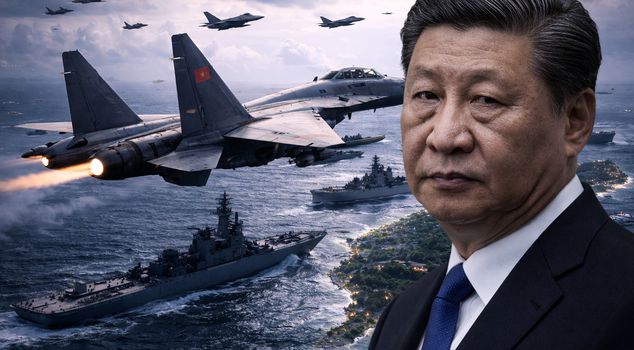
While the war between the US-Israel and Iran continues, China conducted patrol activities around Taiwan with 26 fighter jets and 7 warships; 16 fighter jets entered Taiwan's air defense zone. Experts assess that Beijing's move sends a message of strength to both Taiwan and the US.
In a period where mutual attacks between the US-Israel and Iran continue in the Middle East and regional tensions are rapidly escalating, notable military activity has also been observed in the Taiwan Strait. While it is stated that the war, in which the parties are conducting mutual operations, is affecting global security balances, developments in the Pacific have brought a new tension issue to the agenda.
The Taiwan Ministry of National Defense announced that 26 military aircraft and 7 warships belonging to China are conducting patrol activities around Taiwan. The statement reported that 16 of the mentioned aircraft entered Taiwan's northern, central, and southwestern air defense identification zone (ADIZ).
MILITARY FORCES HAVE BEEN DEPLOYED
Following the development, the Taiwanese military began to mobilize air and naval assets to closely monitor Chinese forces. The military activity in the region has been interpreted as a sign that tensions in the Taiwan Strait are rising again.
A GREAT SHOW OF FORCE TO THE US AND TAIWAN
Experts assess that China aims to convey multiple messages with such military activities. The Beijing administration reminds the Taiwanese government of its military power against possible independence steps while also aiming to keep Taiwan's air defense systems on constant alert.
It is also stated that China's military activity is seen as a show of force not only towards Taiwan but also towards the US. Beijing is reportedly reacting to Washington's political and military support for Taiwan and trying to emphasize that the Taiwan Strait is within its sphere of influence.
According to experts, through such operations, China is demonstrating its military capacity to regional countries like Japan, the Philippines, and South Korea while sending a message to its domestic audience that it has a determined stance on Taiwan.
TAIWAN-CHINA TENSION
The tension between Taiwan and China is seen as one of the most critical and sensitive issues in contemporary international politics. The fundamental problem is China's view of Taiwan as its own territory and its assertion that it must eventually be reunified with the mainland. The Beijing administration firmly opposes the recognition of Taiwan as an independent state based on the "One China" policy. Taiwan, on the other hand, continues to exist as a de facto independent administration with its own government, military, and democratic political system.
After the Chinese Civil War in 1949, the communist forces led by Mao Zedong took power in China, while the nationalist government retreated to Taiwan. Since then, the Beijing administration has defined Taiwan as a "separatist region," while many political actors in Taiwan argue that the island must maintain its independent identity. This historical separation forms the basis of today's geopolitical tension.
In recent years, China has increased its military and political pressure on Taiwan. The Chinese military, which frequently conducts military patrols with warplanes and warships around Taiwan, has led to interpretations that it is preparing for a possible military operation against the island. The number of Chinese warplanes entering Taiwan's air defense identification zone (ADIZ) sometimes reaches dozens. While Beijing defends these activities as a "sovereignty right," the Taiwanese administration describes it as an open military pressure.
US SUPPORT FOR TAIWAN
Another important aspect of the tension is the support the US provides to Taiwan. Although the US does not officially recognize Taiwan as an independent country, it provides defense support to the island under the Taiwan Relations Act and supports Taiwan's capacity to defend itself. This situation frequently leads to diplomatic crises between China and the US. The Chinese administration views Washington's arms sales to Taiwan and political contacts as a violation of sovereignty.
The Taiwan Strait is also a critical region in terms of global trade and technology. A significant portion of the world's semiconductor production takes place in Taiwan, and therefore, a potential conflict that may arise in the region is considered a risk that could have serious effects on the global economy. For this reason, the Taiwan-China tension has become a security issue that directly concerns not only the two parties but also the US, Japan, and many regional countries.